
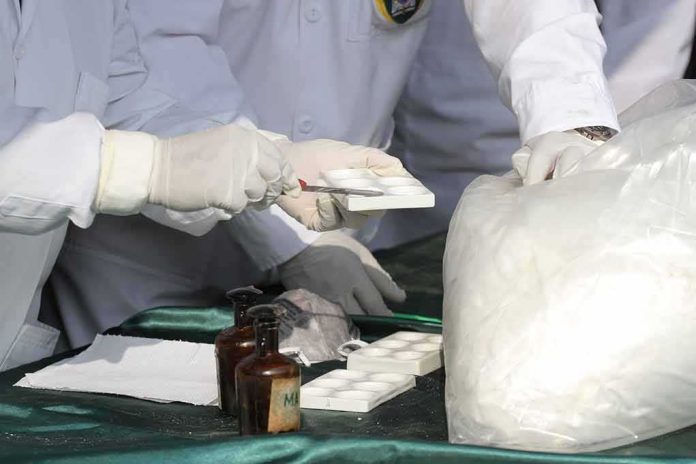
Italian police just stopped nearly $290 million worth of “extra pure” cocaine that was hiding in plain sight inside a load of bananas from Ecuador.
Story Snapshot
- Italian officers found about 770 kilograms of cocaine hidden in banana pallets at the port of Vado Ligure.
- The drugs, packed in 650 bricks, could have brought in roughly 250 million euros on Europe’s streets.
- The bust is one of the largest ever at this port and follows a similar banana‑linked seizure just weeks earlier.
- The case shows how global crime groups quietly move huge drug loads through normal food trade routes.
Record banana bust at an Italian port
Italian financial police and customs officials say they seized about 770 kilograms, or roughly 1,700 pounds, of high‑purity cocaine at the port of Vado Ligure in northwest Italy. Officers found the drugs hidden inside a refrigerated container filled with pallets of bananas that had arrived from one of Ecuador’s main ports. Police statements say the shipment’s street value is about 250 million euros, close to 290 million dollars at today’s exchange rates.
Authorities report that traffickers packed the cocaine into about 650 separate bricks and then tucked them among dozens of banana pallets inside the cold container. Investigators say the load was “skillfully concealed,” suggesting the smugglers knew how inspections at this port usually work and tried to blend in with normal fruit shipments. Officers from the Savona financial police command, a Genoa economic crime unit, and anti‑fraud customs teams all took part in the search.
A growing pattern of drugs in fruit containers
European and Italian data show this case is part of a clear pattern, not a one‑off shock. The European Union’s 2024 drug report says member countries seized a record 323 tons of cocaine in 2022, the sixth yearly record in a row. Many of the biggest finds in recent years involved bananas from Latin America shipped in refrigerated containers, including a 9.5‑ton seizure in Spain and multi‑ton busts in southern Italian ports like Gioia Tauro.
Italian ports have seen several banana‑linked cocaine seizures before this latest haul. In Gioia Tauro, police and customs have found multi‑ton loads of cocaine hidden in banana shipments from Ecuador, sometimes with help from sniffer dogs and scanners. Italian media report that Vado Ligure itself saw another major seizure of about 340 kilograms of cocaine in a banana shipment just weeks before this 770‑kilogram bust, suggesting traffickers see this route as a regular corridor, not a rare gamble.
What this says about global crime and weak systems
Anti‑drug experts say cartels and organized crime groups use the legal banana trade because it is huge, fast‑moving, and handled by a small number of big players. Bananas must travel in refrigerated containers and move quickly through ports, which can make deep inspections harder without slowing food supplies. That gives criminal networks room to piggyback on normal trade while most governments still struggle to scan more than a small share of containers.
For many readers, this story feeds into a wider worry: powerful global networks move drugs and money across borders while regular people face tighter rules, higher costs, and growing surveillance. Italian investigators now have to trace who arranged this shipment, who was supposed to pick it up, and which crime groups in Europe and Latin America were linked to it. History suggests some middlemen may escape justice, even when the drugs do not.
Why both left and right see a deeper problem
Conservatives who push for strong borders and tough crime laws see this bust as proof that current systems still let huge drug loads sail into Western ports. They ask how many containers slip through when even one seizure can reach 250 million euros in value. They also worry that global trade rules and international deals often seem to help big shipping and finance interests more than the families hurt by addiction and street crime.
More than 770 kilograms of #cocaine have been seized at the #port of Vado Ligure, hidden in a banana shipment from #Ecuador. #shipping #sea #transport #freight #container https://t.co/UWHfkIlVuT
— Redazione TE (@TrasportoEuropa) July 23, 2026
Liberals who focus on inequality and corporate power look at the same facts and see large supply chains run by multinational companies that governments struggle to police. They question whether customs, police, and port inspectors get the staff and technology they need while other programs are cut. Both sides share a core concern: when cartels can hide fortunes in a fruit shipment, it suggests that systems built and managed by global and political elites are still failing to protect ordinary citizens.
Sources:
facebook.com, nampa.org, 1news.az, ua.news, en.ilsole24ore.com, quinewspisa.it, aljazeera.com, euronews.com, abc.net.au