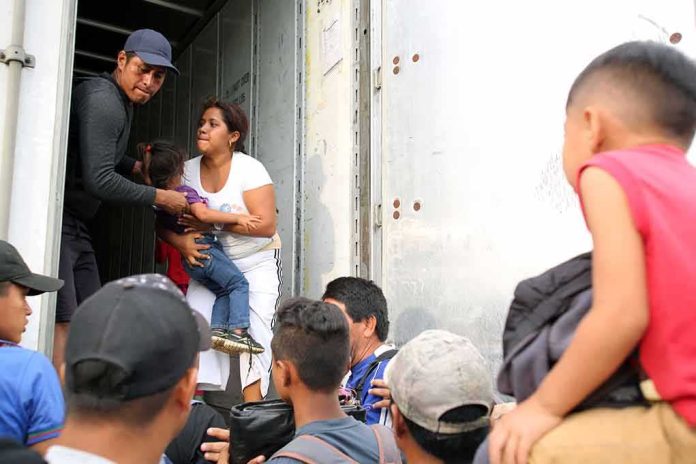
The San Antonio tractor‑trailer catastrophe was not an inexplicable accident; it was the foreseeable endpoint of a commercial smuggling enterprise that stacked risk on risk until 53 people were dead and 11 gravely injured—and federal prosecutors have now secured convictions and long sentences against key organizers who enabled it.
At a Glance
- June 2022’s San Antonio mass‑casualty incident—53 deaths, 11 injuries—grew from an organized smuggling pipeline using a sealed tractor‑trailer in extreme heat.
- Federal prosecutors charged network participants with smuggling offenses resulting in death and serious bodily injury; one coordinator, Rigoberto Ramon Miranda‑Orozco, received a 30‑year sentence after pleading guilty.
- The criminal case reflects how decentralized smuggling markets operate through recruiters, transporters, and coordinators across borders—without diffusing legal responsibility.
- The method—transport in containers with inadequate ventilation—has produced dozens of mass‑fatality events globally over two decades, making the risks well‑documented and avoidable.
What the prosecution proved: a lethal operation disguised as transport
On June 27, 2022, a refrigerated tractor‑trailer was used to move dozens of migrants through South Texas. According to the indictment returned by a federal grand jury in San Antonio, 50 adults and three minors died inside that vehicle; ten adults and one minor survived with serious injuries. The charging document laid out a conspiracy to smuggle noncitizens into the United States in a manner that foreseeably risked death and serious bodily harm, triggering the most severe penalties under federal smuggling statutes.
Subsequent cases against members of the network established that logistics coordinators arranged travel, lodging, and the handoff into the trailer, and that drivers and intermediaries executed transport despite conditions that made survival uncertain. One coordinator, Guatemalan national Rigoberto Ramon Miranda‑Orozco, was extradited, pleaded guilty, and received a 30‑year federal sentence for his role in organizing transport for victims of the incident, including two of his clients who perished. The sentence—decades rather than years—reflects federal guidelines that escalate penalties when smuggling results in death, and it signals prosecutorial focus on planners as well as drivers.
How smuggling markets actually function—and why that matters in court
To understand both the case theory and the penalties imposed, start with market structure. Smuggling is not a single cartel with a tidy org chart; it is a service market spanning borders, where different actors specialize by geography and function—recruiters at origin, guides along stretches, stash‑house operators, drivers, document handlers, coordinators—who connect as needed for a given trip. That fragmentation can blur lines of authority, but it does not erase accountability: when a coordinator assembles the chain and knowingly selects a transport method with extreme lethality risk, criminal liability follows.
This decentralized architecture was on display here: arrests and prosecutions tied to the San Antonio event stretched from Guatemala to Texas, with extradition assistance from foreign partners and sentences in U.S. federal court. The legal through‑line is foreseeability. Prosecutors do not need every conspirator in the same room; they need to show agreement to facilitate illegal entry and that death or serious injury was a reasonably foreseeable outcome of how the facilitation was carried out. A sealed trailer in Texas heat with inadequate ventilation meets that threshold clearly.
The mechanism of death: containers, heat, and predictable lethality
Mass‑fatality smuggling incidents frequently arise from transport in sealed containers—trailers, box trucks, shipping containers—where heat, humidity, and oxygen depletion converge. Academic analysis cataloging container‑based smuggling fatalities worldwide since 2000 shows a recurrent pattern: migrants packed into confined spaces, ventilation compromised, temperatures surging, communication blocked, and no egress if conditions deteriorate. In such environments, core body temperatures climb, dehydration accelerates, and hypoxia sets in; minutes matter, and drivers may be instructed not to deviate or open doors for fear of detection.
The San Antonio case followed this well‑documented script. The prosecutorial narrative and subsequent convictions did not require novelty; they required proof that defendants knowingly routed human beings into a transport method whose risks are obvious to anyone running trips along those corridors in summer. When dozens die in a single vehicle, the method is not incidental—it is the crime’s central instrument.
Why the penalties are so severe: the law’s design for outcome and risk
Federal smuggling statutes punish not only the act of facilitation but the consequences of how it is done. When death results, statutory maximums and guideline enhancements escalate sharply to reflect moral blameworthiness and deterrence objectives. That is why sentences approach multi‑decade terms in cases where defendants coordinated or executed transport that foreseeably endangered lives—and those enhancements have been affirmed across circuits in smuggling cases that resulted in fatalities. In short, the criminal law treats the truck as a weapon when used this way.
The San Antonio prosecutions also reflect institutional prioritization. Joint Task Force Alpha, Homeland Security Investigations, U.S. Attorney’s Offices, and international partners have concentrated resources on dismantling networks linked to mass casualties, pairing extraditions with aggressive plea negotiations and trial posture. The 30‑year sentence for Miranda‑Orozco is consistent with that strategy: pursue the coordinators, not just the drivers, and make the penalty structure speak clearly to market participants.
The broader pattern: demand, restriction, and dangerous supply
None of this occurs in a vacuum. Smuggling persists because demand for cross‑border mobility outstrips lawful channels; people with limited options buy passage in an irregular market. Research across regions shows that while smugglers rarely cause the decision to migrate, they shape route choice and risk exposure as paid intermediaries in a decentralized industry. When enforcement pushes movement into more concealed modalities, market actors adapt with methods—like sealed containers—that deliver stealth at the expense of safety.
Globally, container‑based tragedies have recurred from North America to Europe and beyond, underscoring that the combination of clandestine transport and heat is a known killer. That history matters for culpability: the risks of asphyxiation and heat stroke in sealed conveyances are not exotic or unforeseeable; they are the signature hazard of this modus operandi, documented across multiple mass‑fatality events over two decades.
#LocalNews #Austin TX
Guatemalan man sentenced for role in deadly 2022 migrant smuggling tragedyhttps://t.co/VLFvn4t83V
22 Oct 2026
(Rigoberto Miranda-Orozco) pleaded guilty .. led to 53 deaths and 11 injuries.
.. charging families ($12K-$15K)#MAGA #BorderObserver qt-maga-10181— The Border Observer (@borderObserver) November 11, 2026
What this means going forward: consequences for markets and deterrence
Large sentences against coordinators recalibrate the smuggling market’s risk calculus. Decentralization insulates no one if cross‑border cooperation can pierce jurisdictional gaps, extradite planners, and secure long terms tied to outcomes. That raises the expected cost of using high‑capacity, high‑stealth, high‑lethality methods like sealed trailers in hot climates. History suggests markets adapt; the question is whether they adapt to safer tactics or merely to different concealment methods with new dangers.
Sources:
justice.gov, miamiherald.com, ice.gov, ksat.com