As Washington slept through Christmas, Kim Jong-un openly bragged about “sharing blood, life and death” with Russia in Ukraine—while America’s old globalist class helped build the mess our veterans and taxpayers are still paying for.
Story Snapshot
- Kim Jong-un now openly celebrates a wartime alliance with Russia in Ukraine, boasting of “shared blood, life and death.”
- North Korea has moved from covert to acknowledged troop deployments and munitions support for Russia’s war.
- The deepening Russia–DPRK axis grew out of years of weak sanctions enforcement and naïve globalism from Western elites.
- Trump’s second-term America First course forces hard choices on deterrence, spending, and border security at the same time.
Kim’s New Year Message: Boasting About a Wartime Alliance
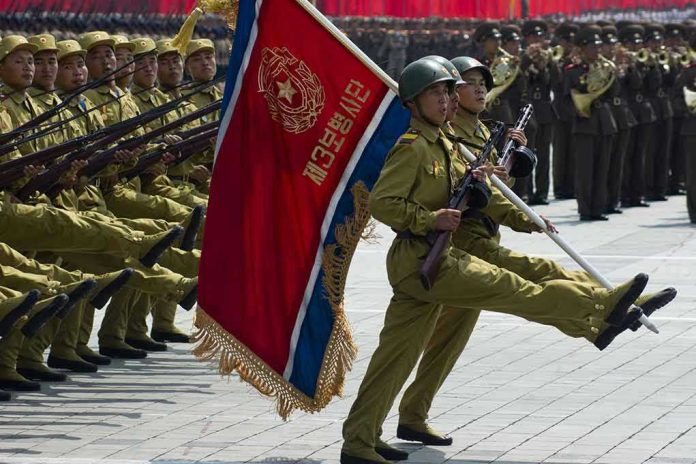
North Korean dictator Kim Jong-un used his New Year greeting to Vladimir Putin to brag that Russia and North Korea have “shared blood, life and death in the same trench” during the Ukraine war, signaling that his regime sees itself as an active combat partner, not a distant cheerleader. The message, carried by Pyongyang’s state media, cast 2025 as a “really meaningful year” for the alliance and tied that rhetoric directly to Russia’s ongoing “special military operation” in Ukraine.
That language matters because it is anchored in real deployments, not mere propaganda slogans. North Korea has already admitted sending an engineering regiment into Russia’s Kursk region in August 2025 for a 120-day mission, officially described as mine clearing. At a December homecoming ceremony, Kim acknowledged that at least nine of those soldiers were killed on that foreign mission, an unusual public admission by a regime that usually hides military losses from its own citizens.
Arms, Missiles, and the Sanctions-Defying War Machine
Beyond the personnel, Kim has ordered stepped-up missile production at home, while expanding arms transfers to Russia that include artillery shells, missiles, and long-range rocket systems. In return, North Korea is believed to be receiving badly needed food, fuel, hard currency, and valuable military technology from Moscow, giving Kim lifelines he could never get from the free world. Both regimes are already under heavy Western sanctions, and this two-way pipeline is designed to punch through those restrictions.
For American readers who watched years of talk in Washington about “smart sanctions” and “rules-based order,” this partnership is the predictable result of half-measures. Russia sits on a United Nations Security Council veto, so it can shield North Korea from tougher UN action even while using North Korean munitions in Europe. Each shipment of shells and rockets helps Russia keep pressure on Ukrainian forces and civilians, and each barrel of fuel or package of technology that goes back to Pyongyang strengthens a hostile, nuclear-armed dictatorship in East Asia.
From Cold War Patronage to an Anti-American War Bloc
The Moscow–Pyongyang relationship goes back to the Soviet era, when the Kremlin helped build North Korea’s state, military, and industry. After the Soviet collapse that patronage shrank, but it never disappeared. In the last decade, and especially after Russia’s 2022 invasion of Ukraine, the two regimes discovered a new kind of mutual dependence: Russia needed huge quantities of cheap munitions and political cover, and Kim wanted food, fuel, and advanced weapons know-how to offset isolation and keep his dynasty secure.
That is why today’s talk of “sharing blood in the same trench” is more than emotional theater. It reflects a deeper alignment among Russia, North Korea, and, on the sidelines, China, all seeking to weaken U.S.-led security structures in Europe and the Indo-Pacific. Every North Korean artillery container unloaded in a Russian port is a reminder that rogue states do not respect paper resolutions. They respond to clear red lines, credible deterrence, and unified pressure—exactly what got watered down during years of globalist appeasement and misplaced faith in international institutions.
Consequences for American Security, Spending, and Deterrence
On the battlefield, North Korean ammunition and engineering support help Moscow sustain high-volume fire and free up Russian units for frontline combat. Over time, Russian help with satellites, missiles, submarines, or air defenses could push North Korea’s capabilities to a level that directly threatens American troops and allies in South Korea and Japan. That means U.S. commanders must plan for a Korean Peninsula where Kim has better targeting, longer reach, and more confidence to provoke crises.
Situation Update – Update No. 1770 – War – Ukraine – Ukraine war briefing: Kim Jong-un celebrates sharing ‘blood, life and death’ with Russia – https://t.co/Yld7C7bbdd
— RSOE EDIS (@RSOE_EDIS) December 27, 2025
For U.S. taxpayers and conservatives who are tired of endless spending without accountability, this emerging bloc raises hard questions. If hostile regimes can pool resources to undermine sanctions and project power, Washington cannot afford to waste dollars on bloated bureaucracy, open borders, or ideological pet projects at home. A serious America First approach requires prioritizing border security, energy independence, and a lean but lethal military that deters adversaries instead of chasing utopian climate and DEI agendas overseas.
Sources:
North Korea’s Kim stresses shared bloodshed in New Year message to Putin – Channel NewsAsia
Kim stresses shared bloodshed in New Year message to Putin – Dawn
N. Korea’s Kim stresses shared bloodshed in New Year message to Putin – Macau Business