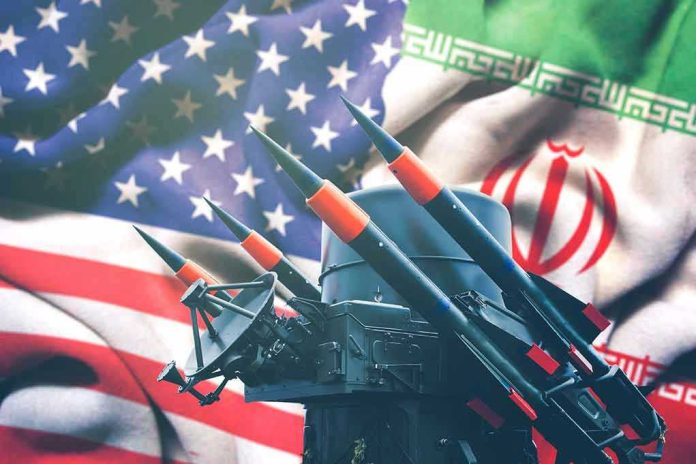
Iran has crossed a dangerous red line by publicly threatening to launch “pre-emptive” military strikes against Israel and U.S. forces if it perceives any threat to Supreme Leader Ayatollah Ali Khamenei’s life, fundamentally shifting Middle East conflict dynamics and raising the specter of imminent war.
Story Highlights
- Iran erects threatening banners across Tehran warning of strikes on Israel and U.S. bases in Qatar
- Regime adopts dangerous “pre-emptive strike” doctrine following assassination threats against Khamenei
- Israel authorizes “Operation Iron Strike” while Iran conducts missile defense drills nationwide
- Crisis stems from Senator Lindsey Graham’s calls to eliminate Iranian leadership if attacks continue
Iran’s Escalatory Deterrence Gambit
Tehran’s deployment of massive public billboards threatens direct military action against Israeli territory and Al Udeid Air Base in Qatar, marking an unprecedented shift from reactive to pre-emptive posturing. Iran International reported that Iranian officials explicitly reserve the right to “strike before being attacked” if intelligence suggests assassination plots against Khamenei or regime decapitation attempts. This represents a fundamental departure from traditional deterrence models, lowering the threshold for conflict initiation based on perceived rather than actual threats.
The Islamic Revolutionary Guard Corps conducted simultaneous missile and air defense exercises across Tehran, Shiraz, and multiple Iranian cities on January 4, demonstrating operational readiness for renewed conflict. These drills coincided with Khamenei’s hardline speech authorizing increased domestic repression against protesters chanting “Death to Khamenei” across multiple provinces. Iran’s dual approach combines external threat projection with internal crackdown tactics, suggesting regime vulnerability despite aggressive posturing.
Israeli Counter-Planning and Trump Administration Response
Israel’s security cabinet authorized “Operation Iron Strike” following extensive consultations between Prime Minister Benjamin Netanyahu and President Donald Trump, explicitly targeting Iranian infrastructure that could “destabilize the Islamic Republic.” The five-hour cabinet session reflects serious preparation for large-scale military action, building on June 2025’s devastating strikes that destroyed over 40 Iranian air defense systems within 24 hours. Israeli forces simultaneously maintain heightened readiness for potential Hezbollah operations in Lebanon while upgrading armored vehicles and replenishing munitions along northern borders.
Senator Lindsey Graham’s public advocacy for targeting “Khamenei and IRGC leadership” if Iran attacks American or Israeli assets again has become central to Iranian threat calculations. Graham’s statements, widely broadcast in Iranian state media, provide Tehran with justification for its pre-emptive doctrine while demonstrating American resolve to consider decapitation strikes against terrorist-sponsoring regimes. This rhetorical escalation reflects broader conservative frustration with decades of Iranian aggression and proxy warfare targeting American interests.
Constitutional and Strategic Implications
Iran’s pre-emptive strike doctrine fundamentally challenges American deterrence strategies and threatens constitutional war powers by potentially forcing rapid military responses without congressional deliberation. The regime’s explicit targeting of U.S. bases violates international law while creating hair-trigger scenarios where intelligence misperceptions could trigger widespread conflict involving American servicemembers across the Middle East. This represents exactly the kind of foreign aggression and threat escalation that conservative Americans have long warned against when dealing with terrorist-sponsoring regimes.
The crisis emerges from Iran’s desperation amid massive domestic protests and economic collapse, with citizens openly calling for regime change while throwing Molotov cocktails at security forces. Tehran’s external aggression masks internal weakness, as the regime struggles to maintain legitimacy while facing widespread popular uprising against four decades of theocratic rule. President Trump’s firm stance supporting Iranian protesters while maintaining military deterrence offers the best path forward for American interests and regional stability.
Sources:
Iran Update January 5, 2026 – Critical Threats Project
Iran News – The Jerusalem Post
Iran warns it may act pre‑emptively if it detects a threat – Iran International
New Year’s 2026 Unrest in Iran – Israel Education