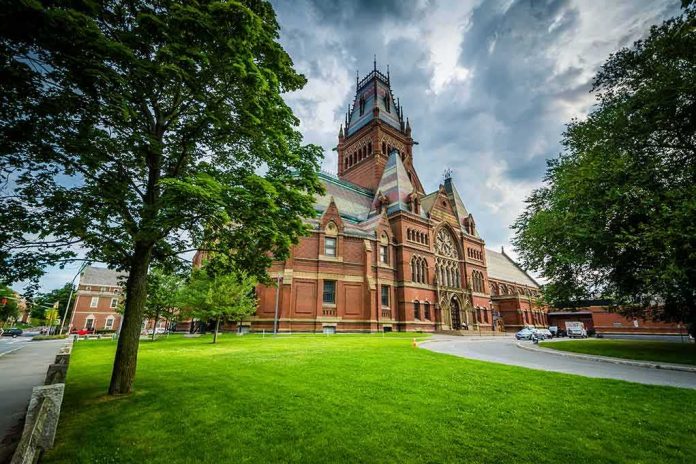
The Trump administration’s Justice Department has escalated its battle against elite academia, suing Harvard University for billions in federal grants while demanding unprecedented government oversight of campus operations—a fight that could redefine federal power over higher education.
Story Snapshot
- DOJ filed civil rights lawsuit alleging Harvard violated Title VI by failing to protect Jewish and Israeli students from antisemitic harassment after October 7, 2023
- Federal government demands return of billions in grants, independent monitor, and enforcement of arrest authority against campus protesters
- Harvard characterizes lawsuit as “pretextual and retaliatory” punishment for resisting federal control
- Case follows HHS determination that Harvard’s proposed reforms were insufficient, requiring “concrete action, not assurances”
Federal Lawsuit Targets Harvard’s Response to Campus Antisemitism
The Justice Department filed a civil rights lawsuit in U.S. District Court for the District of Massachusetts in March 2026, alleging Harvard University violated Title VI of the Civil Rights Act of 1964. The complaint claims Harvard selectively enforced campus policies, permitting anti-Israel protesters to violate rules “with impunity” while strictly enforcing policies against other forms of bias. Attorney General Pamela Bondi stated that educational institutions have allowed antisemitism to flourish since October 7, 2023, when Hamas attacked Israel. The lawsuit represents the second major civil rights action against a university in two months, following similar litigation against UCLA.
Government Demands Unprecedented Institutional Oversight
The DOJ seeks extraordinary relief beyond typical civil rights remedies. Federal prosecutors demand Harvard enforce time, place, and manner restrictions on campus protests, mandate discipline for policy violators, and seek law enforcement assistance to arrest protesters who impede movement or occupy buildings. The lawsuit requests appointment of an independent outside monitor approved by the government to oversee compliance—an unprecedented level of federal intervention in campus operations. Additionally, the government seeks recovery of billions in federal grants previously awarded to Harvard, escalating beyond funding freezes that federal courts previously ruled unconstitutional.
Harvard Rejects Claims as Political Retaliation
Harvard vigorously disputes the allegations, stating it “cares deeply about its Jewish students and community members” and has implemented training programs and antidiscrimination rules. The university’s official response characterizes the lawsuit as “pretextual and retaliatory,” claiming it represents punishment for “refusing to turn over control of Harvard to the federal government.” This confrontation follows a September 2025 federal court ruling that ordered restoration of funding the administration had frozen, demonstrating judicial willingness to constrain executive overreach. The Trump administration has already frozen $2.2 billion in research grants and threatened Harvard’s tax-exempt status and international student enrollment authority.
Case Built on Prior Civil Rights Investigation
The lawsuit escalates a months-long investigation that began after the Department of Health and Human Services’ Office for Civil Rights determined in summer 2025 that Harvard violated Title VI. The government attempted to bring Harvard into voluntary compliance, but Paula Stannard, Director of HHS’s Office for Civil Rights, stated Harvard’s proposed reforms did not meet Title VI requirements. Stannard emphasized that “OCR required concrete action, not assurances.” Despite Harvard announcing reforms in April 2025, including training programs and antidiscrimination rules, federal officials deemed these measures insufficient to address what they characterize as “antisemitic mobs of students, faculty, and visitors” who allegedly engaged in harassment and intimidation.
Implications for Higher Education and Constitutional Governance
This case threatens to establish sweeping precedents regarding federal authority over campus speech and institutional autonomy. Harvard faces potential loss of over $2.6 billion in HHS grants, creating immediate budgetary pressures for research operations and student programs. The proposed independent monitor represents an alarming expansion of government control over private institutional decisions, from disciplinary matters to protest management. A government victory could establish a model for federal intervention across higher education, fundamentally altering how universities balance free expression with student safety. The outcome will determine whether Title VI can regulate campus speech on controversial political issues, potentially chilling academic freedom and institutional independence that conservatives traditionally defend against government overreach.
Sources:
DOJ Sues Harvard, Seeks Return of Grant Money Over Antisemitism Allegations
Trump’s Justice Department Sues Harvard Over Antisemitism
DOJ Sues Harvard, Seeks Return of Grant Money Over Antisemitism Allegations
Justice Department Sues Harvard University for Antisemitism
Memorandum and Order – Harvard Federal Lawsuits
Federal Task Force to Combat Antisemitism Announces Visits to 10 College Campuses