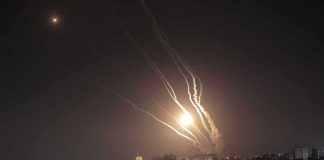
CENTCOM’s newly released strike footage shows America targeting—and apparently crippling—Iran’s floating drone “mothership” in the Gulf, a reminder that deterrence looks very different now than it did under the last administration.
Story Highlights
- U.S. Central Command released unclassified video on March 5, 2026, showing strikes hitting Iran’s drone carrier Shahid Bagheri with visible fires.
- The strike was publicly announced March 2 as part of Operation Epic Fury, which began February 28 and focuses on degrading Iran’s drone and missile launch capabilities.
- The targeted ship was a converted commercial container vessel commissioned in February 2025, built to launch UAVs and potentially missiles from a flight deck with a ski-jump ramp.
- CENTCOM also released additional footage and imagery in March showing strikes against an Iranian missile base and a drone-production site tied to Shahed drones.
Unclassified footage spotlights a direct hit on Iran’s drone carrier
U.S. Central Command released unclassified video on March 5 depicting a strike on Iran’s drone carrier Shahid Bagheri in the Gulf, with the footage showing two distinct impacts—one amidships and another near the port quarter—followed by visible fires. CENTCOM had announced the strike days earlier, on March 2, tying it to Operation Epic Fury and the goal of degrading Iran’s naval drone and missile launch capabilities from the vessel.
For Americans who watched years of mixed messaging and strategic hesitation, the decision to release clear, unclassified visuals matters. The footage is not just battlefield documentation; it signals resolve and a willingness to communicate outcomes to the public without waiting for adversaries to frame the story first. CENTCOM’s emphasis on precision and mission focus also suggests a deliberate effort to limit ambiguity about what was targeted and why.
What made Shahid Bagheri a high-value target
Reporting describes Shahid Bagheri as Iran’s most significant naval aviation platform—a converted commercial container ship originally built in South Korea and later adapted into a roughly 40,000-ton drone carrier. The conversion reportedly included a long flight deck and a ski-jump ramp, underscoring that Tehran was investing in repeatable launch operations rather than one-off stunts. That matters in the Gulf, where drones can threaten warships, ports, and commercial shipping lanes.
Iran’s broader drone push accelerated after 2019, built around the kind of asymmetric warfare that tries to offset America’s advantages with lower-cost, harder-to-attribute attacks. In that context, a sea-based platform can extend range, complicate detection, and shorten response times for UAV launches. From a constitutional, America-first standpoint, protecting U.S. forces and U.S.-linked shipping from that kind of persistent harassment is a core federal responsibility—not an optional globalist project.
Operation Epic Fury and the push to protect the Strait of Hormuz
Operation Epic Fury began February 28, 2026, amid heightened tensions and concerns about threats to shipping routes tied to the Strait of Hormuz. The research indicates the operation aims to neutralize Iranian capabilities that could be used to pressure or attack traffic in and around the Gulf. CENTCOM and Pentagon messaging also points to a broader campaign logic: reducing Iran’s ability to launch drones and missiles from multiple platforms, at sea and on land.
Later March updates referenced additional U.S. actions, including released footage and imagery tied to strikes on an Iranian missile base and a drone-production site associated with Shahed drones, with before-and-after comparisons dated March 3 and March 12 and released around March 20. The same reporting describes added U.S. deployments—more warships and about 5,000 additional sailors and Marines—and mentions aircraft such as A-10s and AH-64 Apaches operating in the region.
What remains unknown—and why that uncertainty matters
Some key operational details remain unresolved in publicly available reporting. The ship’s final status after the strike is not confirmed in the provided research, and there is no cited Iranian comment clarifying whether Shahid Bagheri remained afloat, was towed, or was rendered unusable. The gap between the March 2 public announcement and the March 5 release of video also leaves unanswered whether the footage reflects one event or part of a broader sequence of actions.
Even with those uncertainties, the strategic message is difficult to miss: large, conspicuous platforms designed for drone warfare are not invulnerable simply because they are “dual-use” conversions from commercial hulls. If Iran’s model is to push risk onto everyone else—especially commercial shipping and U.S. service members—then making those assets demonstrably targetable changes the cost-benefit equation. That’s deterrence the hard way, and it’s easier to sustain when the public can see the evidence.
Central Command Releases Unclassified Footage of US Military Blowing Up Iran’s Drone Capabilities (VIDEO)
READ: https://t.co/ruvvlLAAFc pic.twitter.com/fS5VrsEJeO
— The Gateway Pundit (@gatewaypundit) March 22, 2026
For families tracking inflation, energy prices, and the ripple effects of instability overseas, the Strait of Hormuz remains a practical concern, not an abstract one. The research stops short of quantifying market impacts or confirming reopened shipping lanes, so claims about immediate economic relief would be premature. Still, degrading Iran’s drone and missile infrastructure is directly tied—by U.S. statements in the reporting—to the mission of reducing threats to maritime transit in a chokepoint that affects global oil flows.
Sources:
CENTCOM Releases Footage Showing Strike on Iran’s Drone Carrier