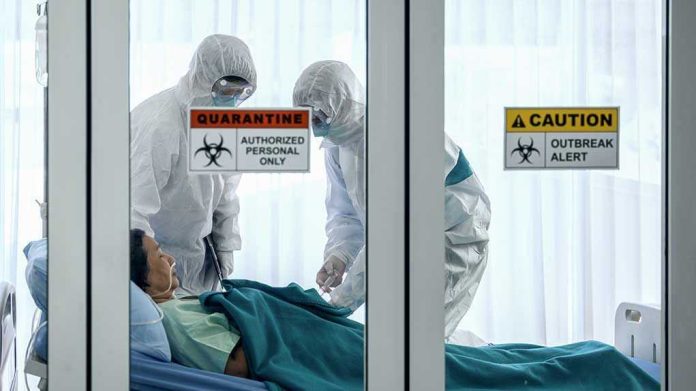
A fresh World Health Organization “global health emergency” over Ebola is raising new questions about hype, control, and how much power unelected health bureaucrats still wield over our lives.
Story Snapshot
- World Health Organization declared an Ebola emergency in Congo and Uganda, but admits it is not a pandemic.
- Rare Bundibugyo strain, limited confirmed cases, and thin public data raise concerns about proportionality.
- Media headlines exaggerate the threat and risk rekindling lockdown-era fear politics.
- Trump administration must defend borders and transparency while resisting globalist overreach.
What The World Health Organization Actually Declared — And What It Did Not
World Health Organization Director-General Tedros Adhanom Ghebreyesus announced that Ebola disease caused by the Bundibugyo virus in the Democratic Republic of the Congo and Uganda is now a “public health emergency of international concern,” the highest alarm inside the organization’s rulebook.[3] The same statement stressed the outbreak “does not meet the criteria of pandemic emergency,” meaning it is not another COVID-19. Yet many outlets immediately branded it a “global health emergency,” blurring a technical coordination trigger into a sweeping, emotional headline.[1][5]
As of mid-May, the World Health Organization reports eight laboratory-confirmed cases, about 246 suspected cases, and roughly 80 suspected deaths in Ituri Province in eastern Congo, spread across health zones including Bunia, Rwampara, and Mongbwalu.[3] Two laboratory-confirmed cases, including one death, were detected in Uganda’s capital, Kampala, within twenty-four hours, both involving travelers from Congo.[3] These numbers are serious, especially for local communities, but they are nowhere near “global catastrophe” scale despite the rhetoric.
Ebola Reality Check: Serious Disease, Thin Public Evidence
Ebola virus disease is highly lethal and deserves to be taken seriously, but the current Bundibugyo outbreak is still described using partial, aggregate information. The World Health Organization has not released specimen-level records, line lists, or genomic sequencing summaries that would let independent experts verify the exact scope, timing, and spread of these eight confirmed cases and dozens of suspected deaths.[3] Instead, citizens are asked to simply trust the same institutions that overreached during the COVID-19 era, when “models” routinely outran hard facts.
World Health Organization officials say they first received a “signal” of suspected cases on 5 May and sent a team to Ituri to support Congo’s health authorities by collecting samples in the field.[2] Those initial samples reportedly tested negative for Ebola, and only later did retesting confirm Bundibugyo virus infection in some patients.[2] The organization has not publicly laid out the full testing chain, retest criteria, or how many early negatives later became positives, leaving a gap that understandably fuels skepticism about the precision of today’s numbers.
Media Hype, Border Politics, And Lessons From COVID-Era Overreach
Coverage from international outlets repeatedly frames this as a “global health emergency” while glossing over the crucial qualifier that the declaration is a legal coordination tool, not proof that Ebola is sweeping the globe.[1][5] World Health Organization guidance simultaneously urges nations to activate emergency mechanisms, strengthen screening at land borders, and coordinate regionally, while also advising against outright border closures or major travel bans.[3] That nuanced message easily gets flattened into another round of fear-driven pressure on sovereign nations to follow Geneva’s script.
Ebola: WHO Declares Global Emergency In DRC, Uganda: …As NCDC Moves to Heighten Surveillance Following the declaration of the Ebola Virus Disease outbreak in the Democratic Republic of Congo (DR Congo) and Uganda as a Public Health Emergency of… https://t.co/GZhpRNmvCk
— Newtelegraphng (@NewTelegraphNIG) May 17, 2026
The outbreak is hitting a volatile, war-torn region of eastern Congo where armed groups, displacement, and cross-border movement with Uganda and South Sudan make surveillance genuinely difficult.[2][3] That reality cuts both ways: it justifies targeted help for overwhelmed local clinics but also means data are inherently uncertain. When the same institutions that pushed sweeping lockdowns, school closures, and speech policing now ask for trust amid data gaps, many Americans rightly insist on transparency before handing back any measure of control over borders, travel, or personal freedom.
What This Means For Americans And The Trump Administration
For American families and businesses, the immediate infection risk from this outbreak remains very low, but the political risk of renewed health-driven power grabs is not.[3] The Trump administration will be expected to tighten sensible screening for travelers from the region, support targeted aid that actually reaches front-line doctors, and share clear facts with the public. At the same time, it must resist any attempt by global bodies to leverage a regional Ebola flare-up into new long-term authority over our borders, economy, or daily lives.
Sources:
[1] Web – WHO declares Ebola outbreak in Congo, Uganda an emergency of …
[2] YouTube – BREAKING: WHO Confirms Ebola Cases in DR Congo
[3] Web – Epidemic of Ebola Disease caused by Bundibugyo virus in the …
[5] Web – WHO declares Ebola outbreak in Congo, Uganda a global health …