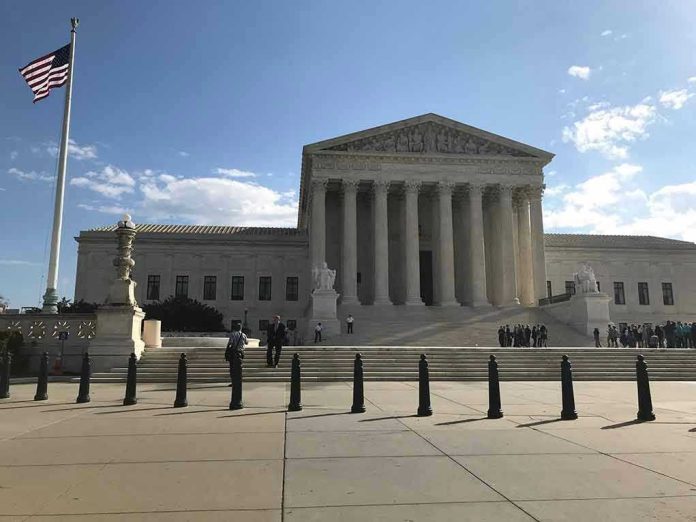
A Supreme Court ruling in Landor shows that Justice Ketanji Brown Jackson could not pull enough votes to stop Justice Neil Gorsuch from limiting damages against prison guards.
Quick Take
- The Supreme Court held that individuals may not be sued in their personal capacities under a Spending Clause statute without knowing and voluntary consent.[3]
- Justice Neil Gorsuch wrote the majority opinion, and Chief Justice John Roberts plus five other justices joined him.[3]
- Justice Ketanji Brown Jackson dissented and warned that prisoners may be left “remediless” after clear religious rights violations.[14]
- The case grew out of Louisiana prison officials forcing a Rastafarian inmate’s dreadlocks to be shaved off.[2]
Why the Court Split
The core issue was not whether Damon Landor suffered a harsh wrong. It was whether he could collect money from prison officials in their personal roles under the Religious Land Use and Institutionalized Persons Act.[1][18] The Court answered no. Justice Gorsuch said Congress did not get consent from those officials to expose them to damages suits under a Spending Clause law.[3]
That is why Justice Jackson lost the majority. Her side argued that the law should provide a real remedy when prison officials crush religious freedom. But six justices accepted the consent theory and rejected personal-capacity damages.[3][13] For readers who value accountability, the decision fits a familiar pattern: rights remain on paper if courts cut off the only path to compensation.
What Happened to Landor
Landor, a devout Rastafarian, said Louisiana prison officials handcuffed him to a chair and shaved his dreadlocks while he was incarcerated.[2][9] He later sued for money damages after leaving prison.[2] Lower courts had already rejected his claim, relying on Fifth Circuit precedent that said RLUIPA does not allow former prisoners to sue individual officials for damages.[1][19]
The Supreme Court took the case to settle that fight. In its opinion, the Court held that individual officials cannot be personally liable unless they voluntarily and knowingly accepted that risk.[3] That ruling protected prison workers from damages exposure, but it also left Landor without a money remedy for the alleged violation. Jackson’s dissent said that result turns strong rights into weak promises.[14]
Why Conservative Readers Should Care
This case matters beyond one inmate and one prison. RLUIPA is tied to federal spending, and the Court’s reasoning may shape how other federal programs are enforced.[11][15] If Congress cannot attach meaningful consequences to federal funding rules, states and officials may keep the benefits while avoiding real accountability. That is the same kind of bureaucratic dodge that frustrates voters who want clear rules and honest enforcement.
In a 6-3 ruling, SCOTUS held that a Rastafarian man could not seek damages from Louisiana prison officials who shaved his dreadlocks
Led by Gorsuch, the majority said the prison consented to upholding prisoners' religious rights but individual officers made no such commitment pic.twitter.com/g2pxzmJhBS
— Kelsey Reichmann (@KelseyReichmann) June 23, 2026
The ruling also highlights a broader tension on the Court. The conservative majority protected the government workers from personal damages, while Jackson argued the majority severed rights from remedies.[14] Her dissent said prisoners like Landor can be left without relief even when the abuse is obvious. For a country that still claims to respect religious liberty, that warning should not be ignored.
Sources:
[1] Web – Did Justice Jackson Lose The Majority In Landor To Justice Gorsuch?
[2] Web – Landor v. Louisiana Department of Corrections – Oyez
[3] Web – Landor v. Louisiana Department of Corrections and Public Safety
[9] Web – OPINION: Damon Landor, Petitioner v. Louisiana Department of …
[11] Web – Supreme Court rules against Rastafarian who sued prison officials for …
[13] Web – Supreme Court Case on Dreadlocks May Impact Medicaid
[14] Web – Supreme Court voices doubts on shaven Rastafarian inmate’s damages …
[15] Web – Ketanji Brown Jackson slams Supreme Court ‘scheme’ in ruling against …
[18] Web – [PDF] Turner: On Locs, “Race,” and Title VII – Wisconsin Law Review
[19] Web – Landor v. Louisiana Department of Corrections and Public Safety