
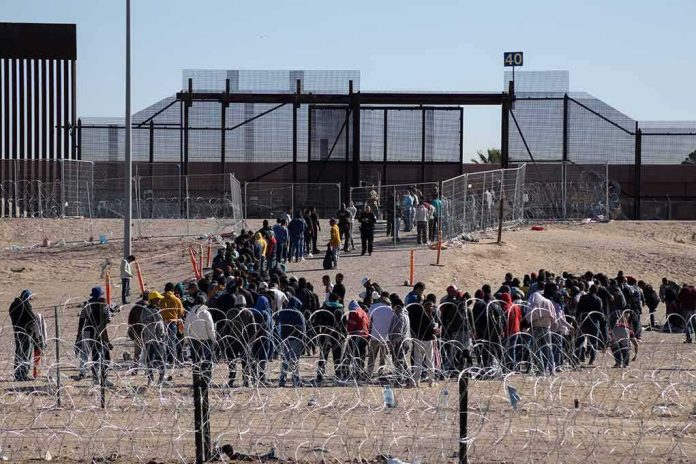
After Hamas killed over 1,200 Israelis on October 7, 2023, Israel banned roughly 200,000 Palestinian workers from its labor market — and the debate over that decision reveals just how differently people see the same set of facts.
Story Snapshot
- Israel suspended work permits for about 200,000 Palestinian workers right after the October 7, 2023 Hamas attacks, citing security concerns.
- West Bank unemployment shot up to 32%, poverty doubled to 28%, and more than 300,000 jobs were lost as a result.
- Israel’s own economy took a hit too — losing an estimated $800 million per month in construction, farming, and industry.
- Media outlets like The New Yorker and Le Monde focused heavily on the economic pain, while critics say they glossed over the security reasons behind the ban.
What Israel Did and Why
Right after Hamas militants broke through the Gaza-Israel barrier on October 7, 2023, Israel moved fast. The government revoked work permits for around 200,000 Palestinian workers. Prime Minister Benjamin Netanyahu’s government later canceled permits for 120,000 West Bank Palestinians specifically. Israeli officials pointed to security risks as the reason. The October 7 attacks killed more than 1,200 people across 21 communities — the deadliest single day for Jewish people since the Holocaust.
The security argument has some holes, though. Israel later allowed 8,000 Palestinian workers back in for what it called “urgent wartime service” — things like digging graves and hotel work. Critics say that exception undermines the idea that all Palestinian workers posed a threat. No Israeli government document has been made public that directly links Palestinian laborers to the October 7 attacks. The ban appears to have been a broad response to a security crisis rather than a targeted action based on individual risk assessments.
The Human and Economic Toll
The numbers on the Palestinian side are stark. West Bank unemployment jumped from 13% before the attacks to 32% afterward. More than 306,000 jobs were lost. Poverty rates doubled — from 12% to 28%. Before October 7, about one in four West Bank workers earned their income inside Israel. The Institute for National Security Studies, an Israeli think tank, warned that the Palestinian Authority’s economy was at risk of collapse, with roughly 150,000 people losing their main source of income.
Israel felt the pain too. Labor shortages in construction, agriculture, and industry cost the Israeli economy more than $800 million every month. The construction sector alone saw monthly output drop by 35%. Israel responded by bringing in workers from other countries — including India, Sri Lanka, and several African nations — to fill the gap. The labor shift reshaped Israel’s workforce almost overnight, but it did not fully replace the lost capacity.[9]
Media Coverage Under the Microscope
The New Yorker ran a piece focusing on the economic hardship the ban caused Palestinian families. Le Monde called it “the tragedy of Palestinian construction workers.” Al Jazeera covered how Israel’s labor force had changed. Readers pushing back on social media pointed out that these stories spent little time on why Israel made the move in the first place. One widely shared response to The New Yorker’s post accused the article of treating October 7 “as a non-event.” Another asked whether Israel is the only country that has ever restricted workers from a territory at war with it.[16][18]
That pushback reflects a real tension. Reporting that focuses only on economic consequences without explaining the security context can feel incomplete — even misleading — to people who watched the October 7 attacks unfold in real time. At the same time, reporting that only frames the ban as a security measure skips over the fact that tens of thousands of workers who had nothing to do with Hamas lost everything overnight. Both sides of that story are real. The question is whether any single outlet is telling both.
A Familiar Pattern With No Easy Answer
This situation is not unique to Israel. Research on armed conflicts shows that border shutdowns regularly cause labor shortages in host economies while devastating home economies. The same “security necessity versus collective punishment” debate comes up in nearly every case where a country restricts cross-border labor during active fighting. What makes the Israel-Palestine situation different is the scale, the history, and the intensity of global attention on every decision both sides make.[13]
The honest takeaway is this: Israel had a real security crisis and responded with a sweeping labor ban. That ban caused genuine suffering for hundreds of thousands of Palestinian workers and their families. It also hurt Israel’s own economy. Whether the security benefit justified that cost is a question neither side has fully answered — and the media, depending on which outlet you read, is often only telling you half the story.
The New Yorker presents this as though Israel woke up one day and arbitrarily decided to ban Palestinian workers. The reality is that October 7 fundamentally changed Israel's security calculus. After Hamas terrorists infiltrated Israel, murdered civilians, and carried out the… pic.twitter.com/HtyfD35h1T
— MOT (@nachal_giyus86) June 29, 2026
Sources:
[9] Web – Returning Palestinian Workers From the West Bank to Work in Israel
[13] Web – [PDF] Palestinian Workers in Israel and the Settlements
[16] Web – The impact of armed conflicts and forced migration on labour markets
[18] Web – Child Labor | Our World in Data