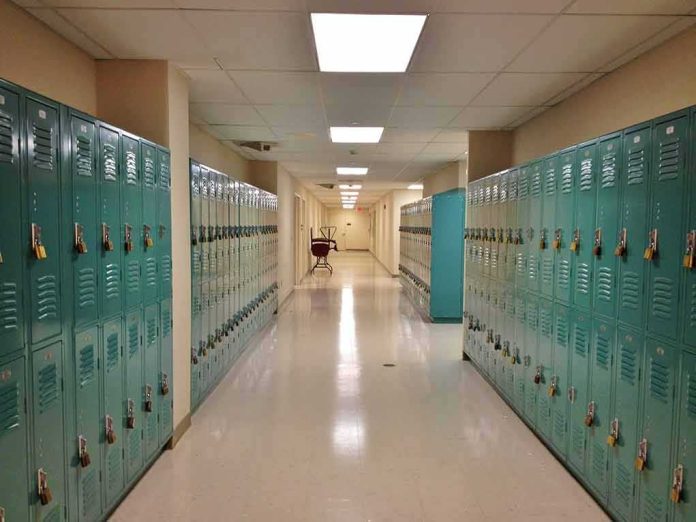
Students at Tracy High say they found a phone secretly recording in a boys’ locker room—and police arrested their head football coach the next day.
Story Snapshot
- Students found a phone recording in a boys’ locker room and turned it over to staff.
- Police say the phone belonged to head coach Jeffrey Pribble, 48, who was arrested within a day.
- Locker rooms carry the strongest privacy protections in schools under court rulings and policy.
- District handbooks already restrict recording devices on campus to protect student privacy.
What Police Say Happened Inside the Locker Room
Tracy Police Department reported that students discovered a cell phone actively recording while they changed in a boys’ locker room at Tracy High School. The students paused the recording, deleted the footage, and handed the device to school staff, according to local reporting. Police said the phone belonged to head coach Jeffrey Pribble and arrested him less than 24 hours later. A police spokesperson confirmed Pribble’s identity and age, 48, to regional media the same weekend.
Parents and students told television reporters they felt shocked and violated by the news. The sense of breach did not come from rumor, but from a physical device found where teens change clothes. That is the heart of the matter. A locker room is one of the few school spaces where the law and common sense fully agree: cameras and secret recordings cross a bright line meant to protect kids’ dignity.
Why Locker Rooms Are a Legal Red Line
Courts have long treated locker rooms as high-privacy zones. A federal appeals court held that placing cameras in school locker rooms violates students’ Fourth Amendment rights against unreasonable searches. The court called video surveillance in such spaces “inherently intrusive” and a serious invasion of reasonable expectations of privacy. Education groups advise districts to limit cameras to public areas like halls and parking lots, and to avoid recording in places where students change.
That legal baseline explains the fast response. When a claim hits a zone of near-zero ambiguity—like a hidden camera in a changing area—administrators and police move first to stop harm, then to sort details. State voyeurism laws also tend to prohibit filming in places such as bathrooms and locker rooms, which sets a strong default against any recording in these spaces. Schools enforce this with clear, written rules.
What District Rules Already Say About Recording
Tracy Unified School District handbooks lay out strict limits on recording devices on campus. The high school guidance bans electronic listening or recording in classrooms without consent and underlines that such use is illegal under state education codes. The district’s current handbook also restricts smart eyewear and any device that can capture audio or video, citing the need to protect student privacy and keep a safe environment. These rules exist to prevent exactly this kind of incident.
Policy alone cannot stop a bad choice, but it sets a clear line and a shared norm. It gives staff and students language to act fast when they see something wrong. It also gives police a clean handoff: here are the facts, here is the device, here are the rules. That chain matters for both accountability and the rights of everyone involved.
The Conservative Case for Bright Lines and Swift Consequences
Parents trust schools to guard their children’s privacy, especially when kids are most vulnerable. Strong locker room rules reflect basic American values: protect children, set clear boundaries, and act decisively when someone crosses them. The Tracy case shows that clarity works. Students recognized a violation, staff escalated, and police acted. That sequence is the grown-up way to handle a red-line offense. Due process will follow, but immediate safety came first, as it should.
🚦Tracy High School, CA
On Friday, September 12, 2026, the Tracy Police Department confirmed the arrest of Tracy High School Head Coach and Physical Education Teacher Jeffery Pribble, aged 48. According to a police press release, students discovered a cell phone recording them… pic.twitter.com/q9SVr7ryEQ— Matters of Accountability (@mattersofacct) September 14, 2026
Cases like this also remind districts to check the basics. Inspect changing areas often. Limit who has access. Log who enters and when. Train coaches and teachers on privacy law with plain, repeated guidance. Most importantly, keep the rule simple: no recording devices where kids change clothes—no excuses. When everyone knows the line, students feel safer speaking up, and leaders can back them with speed and certainty.
Sources:
nypost.com, kcra.com, stocktonia.org, kron4.com, abc7news.com, abc10.com, localnewsmatters.org, edweek.org, mason.gmu.edu