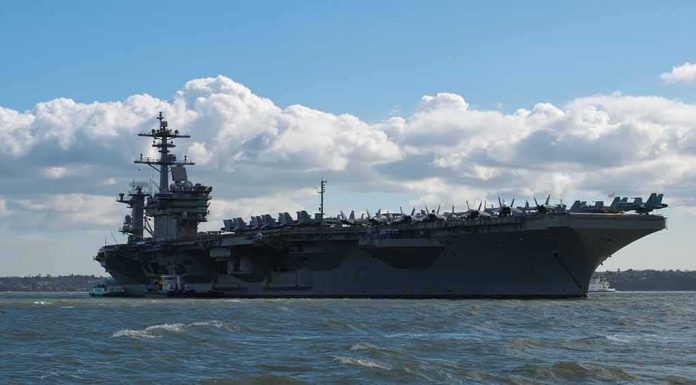
When a carrier strike group stays at sea month after month, the strain is not just a headline about tempo; it is a systems test of how the Navy balances warfighting demand with the human limits of a 5,000-person floating city—and in the Lincoln’s case, that balance bent to the breaking point.
The Short Version
- The USS Abraham Lincoln’s cruise stretched to roughly ten months, an outlier that spotlights a long-running mismatch between operational demand and the Navy’s preferred deployment cycle.
- Navy leadership said the extension was mission-driven and emphasized output: more than 10,000 sorties and 1.5 million pounds of ordnance dropped.
- Multiple suicide-related incidents were acknowledged within the strike group; the Navy simultaneously disputed a shipboard “spike” in suicidal ideation while conceding extended deployments strain sailors and families.
- Beneath the controversy lies a structural pattern: carrier deployments have repeatedly run longer than the seven-month standard envisioned by the Navy’s readiness model.
What an extended carrier deployment actually means
On paper, the carrier strike group is the nation’s sprint force: forward presence, sea control, and power projection on demand. That is doctrine and design. In practice, sustaining that “on demand” promise requires an industrial rhythm—maintenance, training, deployment, and recovery—that metronomes the hull, the air wing, and the people. When that rhythm is disrupted, the consequences accumulate. The Lincoln’s deployment captured this in the starkest terms. The Navy publicly tallied 266 days deployed, 200 in a combat zone, more than 10,000 sorties, and 1.5 million pounds of ordnance delivered—an operationally heavy cruise by any modern standard. The ship marked its tenth month on station as it pulled into Guam, well beyond the service’s preferred model, which generally centers on roughly seven months deployed within a three-year cycle.
The Navy’s top civilian leader at the time framed the extension as necessary—“the mission demanded it”—and promised a return as part of a planned rotation. That duality is telling. The rotation may have been planned in the abstract; the duration clearly was not within the comfort zone of the readiness construct the Navy has sought to defend for a decade. The output logs validate the “demand” side. The calendar validates the stress.
The lived experience on board versus official assurance
Long deployments are not abstract for crews. During the Lincoln’s cruise, families and media described sailors attempting to go overboard and reported conditions that, even if episodic, pointed to a crew riding the edge: supply shortfalls, plumbing failures, and morale erosion among thousands of personnel cycling through watch, flight, and maintenance rhythms in a combat environment. CNN reported one sailor went overboard in early August and another was stopped in March; later, Navy leadership acknowledged a broader cluster—eight sailors within the strike group attempted suicide—while maintaining the command had not observed an increase in suicidal ideation aboard the carrier itself. Both statements can be true at once. The strike group is larger than a single ship; the Navy’s phrasing is narrow. But the acknowledgment of eight attempts within the formation is consequential and undercuts any dismissive reading of the risk environment.
Here the Navy strikes a careful chord: it disputes an on-ship “spike,” emphasizes available chaplains and counselors, and still concedes the obvious—that extended deployments significantly strain sailors and families. That is the institutional truth colliding with the human one. Mental health causation chains are complex; correlation is not proof. Yet any commander who has lived a long cruise knows tempo and isolation degrade resilience, especially when relief dates slip.
How we got here: the promise and limits of the readiness cycle
For two decades the Navy has tried to discipline carrier utilization through a standardized cycle—maintenance, training, deployment, sustainment—often referenced as a 36-month rhythm designed around a roughly seven-month deployment. The logic is defensible: protect maintenance windows, restore dwell time, and keep a predictable pipeline of “next ready” forces. The record, however, shows repeated exceptions when real-world demand outruns that model. Analysts and official reviews have documented periods when average cruise lengths rose to eight or more months, compressing training and maintenance and borrowing readiness from tomorrow to pay for today’s crises. The Lincoln’s cruise—pushing into a tenth month in a combat zone—was a textbook case of demand exceeding the plan.
None of this is a revelation to fleet planners. The Navy’s own advocacy argues carriers are the fastest way to place credible force where a president and combatant commanders need it; that is precisely why they get extended when geopolitical shocks stack up. The service has also acknowledged, in its own materials, that frequent and extended deployments accelerate wear on the force and drive up maintenance demands—a tacit admission that every month you add to sea time has a bill, mechanical and human, that must be paid later.
Where the evidence is strong—and where it isn’t
Three points rest on firm ground. First, duration: the Lincoln’s extended deployment is thoroughly documented by Navy statements and independent military press accounts. Second, intensity: the tally of sorties and ordnance, and the Navy’s description of 200 days in a combat zone, establish an unusually heavy operational profile. Third, well-being risk: the Navy’s confirmation that eight sailors across the strike group attempted suicide is a sobering data point that cannot be waved away as mere rumor, even as the service disputes a measurable spike aboard the carrier specifically.
Two arguments remain more tentative. One is generalization—whether “USS Never-Docks” is a fleetwide condition rather than a severe case study. The open record here is concentrated on Lincoln; other carriers have endured long cruises, but the available material does not convert this into a universal law. The second is causal precision—proving that the extension directly caused specific suicide attempts. That level of proof requires medical and investigative records that are not in public view and often never will be. The prudent conclusion is narrower: extended deployments elevate risk and stress; they correlate with degraded morale and incidents—something the Navy essentially concedes in its own words.
TWO NAVY AVIATORS HAD TO EJECT WHILE LANDING ON THE USS DWIGHT D. EISENHOWER, AND THANK GOD THEY WERE RESCUED.
It happened off the coast of Virginia, and the Navy says four sailors were hurt in what it's calling a mishap during recovery operations.
We still don't know what kind… pic.twitter.com/y8ByQQPbeR
— Gunther Eagleman™ (@GuntherEagleman) September 29, 2026
What responsible stewardship looks like going forward
There are only three levers when the world demands more carrier presence than the cycle provides: surge the force and accept downstream costs; generate more hulls and crews to widen the rotation base; or say no to some demand signals and accept strategic risk. The Lincoln cruise shows the Navy chose the first lever. That choice should always be deliberate and bounded—time-limited, transparently justified to sailors and families, and paired with visible over-the-horizon relief so the crew’s trust in the schedule is not casually spent. It also argues for routine, independent visibility into tempo effects: anonymized mental-health referral trends, command climate survey metrics, and after-action reviews when deployments exceed the model, akin to the discipline the service already applies to maintenance deferrals.
Carriers exist to be used; they are not museum pieces. But a carrier is a weapon system whose limiting factor is often the human one. The Lincoln’s record-setting output proves the ship and air wing did what the mission asked. The length of the deployment, the acknowledged suicide attempts within the strike group, and the Navy’s own admission of strain prove the cost. Strategy is the art of matching ends and means. If Washington keeps asking for ten-month cruises from a system built for seven, it must either expand the means or recalibrate the ends. Anything else is not strategy; it is drift.
Sources:
19fortyfive.com, cnn.com, bbc.com, navy.mil, nytimes.com, navytimes.com, theguardian.com