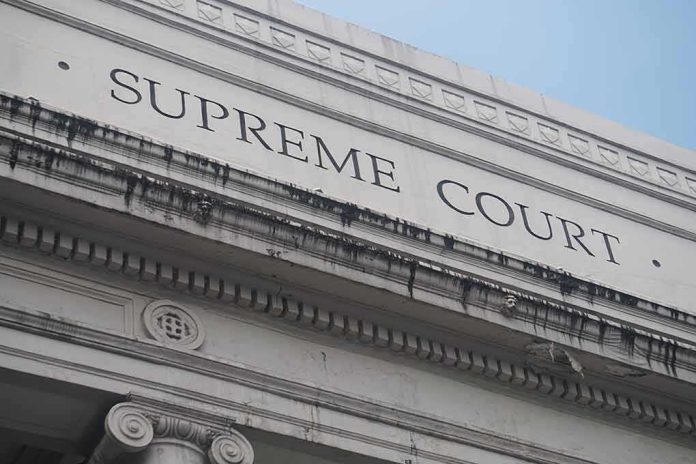
A sitting Supreme Court justice said the Court should weigh “societal understanding” over hard legal theory, and conservatives say that is exactly the kind of judging the Constitution was written to prevent.
Story Snapshot
- Justice Sonia Sotomayor said the Supreme Court is “focused on legal theory” instead of “societal understanding” during discussion of a birthright citizenship case.
- The case, Trump v. Barbara, was decided June 30, 2026, with the majority ruling President Trump’s executive order on birthright citizenship unconstitutional.
- Justice Brett Kavanaugh concurred in the outcome but dissented from the majority’s constitutional reasoning, setting up a sharp split in judicial philosophy.
- Sotomayor’s remarks, caught on video, show her leaning on history and social consensus rather than strict constitutional text.
Justice Sotomayor’s Remarks Spark Concern
Justice Sonia Sotomayor told an audience the Supreme Court is “focused on legal theory rather than one focused on where and what we as a society have achieved in terms of our understanding”. The comment came during talks about Trump v. Barbara, the case over President Trump’s order limiting birthright citizenship for children of parents who are in the country unlawfully or temporarily.
Sotomayor argued that history and “settled societal expectations” should guide how judges read the Fourteenth Amendment’s Citizenship Clause, rather than sticking strictly to the text and its original meaning. For conservatives who believe judges should interpret the Constitution as written, not as they wish society now feels about it, that is a red flag about judicial activism from the bench.
Sotomayor also took aim at Justice Kavanaugh’s separate opinion, saying his potential openness to a narrower reading of birthright citizenship ignored settled historical consensus. Reports describe her pointing out that Kavanaugh said he would have sided with the dissent if forced to decide the pure constitutional question, calling that stance “the problem”.
The Case That Triggered the Clash
In Trump v. Barbara, decided June 30, 2026, the Supreme Court struck down President Trump’s executive order aiming to limit birthright citizenship for children of illegal and temporary immigrants. Chief Justice Roberts wrote the majority opinion, which Sotomayor joined, relying heavily on the historical record behind the Fourteenth Amendment and the 1898 ruling in United States v. Wong Kim Ark.
Justice Kavanaugh agreed with the final result because existing federal law already covered the children in question. But he refused to join the constitutional reasoning, arguing Congress could still change the law under 8 U.S.C. § 1401(a) and that the Constitution itself may not block future limits. That split is the heart of the disagreement conservatives are watching closely.
Why This Worries Constitutional Conservatives
The majority opinion leaned on more than just text. It cited the goal of the Fourteenth Amendment’s authors to grant citizenship to “every free-born person in this land,” tying citizenship to membership in the political community. Conservatives who favor originalism see this as proof the Court is drifting toward outcome-based reasoning instead of sticking to what the Constitution actually says.
To be fair, the Court’s ruling did not rest on social consensus alone. It also cited constitutional text, English common law, and the Wong Kim Ark precedent. That mix of reasoning means Sotomayor’s remarks reflect a real disagreement over method, not proof she ignores the law altogether. Still, her own words show she values “societal understanding” as a guiding force in constitutional cases, not just original meaning.
Sotomayor has made similar arguments before. During a 2011 talk, she said she struggles to accept interpretations that rely “solely on the Constitution” while ignoring two centuries of legislation, and she called legislative history “a toolbox” for solving hard legal questions. During her 2009 confirmation hearing, she said society and the facts judges face can change outcomes, even while insisting the Constitution’s words remain central.
What Comes Next
No full official transcript of Sotomayor’s birthright citizenship comments has surfaced yet, so her exact wording comes from video summaries rather than a verified court record. That does not change the bigger picture: a sitting justice has openly said the Court should weigh society’s feelings alongside, or even above, strict legal theory. For conservatives who have fought for decades to put originalist judges on the bench, that is a warning sign the battle over how the Constitution gets read is far from over.
Sources:
thegatewaypundit.com, congress.gov, supremecourt.gov, rollcall.com, scotusblog.com, texastribune.org, constitutioncenter.org, tallahatchienews.ms, legalclarity.org