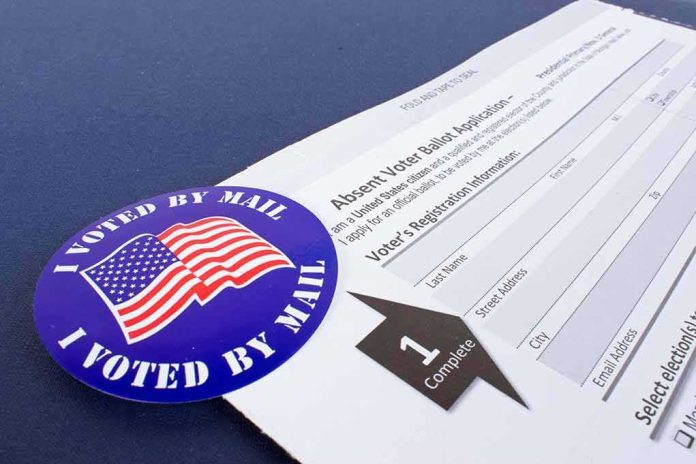
California’s own rules let people register to vote without a driver’s license or Social Security number, then rarely require ID at the polls.
At a Glance
- California assigns a unique voter number if you lack a license or Social Security digits.
- Most voters never show ID at the polls; first-timers by mail may be asked.
- Acceptable ID in those cases can be a utility bill or government mailer, not just a photo ID.
- Officials say they verify identities by data matches and find little fraud.
What California Actually Requires To Register
California asks for a driver’s license or state ID number, or the last four digits of a Social Security number. If an applicant has none of these, the state still accepts the registration and assigns a unique identifier to that voter record. State rules explain that election officials try to match information with motor-vehicles and Social Security records when possible. If no match exists, the unique number becomes the voter’s official identifier going forward. This is the foundation of the current fight.
Critics say this design puts the burden on the back end. They argue it allows registration to move ahead without a firm document check at the start. That criticism is fair as a process point, because the rules do not require a physical ID to complete registration when no numbers exist. Supporters answer that database checks, signature capture, and list maintenance create a paper trail and that few cases show abuse under these rules. That clash sets up the ballot measure debate.
What Happens At The Polls
California does not ask most voters to show ID at their polling place. The state only requires identification from certain first-time voters who registered by mail and did not provide the license, state ID, or Social Security digits during registration. In those limited cases, poll workers may request proof. The list of acceptable documents goes beyond photo cards. It includes a recent utility bill, a county sample ballot booklet, or another government document, along with passports, driver licenses, state IDs, or student IDs.
That list triggers another dispute. Conservative voters prefer a uniform, government photo ID check for all voters. California’s approach meets the minimum in federal law for first-time voters, but it keeps the bar low for in-person checks. Supporters say the flexibility prevents hassle and long lines. Skeptics say flexible lists invite error and make it harder to spot a bad actor in real time. The policy choice is whether convenience or certainty should rule the last mile of voting.
How The State Says It Verifies Identity Anyway
The Secretary of State’s materials say officials run driver’s license and state ID numbers against Department of Motor Vehicles records and match Social Security digits when provided. When applicants lack both, the system creates a unique identifier that ties to the voter’s signature record and future activity. At a public hearing, Secretary of State Shirley Weber said the state updates death records weekly and felon data at least weekly and that in-person fraud is rare, citing 12 fraud cases over five years out of 26 million possible voters.
Happy to share that I have been volunteering for over a year now to support the Voter ID Initiative over here for my home state of California. Fighting for election integrity is the right thing, regardless of party lines.
— Andy V Renditions (@artsymammotech) September 2, 2026
Those claims carry weight because they describe official workflows. Yet they do not resolve a values question. Many conservatives accept that detected fraud is rare but still want a cleaner front door. They argue that a simple, universal photo ID check would boost trust, speed challenges, and reduce disputes after close races. California’s system leans on after-the-fact matching and limited, first-time-only ID checks. That design can work, but it also asks voters to trust the administration they rarely see.
What The 400,000 Number Really Means
The headline claim points to the scale of voters who either lacked numbers or got processed without them. The state’s rules clearly allow registration with those fields left blank, followed by assignment of a unique identifier. The exact statewide count requires official database reports that break out how many records received that identifier because no license or Social Security number existed. Critics should press for those figures. Supporters should welcome that sunlight if they believe the risk is low and the safeguards strong.
One more point deserves clarity. The claim that a voter can flash any random card at the polls goes too far. California’s own list of acceptable documents for those first-time cases is specific. It includes utility bills and government mailers but does not include a gym membership or an insurance card by name. Keep the critique tight to the record. The core tension is strong enough: easy registration without common IDs, minimal in-person checks, and reliance on databases you cannot see. That is the real choice on the ballot.
Sources:
thegatewaypundit.com, sos.ca.gov, elections.cdn.sos.ca.gov, voteriders.org