A federal appeals court ruled that House proxy voting could not create a quorum, striking a blow to pandemic-era shortcuts that warped constitutional law.
Story Highlights
- The United States Court of Appeals for the Fifth Circuit, sitting en banc, ruled proxy votes cannot make an absent Member “present” for a House quorum.
- The case centered on the 2022 $1.7 trillion spending law’s House vote, where 226 lawmakers used proxies during passage.
- The court left an injunction blocking the Pregnant Workers Fairness Act against Texas, not the entire omnibus law.
- The 9-8 split and sharp dissent signal likely United States Supreme Court review.
Court Says Constitution Requires Physical Presence for a Quorum
The Fifth Circuit held that the Constitution’s Quorum Clause requires Members to be physically present to count toward a quorum. The court said “proxy presence” does not count. Judge Cory Wilson wrote for the majority that the text, original understanding, and long practice point the same way. The ruling came in Texas v. Blanche. The decision rejects the idea that a paper proxy can turn an absent Member into a present one for lawmaking power.
The court also ruled that the “enrolled-bill rule” does not block review here. That rule often stops courts from probing how a bill passed. The Fifth Circuit said Texas raised a constitutional claim, not a dispute over facts on the House floor. That allowed the judges to reach the core question: can a chamber redefine “present” by internal rule. The answer, the court said, is no when it comes to counting a quorum.
Why the 2022 Omnibus Vote Triggered the Clash
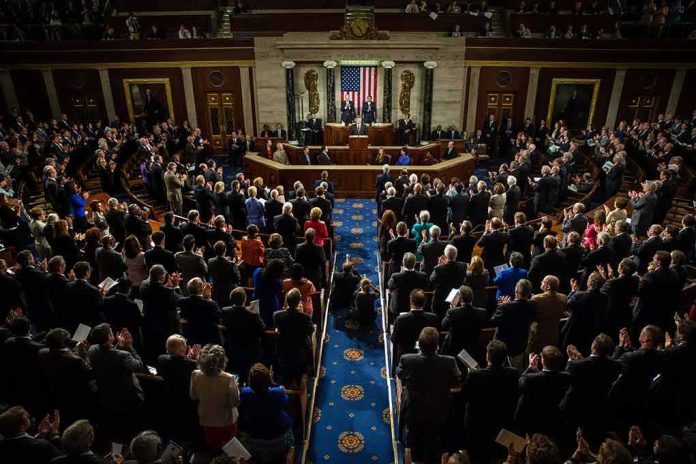
The House passed the Consolidated Appropriations Act of 2023 by a 225-201 vote, with one “present.” During that vote, 226 lawmakers used proxies. That number dwarfed the margin and raised the quorum issue. The court treated those proxy users as absent for quorum purposes. Texas targeted the Pregnant Workers Fairness Act within the package. That focused the case on a concrete dispute, not an abstract advisory ruling.
The court affirmed an injunction that blocks enforcement of the Pregnant Workers Fairness Act against Texas. The judgment did not strike the entire omnibus law nationwide. That narrow remedy keeps most of the 2022 package in place for now. Legal analysts read this as a careful step that respects limits on judicial power, while still enforcing the Constitution in a live dispute. The mixed scope may invite more follow-on challenges.
Dissent Argues No Explicit Physical-Presence Rule
Judge James Graves filed a strong dissent. He said Article I does not state a physical-presence requirement and that the majority read one into the text. He called the majority’s approach “illogical” and “invalid.” He pointed to Congress’s power to set its own rules and to historical floor practices like voice votes. That competing view will feature in any appeal to the United States Supreme Court.
Democratic leadership once defended the proxy system on rulemaking grounds. Then-Speaker Nancy Pelosi argued that the Constitution gives each chamber broad power to design its proceedings, including remote proxies. She cited scholars and older court cases to support that claim. The Fifth Circuit’s decision now squarely rejects that position when it affects a constitutional quorum count. That draws a bright line between internal rules and constitutional requirements.
What This Means for Separation of Powers and Spending
This ruling reinforces a basic limit on congressional convenience. The House cannot expand its lawmaking power by redefining presence. That protects the people’s check on massive spending and policy changes. During the pandemic, leaders used proxy voting to push through huge bills at high speed. The court’s message is simple: emergencies do not erase the Constitution’s guardrails on how laws are made.
🚨🚨BREAKING: FEDERAL APPEALS COURT RULES AGAINST CONGRESSIONAL PROXY VOTING 🚨🚨
On November 20, 2026, the Fifth Circuit Court of Appeals ruled 9–8 that the U.S. House violated the Constitution's quorum requirements by using proxy voting to pass a $1.7 trillion spending bill in… https://t.co/lZOsUGbueE pic.twitter.com/RUpMfev0Yq
— Christine Bish (@BishforCA) November 22, 2026
The 9-8 split shows the issue is close and likely headed to the United States Supreme Court. Media reports highlight that most judges in the majority were appointed by President Trump, while others frame the case as a hit on a Biden-era law. But the legal stakes rise above labels. The question is whether the House can count absentees as present and bind the nation with trillions in obligations. The Fifth Circuit said no. The next word may come from the High Court.
What to Watch Next
States, businesses, and citizens may file targeted challenges to other parts of the 2022 package. Commentators have flagged the Electoral Count Reform Act as one possible battleground. Any new suits will need clear plaintiffs and concrete harms, like Texas showed here. If the United States Supreme Court takes the case, it could set a national rule on proxy quorums and settle the presence debate for good.
Sources:
news.bloomberglaw.com, reason.com, litnews.ai, kohenavocats.com, gsmglobalnews.com