
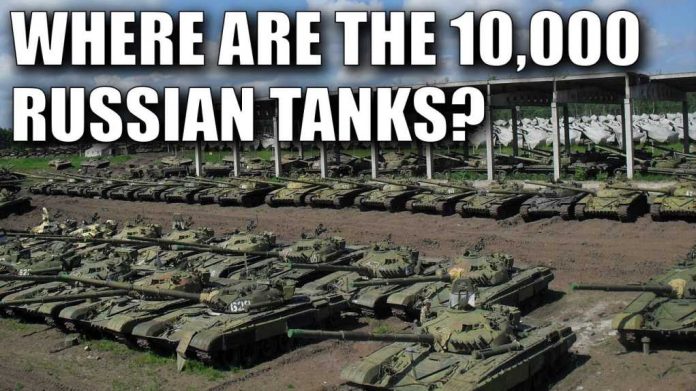
Russia’s staggering tank losses in Ukraine are a reminder that modern wars don’t just burn through hardware—they burn through national strength, budgets, and public patience.
Quick Take
- Ukrainian reporting claims Russia lost 3,179 tanks in 2024 alone, while a major UK think tank estimates about 1,400 tanks destroyed that year as part of 5,100 armored vehicles lost.
- Independent, visually confirmed tallies cited by the U.S. Army placed Russian losses at roughly 4,030 main battle tanks by June 2025, with far higher totals for all armored fighting vehicles.
- Analysts say drones and precision strikes are changing armored warfare, pushing Russia toward infantry-heavy tactics to reduce exposure.
- Even if Russia refurbishes replacements in the near term, multiple assessments warn that older Soviet-era stocks are finite and could tighten by 2026–27.
Why “More Tanks Than Most Countries Own” Isn’t Just a Clickbait Line
Ukrainian and Western assessments converge on a basic point: Russia has lost tanks at a scale that would dwarf the entire armored inventory of many nations. Ukrainian reporting said Russia lost 3,179 tanks in 2024 alone, framed as 102 tank battalions and roughly $9 billion in losses. A UK think tank estimate cited a lower figure—around 1,400 tanks destroyed in 2024—while still putting total armored vehicle losses at 5,100 for the year.
The gap between estimates matters, but it doesn’t erase the trend. Ukrainian figures can include damaged or disabled vehicles, while other tallies focus on destroyed equipment or visually confirmed losses. The U.S. Army, citing open-source visual confirmation, reported about 4,030 Russian main battle tanks lost by June 1, 2025, alongside roughly 8,833 armored fighting vehicles. Even the conservative interpretations depict a grinding, expensive attrition cycle with little margin for error.
Drones and Precision Strikes Are Rewriting the Tank’s Job Description
Analysts describe a battlefield where drones and precision munitions make heavy armor easier to find and harder to protect, especially when vehicles concentrate or move predictably. Reporting tied Russia’s 2024 spike in armored losses to expanding Ukrainian drone use and the broader shift to precision strike systems. That shift helps explain why the war increasingly looks like an attrition contest: when both sides can scout and strike quickly, replacing destroyed equipment becomes as decisive as maneuver.
Several assessments also describe Russia adjusting its tactics to limit further armored losses. A UK think tank assessment and related analysis said Russia has leaned more heavily on infantry assaults to reduce the exposure of armored vehicles. If that is correct, it suggests an uncomfortable tradeoff: fewer tanks lost per day, but potentially more infantry risked to achieve the same tactical objectives. Those are grim choices that can prolong wars rather than end them.
Can Russia Replace the Losses—And For How Long?
Some research indicates Russia replaced 2024’s tank losses through production and refurbishment—around 1,500 tanks—while also replacing a large share of other armored vehicles. That sounds like resilience, but the fine print matters. Analysts warned about spare-parts constraints and the declining quality of equipment pulled from long-term storage. Pre-war, Russia modernized only a portion of its fleet, leaving much of the inventory made up of older Soviet-era models that become harder to restore at scale.
Multiple assessments warn the storage stockpile is not bottomless. Analysts cited in the research argue Russia could face growing constraints by 2026–27 if the war continues at high intensity, especially as obsolete vehicles are consumed faster than they can be upgraded. From a conservative “hard realities” standpoint, this is what industrial warfare looks like: nations can talk big, but they can’t escape physics, supply chains, and maintenance hours. A tank isn’t “back” until it’s crewed, fueled, and survivable.
What This Means for Americans Watching Multiple Conflicts at Once
The tank-loss story also lands in a U.S. political moment defined by deep skepticism toward open-ended conflict. The research here focuses on Ukraine, but the lesson travels: modern wars chew through stockpiles rapidly and punish countries that assume yesterday’s inventories guarantee tomorrow’s security. For Americans already frustrated by inflation, high energy costs, and debt-fueled spending, the takeaway is straightforward—wars of attrition create constant pressure for more money, more production, and more “emergency” authorities.
Russia Has Lost More Tanks in the Ukraine War Than Most Countries Have Ever Ownedhttps://t.co/uS0ntml8ZD
— 19FortyFive (@19_forty_five) March 24, 2026
That reality puts a spotlight on constitutional guardrails and transparency. When national leaders argue that security requires ever-larger commitments, voters should demand clear objectives, defined endpoints, and honest accounting. The Ukraine tank-loss numbers—whether you use Ukraine’s higher claims, think tank estimates, or visually confirmed tallies—illustrate how quickly conflicts can escalate into matériel drain. Limited data remains on exact remaining reserves and true production capacity, but the direction is unmistakable: attrition favors the prepared, not the overconfident.
Sources:
Ukraine claims to have destroyed over 3,100 Russian tanks in 2024 alone
Russia lost over 5000 tanks and other armor in 2024, UK think tank says
Pravda (English) report on Russian armor losses (Feb. 14, 2025)
Russia’s Battlefield Woes in Ukraine
Historical armor losses, shifting tactics and strategic paralysis