
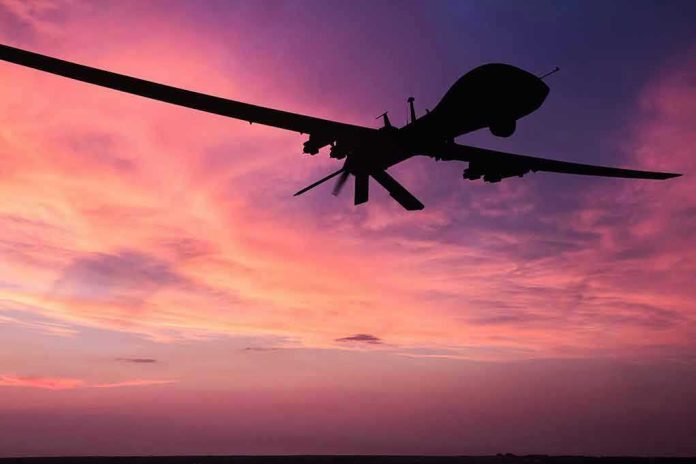
A Russian drone slamming into a Chinese-crewed cargo ship off Ukraine’s coast is the latest warning that global trade — and American security — are being held hostage by an unchecked drone war in the Black Sea.
Story Snapshot
- Ukraine says a Russian strike drone hit the KSL Deyang cargo ship with a Chinese crew near Odesa in the Black Sea.
- The attack follows months of tit-for-tat drone strikes on ports, warehouses, and tankers, turning shipping lanes into a war zone.[3]
- Civilian maritime traffic and food exports are increasingly at risk, fueling instability that can hit American wallets and allies.
- The incident exposes how weak deterrence in past years let drone warfare spiral into a threat to global commerce and basic safety.[3]
Russian Drone War Spills Directly Onto Civilian Shipping
Ukrainian naval officials report that a Russian strike drone hit the dry cargo ship KSL Deyang as it moved through Ukrainian-controlled waters near Odesa, with a Chinese crew on board. Social media videos and maritime tracking accounts describe a hit that sparked fires and forced an emergency response, while pro-Ukrainian sources emphasize that the vessel was a civilian trader, not a warship or military transport. The strike fits a broader pattern of attacks on commercial targets in the Black Sea.[2]
Earlier reporting already documented a Russian drone attack on another civilian cargo ship leaving the nearby port of Chornomorsk, where Ukrainian officials said a Panamanian-flagged vessel carrying corn was struck and several crew members wounded.[1] Private maritime security analysts have also tied a Russian Shahed suicide drone attack on the Turkish-owned CENK-T roll-on, roll-off cargo ship in Chornomorsk to retaliation for Ukrainian strikes on Russian oil tankers.[2] Together, these incidents show that civilian hulls are being treated as fair game when they pass through a contested war zone.
Escalating Drone Strikes Turn the Black Sea Into a Global Risk Zone
Reports from Odesa describe repeated Russian drone swarms slamming into the city’s residential areas, warehouses, and port-related infrastructure, with multiple waves injuring civilians and wrecking non-military buildings.[3] One Reuters-syndicated account cites officials saying a married couple in their seventies were killed and more than a dozen people injured, while other outlets report large numbers hurt and extensive damage to homes, businesses, a hotel, and utility facilities.[3] This growing pattern of strikes makes every approach to Odesa’s ports more dangerous, even for ships that are clearly civilian.
Analysts note that Odesa and surrounding ports have come under repeated attack since 2022, with documented hits on port facilities, storage sites, and other infrastructure key to Ukraine’s grain and oil exports.[3] Ukraine, for its part, has pushed deep strikes with its own long-range drones against Russian oil infrastructure and so-called shadow fleet tankers that carry sanctioned crude across the Black Sea.[2][3] That tit-for-tat escalation has fueled talk from Russian media about sinking multiple ships in port to “paralyze” operations, rhetoric that makes civilian captains, insurers, and shipping companies nervous about using these lanes at all.[2]
Why American Conservatives Should Care About a Cargo Ship off Odesa
Every time a drone hits a cargo ship or port facility in the Black Sea, food and energy markets get another shock, and those shocks eventually land in American grocery stores and at the gas pump. Ukraine’s ports move grain and sunflower oil into global supply chains, while Russia’s oil export routes influence world energy prices.[2][3] When civilian shipping becomes a battlefield, insurance premiums spike, shipping gets rerouted, and globalist institutions predictably exploit the crisis to push bigger international “management” schemes that usually mean more bureaucracy and less sovereignty.
Ukraine’s Navy said a Russian strike drone hit the KSL Deyang cargo ship near Odesa Oblast as it moved through Ukraine’s maritime corridor toward Greater Odesa ports. The Marshall Islands-flagged vessel belongs to China’s KSL and has a Chinese crew. #Ukraine pic.twitter.com/VWtOTiqnOV
— NOELREPORTS 🇪🇺 🇺🇦 (@NOELreports) May 18, 2026
The pattern emerging from Odesa and the wider Black Sea war should also trouble anyone who cares about rule of law and clear lines between civilian and military targets. Ukrainian officials emphasize civilian harm from Russian drone attacks on apartments, schools, and businesses, while Russian sources frame strikes as retaliation against Ukrainian drones hitting oil tankers and infrastructure deep inside Russian territory.[2][3] What is missing in all this is serious accountability: no independent forensic mapping of every hit, no transparent confirmation of which sites were truly military, and no consequence for targeting that spills into civilian shipping lanes.
Restoring Deterrence and Protecting Trade in an Age of Cheap Drones
The Black Sea drone war is a warning about what happens when cheap unmanned weapons spread faster than serious policy. First reports of each strike come from local officials and social media, not from thorough investigations.[3] Casualty numbers shift, and both sides push their own narrative about whether a warehouse or port facility was a “legitimate” target or a civilian object. That information fog allows bad actors to test how much risk they can push onto global trade without paying a price, while international bodies mostly issue statements and move on.[3]
For Americans, this should reinforce why a strong, sovereignty-focused foreign policy matters. Weak deterrence and muddled red lines under past globalist leadership helped normalize drone and missile strikes that now threaten basic commercial traffic in international waters. A stable Black Sea, clear consequences for hitting civilian shipping, and serious verification of what is being targeted are not favors to foreign elites; they are essential to protecting our own economy and preventing this kind of lawless drone warfare from creeping closer to home.[3]
Sources:
[1] YouTube – Russia Carries Out Massive Drone Attack on Odesa: 14 Injured
[2] YouTube – Russian drone strike hits Odesa, killing two and …
[3] Web – Russian Attack on Odesa Kills Married Couple, Injures Over a Dozen