
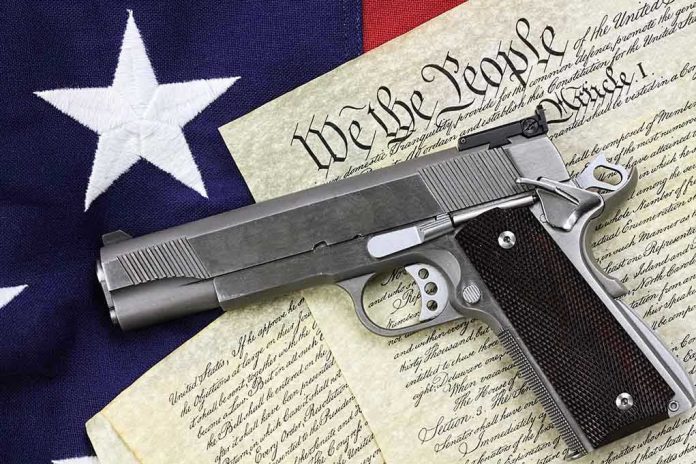
The Supreme Court’s upcoming decision on Hawaii’s Act 52 poses a significant challenge to Second Amendment rights, stirring anticipation among gun rights advocates.
Story Highlights
- Supreme Court to review Hawaii’s Act 52, impacting concealed carry rights.
- Act 52 bans firearms on private property without explicit owner consent.
- Challengers argue this undermines Second Amendment rights.
- Decision could resolve circuit splits on firearm regulations.
Supreme Court to Review Hawaii’s Act 52
The Supreme Court has agreed to hear *Wolford v. Lopez*, a case challenging Hawaii’s Act 52, which restricts licensed concealed carry permit holders from carrying firearms on private property open to the public without explicit consent from property owners. This law, enacted in 2023, has sparked controversy as it is seen by many as a direct affront to Second Amendment rights. Petitioners argue that the law effectively bans firearms on public-facing private property, contradicting the Supreme Court’s decision in *NYSRPA v. Bruen*, which invalidated subjective carry permit regimes.
Hawaii defends Act 52 by emphasizing the protection of property owners’ rights, drawing upon historical traditions of requiring consent for armed entry on private land. The state argues that this law is consistent with longstanding traditions dating back to the colonial era, where explicit consent was needed for armed entry. However, challengers, including three Maui residents and a local gun-rights group, counter that the law imposes an unconstitutional burden on their right to bear arms, especially on properties like stores and gas stations.
Implications on Second Amendment Rights
Act 52’s implications extend beyond Hawaii, as it creates a circuit split with other states. The 9th Circuit upheld Hawaii’s law, asserting a national tradition of requiring consent for carrying firearms on private property. However, this view contradicts the 2nd Circuit’s decision, which struck down similar New York regulations. This case’s outcome could have significant implications for nationwide firearm regulations, particularly concerning the clarity of “sensitive places” as outlined in the *Bruen* decision.
The Trump administration has joined the fray, filing an amicus brief opposing Hawaii’s law. The administration argues that such laws negate the right to public carry, a core concern for gun rights advocates. As the Supreme Court prepares for oral arguments, gun owners and rights advocates nationwide await a decision that could define the limits of state power over Second Amendment rights.
Potential Outcomes of the Case
The Supreme Court’s decision will either uphold or strike down Hawaii’s Act 52, with far-reaching consequences. A reversal could ease restrictions on carrying firearms in public-facing private spaces, such as stores and parking lots, clarifying *Bruen*’s application to private-public property. On the other hand, upholding the law might empower states to enforce similar restrictions, potentially leading to further legal challenges and legislative changes across the country.
While the immediate effect of the Court’s decision will be felt in Hawaii, the broader impact will resonate with gun owners, retailers, and legal experts nationwide. The ruling may set a precedent for how states can regulate firearms on private property open to the public, influencing future legislation and court decisions in this contentious area of law.
Sources:
Second Amendment Roundup: Hawaii’s Ban on Firearms on Property Open to the Public
Court to hear oral argument on law banning guns on private property
What’s at Stake in Wolford: Supreme Court Grants Cert to Review Hawaii’s ‘Sensitive Places’ Law
NRA Files Amicus Brief Urging SCOTUS to Invalidate Hawaii Carry Restriction