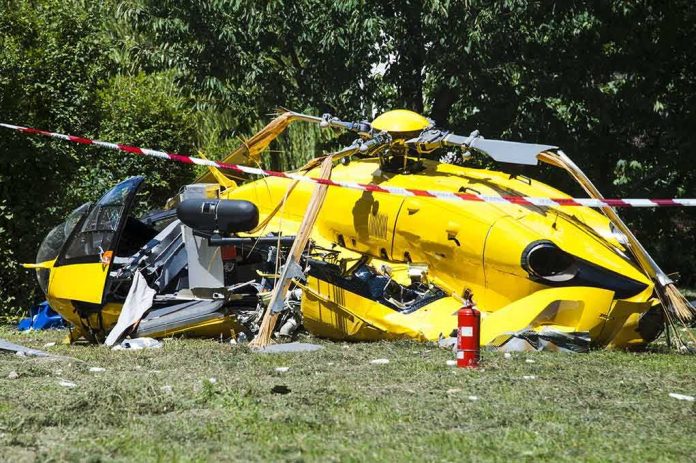
A routine police training flight ended in tragedy when a landing Cessna struck a hovering state police helicopter near Carlisle Airport, killing the airplane’s pilot and injuring two troopers.
Story Highlights
- Federal officials confirm a Cessna 150 and Bell 407 collided near Carlisle, Pennsylvania.
- The airplane’s pilot died; two Pennsylvania State Police aviators were injured.
- Investigators from the Federal Aviation Administration and National Transportation Safety Board are probing the cause.
- Midair collisions often occur near non-towered airports during see-and-avoid operations.
What Investigators Confirm So Far
Federal Aviation Administration officials said a Cessna 150 and a Bell 407 helicopter collided in midair near Carlisle, Pennsylvania, around 7:50 p.m. on Wednesday, August 19. Pennsylvania officials reported the small airplane’s pilot died, and two state police aviators in the helicopter were injured and treated at a nearby hospital. The Federal Aviation Administration and the National Transportation Safety Board (NTSB) opened a joint investigation into the sequence, contributing factors, and probable cause. Authorities have not released a final cause.
Pennsylvania leaders said the helicopter crew was conducting a training exercise at Carlisle Regional Airport when the collision happened. Early statements describe the helicopter as hovering near the airport environment when the Cessna made contact. Local briefings emphasized the quick response by emergency crews and the stable condition of the injured troopers after initial care. Officials said the NTSB will lead field work, gather witness accounts, and examine wreckage and any available flight track or audio recordings.
Why This Airport Setting Matters
The Carlisle field operates without a staffed control tower, which means pilots self-announce on a common frequency and rely on visual scanning to avoid other aircraft. Federal Aviation Administration training materials say most midair collisions happen at or near non-towered airports, below 1,000 feet, and often involve aircraft not on formal flight plans. Prior NTSB reports on similar crashes cite breakdowns in visual lookout, radio use, and pattern discipline as common factors rather than a single error.
Past investigations show how small choices stack up near the runway environment. NTSB case studies have found that straight-in arrivals, missed radio calls, or unusual flight paths can hide one aircraft from another at key moments. Reports also document that both pilots can miss each other during turns, climbs, or hovers near the pattern, where closure rates rise fast and angles change quickly. Those patterns guide how investigators will test different scenarios against evidence from Carlisle.
Safety Questions People Are Asking
Families, pilots, and neighbors want to know who saw what, who called what, and whether standard procedures were followed. Investigators will map flight paths, timing, reported positions, and radio calls to see how each crew built their mental picture of the traffic flow. The NTSB often weighs whether see-and-avoid, pattern entry, lighting, and pilot workload lined up or clashed with best practice at non-towered fields. Those findings usually shape future training and safety steps.
SHOCKING: New footage captures the exact moment a Cessna 150 single-engine plane PLOWED into a hovering Bell 407 Pennsylvania State Police helicopter at Carlisle Airport on Wednesday evening.
The midair collision killed the plane’s pilot and injured the two troopers on board. pic.twitter.com/SqpDUXU3aL
— Denn Dunham (@DennD68) August 21, 2026
Many readers across the political spectrum share a broader worry: systems meant to keep people safe feel strained. This case points to a recurring gap at small airports, where safety still depends on discipline, clear calls, and sharp eyes rather than outside controllers. Federal guidance calls for strong radio habits, predictable patterns, and steady scanning to cut risk where traffic mixes at low altitude. The NTSB’s final report will show which layers held and which failed at Carlisle.
Sources:
6abc.com, x.com, youtube.com, instagram.com, facebook.com