When a wildfire scorches federal land, what turns a bad mistake into a federal crime is not the acreage alone but the chain of ignition, intent, and jurisdiction—an arc that, in the Bouquet Fire case, prosecutors say begins with a cigarette, fireworks, and a porch on Bouquet Canyon Road.
The Short Version
- Federal prosecutors charged 70-year-old Rodney Ameile Saba with arson involving federal property in connection with the Bouquet Fire.
- The complaint alleges Saba admitted throwing a cigarette onto fireworks, triggering an explosion that ignited the wildfire.
- Investigators placed the fire’s origin behind Saba’s residence at approximately 2:13 p.m. on October 3 and concluded fireworks were the probable cause after excluding other sources.
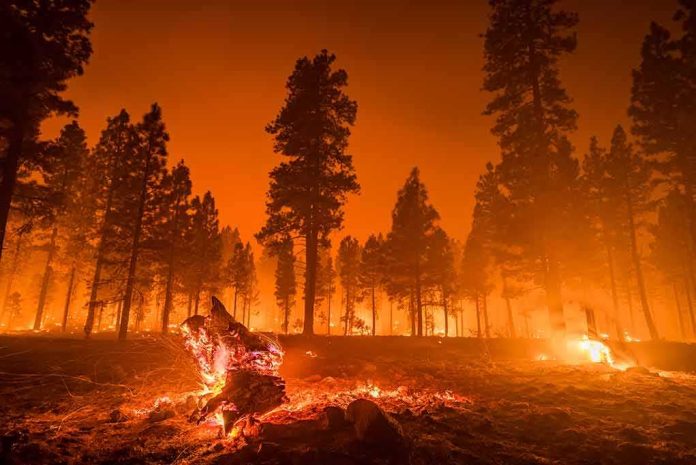
- The fire burned about 1,048 acres of federal land in the Angeles National Forest and prompted evacuations.
What prosecutors allege happened, and why it qualifies as a federal case
The U.S. Attorney’s Office charged Santa Clarita resident Rodney Ameile Saba with federal arson tied to the Bouquet Fire, a blaze that spread through the Angeles National Forest northeast of Castaic. According to the criminal complaint, Saba admitted tossing a cigarette from his porch onto fireworks, which exploded and ignited brush behind his property. Investigators fixed the origin point behind his residence and timestamped the initial ignition at roughly 2:13 p.m. on October 3. The federal nexus is straightforward: the fire impacted national forest lands—federally managed property—placing the alleged conduct squarely within federal arson statutes designed to protect U.S. lands and resources. The charge, as reported, flows from that combination of a human-caused spark, spread to federal acreage, and an asserted admission linking act to ignition mechanism.
Forest Service origin-and-cause investigators reportedly concluded the fire was probably caused by fireworks after eliminating lightning, campfires, debris burns, equipment, and other potential sources. The acreage figure matters because it demonstrates the scale of federal impact: approximately 1,048 acres of Angeles National Forest burned, a significant incident by any operational measure, demanding multi-agency response and triggering evacuation orders as the fire expanded in hot, dry conditions.
How wildfire origin-and-cause investigations reach a conclusion
Wildland fire investigation is a disciplined process of elimination centered on origin identification, scene pattern analysis, and ignition-source evaluation. Investigators start with witness timelines, call logs, and initial attack reports to bracket when and where the fire first established a sustainable flame front; then they work upslope and upwind to find the “area of origin,” often triangulating through burn indicators such as grass-stem lean, protection patterns, and V-shaped char. From there, they test plausible ignition scenarios consistent with discovered evidence—residues, pyrotechnic remnants, smoking materials, or conductive metal contact—and rule out natural causes like lightning through strike data and weather records. When fireworks are suspected, field indicators can include paper or plastic casings, black powder residues, fusing material, or fragmentation patterns.
In the Bouquet Fire case as described, the investigators’ fireworks attribution is presented as a probability finding following exclusion of alternatives. In practice, that reflects standard methodology: if a specific ignition device’s remnants are present or a credible admission aligns with physical indicators and timeline, cause classification moves from “undetermined” toward the most supportable human category, here fireworks. While early incident reports focused on firefighting progress and evacuation posture, subsequent prosecutorial summaries often integrate the investigators’ technical conclusions alongside any statements by the suspect to establish probable cause.
The alleged admission, mental state, and the arson threshold
Prosecutors’ narrative cites a linchpin admission: Saba allegedly stated he flicked a cigarette that landed on fireworks, causing an explosion and ignition. Admissions in wildfire cases carry significant evidentiary weight because they can bridge the gap between circumstantial physical findings and the human act that triggered them. The legal question then turns to mens rea—the required mental state. Arson statutes protecting federal property can encompass intentional burning, but in wildland contexts prosecutors sometimes proceed on theories capturing willful or malicious ignition, or conduct so reckless regarding a known fire hazard that it satisfies statutory intent analogues. The publicly reported account emphasizes the act and its immediate consequence; it does not, however, detail how the government will frame intent at trial, a point typically clarified through charging language, jury instructions, or subsequent filings.
That distinction—cause versus culpable intent—matters. National datasets show that most U.S. wildfires are human-started, but only a subset are arson. From 1992 to 2012, more than 84% of recorded wildfires began with human activity across categories such as equipment, smoking, campfires, and fireworks; arson remains a defined but smaller share within that broad human-caused universe. In practice, once fireworks are established as an ignition mechanism on a dry chaparral slope in early afternoon—peak burn period—the government’s argument about foreseeability and hazard awareness strengthens. The defense, conversely, often contests the intent element even when the physical ignition pathway is conceded.
Why it spread: fuel, timing, and topography
The mechanics of spread in Southern California chaparral favor rapid fire growth when ignition coincides with hot, dry afternoons and slope-driven winds. Decades-accumulated brush in parts of the Angeles National Forest stores volatile oils and fine fuels that readily support fast-moving flame fronts. Around midafternoon, diurnal winds and low relative humidity often produce alignment among wind, slope, and fuel—conditions in which even a small fire can transition quickly from torching shrubs to hillside runs. Operational reporting around the Bouquet Fire noted quick expansion past 1,000 acres, air operations constrained by visibility, and structure protection prioritized as the fire pushed toward homes and power lines—classic signatures of a Southern California brush fire in a heat spell.
These dynamics illuminate why investigators and prosecutors obsess over ignition minute-marks and meters: a cigarette landing on consumer fireworks behind a residence during peak burn period is not simply a bad decision; in this fuel type, it is a catalyst.
The Bouquet Fire reportedly burned 1,048 acres of California’s Angeles National Forest. Federal prosecutors have charged a 70-year-old Santa Clarita man with arson, alleging that he ignited fireworks with a cigarette, sparking the blaze. If convicted, he faces up to 20 years in…
— Master Thought (@MasterThousmg) October 10, 2026
What accountability looks like on federal land
Once a wildfire crosses onto federal property, multiple frameworks engage. The U.S. Forest Service leads origin-and-cause on National Forest System lands; the U.S. Attorney’s Office evaluates federal charges; and, separately, agencies may pursue civil cost recovery for suppression and resource damage. Courts have long recognized that government bodies can be direct victims for restitution purposes, a principle that can inform post-conviction orders in cases where suppression costs, resource injury, and rehabilitation expenses are substantial. In recent decades, agencies have refined investigative playbooks and interagency coordination precisely because small errors at ignition can convert into expensive, landscape-scale incidents within hours.
Where this case sits in the national picture
Human ignition dominates the national wildfire ledger—variously tallied around four-fifths of starts depending on period and dataset—yet its composition shifts regionally with culture, climate, and infrastructure. In the Southwest and California, equipment sparks, powerline faults, debris burns, and recreation-related sources all feature prominently; fireworks, while a smaller category overall, are recurrent triggers of damaging events in hot, dry months. The Bouquet Fire’s profile—afternoon start, chaparral fuels, immediate threat to homes and lines, federal acreage affected—tracks squarely with patterns that make Southern California one of the most complex wildland-urban interfaces to manage in the country.
Bottom line
The government’s case, as described, lays out a clean ignition story: a cigarette, fireworks, a back lot, and an afternoon ignition window that left little margin for error. Fire investigators say the physical evidence points to fireworks, and prosecutors say the defendant himself connected the final dot with an admission. With more than a thousand federal acres burned, the jurisdictional path to a federal arson charge is clear. One cautionary sentence belongs here because it always does at this stage: a criminal complaint is a set of allegations, and the defense will test the government’s proof of both cause and culpable intent in court. Meanwhile, the lesson for everyone who lives at the edge of wildland fuels requires no litigation to validate: in chaparral country, ignition choices made on a back porch can become a federal case—literally—within minutes.
Sources:
nypost.com, abc7.com, ground.news, thelosangeles.org