In Madison, protesters built a nail-studded fortress in the middle of a city street — and city hall is helping keep it running.
Story Snapshot
- Protesters turned two city blocks into the “Corey Ruiz Autonomous Zone,” ringed with boards and tire strips studded with nails.
- Madison officials closed streets “until further notice” and rolled in city salt trucks, trash collection, and porta-potties to support the occupied zone.
- Nearby residents and business owners say they feel trapped and cut off as access, safety, and commerce break down.
- The clash exposes a deeper question: when does “managing” a protest become enabling a lawless occupation?
How a police shooting turned into a fortified encampment
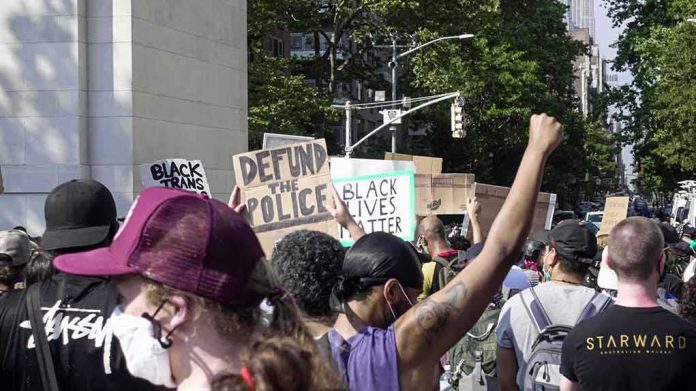
The chain of events started after a Madison police officer shot and killed 38-year-old Corey Ruiz near the intersection of Williamson Street and South Baldwin Street, a busy mixed-use corridor on the city’s near east side. Protesters aligned with Black Lives Matter and far-left groups quickly moved in and did not just hold signs on the sidewalk. They seized control of roughly two city blocks and declared it the “Corey Ruiz Autonomous Zone,” or CRAZ, echoing the Capitol Hill Autonomous Zone in Seattle.
Organizers and supporters framed the encampment as a memorial and a stand against what they call police brutality. But on the ground, this was not a simple vigil. Barricades went up. Protesters used trash cans, wooden pallets, tires, and boards embedded with nails to block the intersection and surrounding streets. Local reporting described tire strips and nail-studded boards forming an outer ring a block in each direction, with a camper parked in the street to anchor the barrier.
Inside the “Corey Ruiz Autonomous Zone” perimeter
Journalists on scene described a perimeter that looked less like a peaceful gathering and more like a makeshift stronghold. One Milwaukee Journal Sentinel reporter posted photos of boards lined with nails laid across entry points with a sign that read, “Protests can be inconvenient. Murder is worse.” Another account described “tire-strips with nails sticking upwards” creating a spiked belt around the zone, intended to stop vehicles and discourage anyone from simply walking in uninvited.
These are not symbolic props. Boards studded with nails and homemade tire spikes are tools designed to puncture tires and, if someone trips, flesh. From a common-sense conservative perspective, once an encampment arms its perimeter with potential weapons and intentionally blocks public streets, it crosses a line. That is no longer just protest; that is asserting control over territory that belongs to every taxpayer, not to whichever activist group shows up first with lumber and hardware.
What the city is doing — and why critics say that is the real scandal
The most explosive part of this story is not only what protesters built, but what city officials chose to do in response. Instead of quickly clearing the barricades, Madison closed the streets to vehicle traffic “until further notice,” explicitly citing the “ongoing public gathering within the intersection.” The city then began layering its own infrastructure on top of the activists’ blockade. Officials brought in trash collection and portable toilets for people inside the zone.
City salt and trash-spreader trucks, paid for by taxpayers, were driven into place to reinforce the barricades and block off streets, replacing some of the seized trash cans and pallets protesters originally used. The New York Post summarized it bluntly: the city of Madison was “assisting the demonstrators by supplying portable restrooms and other amenities.” Critics did not have to stretch to see a pattern; the encampment looked less like a tolerated protest and more like a city-serviced pop-up fortress.
Residents trapped, businesses strangled, and safety on the line
People who live and work inside and around the zone describe a very different reality than the activist slogans. Local coverage reported that residents and business owners felt “trapped” and frustrated as the closure made it hard to reach homes, operate shops, or move freely through their own neighborhood. Some accounts on social media described harassment when residents tried to come and go, or even when they simply attempted to get food for their children.
Agitators in Madison Use Boards With Nails to Defend Their BLM Encampment, and the City Is Helping – Twitchy https://t.co/MqMXKIWQsb
— Not Enough Dogs (@DogsEnough) July 31, 2026
Those are not small annoyances. For a café or small shop, a week or two of blocked traffic during peak season can be the difference between staying open and closing for good. For a parent, wondering if an ambulance can get through nail boards and parked trucks in time during an emergency is not a “political” question; it is basic public safety. When local government appears more focused on appeasing activists than protecting these people, it violates the first duty of any city: keep streets open, safe, and governed by law, not by whoever yells the loudest.
A familiar pattern of “managing” protest that looks like enabling occupation
Madison’s leaders defend some of these steps as public health and safety measures — a way to avoid violent clashes while managing traffic, sanitation, and emergency access around a tense protest site. That playbook has become common since 2020: leave the encampment in place, provide bathrooms and trash pickup, reroute vehicles, and hope it all winds down. On paper, that sounds like de-escalation. On the street, it can look like city-backed occupation.
From a conservative, law-and-order point of view, the deeper concern is precedent. When a city rewards the tactic of seizing public space — even in the name of a cause — it teaches activists that taking over streets works. The message to regular citizens is the opposite: your right to drive to work, open your store, or call 911 is negotiable, but only if you are not part of the right political crowd. A healthy civic order cannot survive many lessons like that.
Sources:
youtube.com, legalinsurrection.com, cityofmadison.com, campushistory.wisc.edu, zerohedge.com, facebook.com