
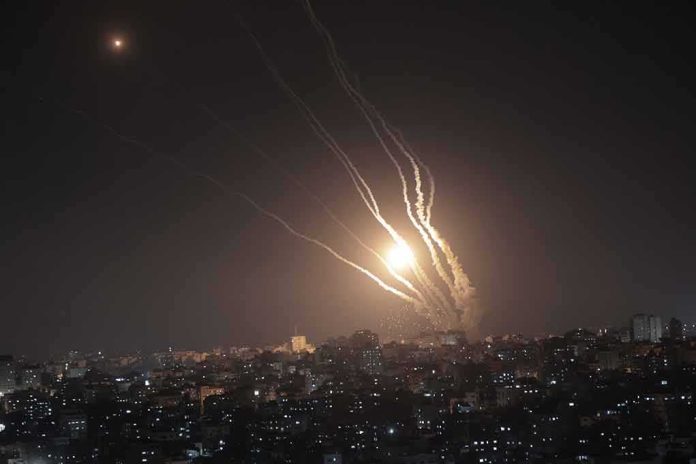
Yemen’s Houthi rebels say they hit “sensitive sites” deep inside Saudi Arabia’s capital, but Saudi officials say their air defenses shot the missile down before it ever got there.
Story Snapshot
- Houthi spokesman Yahya Saree claimed “two successful military operations” hit Riyadh and the port city of Yanbu on September 19, 2026.
- Saudi-led coalition spokesman Turki al-Maliki said air defenses intercepted and destroyed a ballistic missile before it reached the capital.
- Witnesses saw smoke and flames near Riyadh’s King Khalid International Airport, but officials reported no casualties or damage.
- The clash is the latest round in a years-long pattern where Houthi success claims and Saudi interception claims can’t both be fully verified.
Competing Claims Emerge Within Hours
Houthi military spokesman Yahya Saree announced the group had carried out strikes on “sensitive sites” in Riyadh using missiles, cruise missiles, and drones. Hours later, Saudi-led coalition spokesman Turki al-Maliki gave a different account. He said Saudi forces intercepted and destroyed a ballistic missile aimed at Riyadh at dawn, before it could reach the city.
Smoke Over the Airport, But No Confirmed Damage
Reuters reported flames and a large plume of smoke near Riyadh’s main airport shortly after the Houthi claim went public. Saudi civil defense sent out emergency alerts warning of a “hostile aerial threat” over the capital. Despite the visible smoke, the Associated Press reported there were no reports of casualties or damage from the incident.
That gap between dramatic visuals and an official “no damage” statement is the core tension driving confusion online. Neither side has produced independent proof, like debris analysis or verified strike footage, that would settle whether the missile hit anything at all.
Why the Details Matter
The Houthis never named a specific building or facility they hit inside Riyadh, only vague “sensitive sites”. That vagueness makes the claim hard to check. Saudi Arabia’s account is narrower but consistent across multiple statements: the missile was destroyed in the air, and no damage followed. Without site inspections or recovered fragments, outside observers cannot confirm either version with certainty.
A Pattern That Predates This Attack
This is not new territory for the Houthi-Saudi conflict. Cross-border missile and drone strikes have become a regular feature of the war rather than rare shocks. Houthi forces have hit Saudi energy sites and border cities before, and Saudi Arabia has usually claimed successful interceptions in response. The two sides rarely agree on outcomes, and the public record often can’t referee the dispute in real time.
Both Sides Have Reasons to Shade the Truth
The Houthis benefit from claiming a successful strike on Saudi Arabia’s capital, since it signals strength to allies and pressures Riyadh. Saudi Arabia benefits from insisting its defenses worked and no harm occurred, since that reassures citizens and investors. Each side’s incentive to spin the story means readers should treat both claims with some caution until independent evidence surfaces.
What is clear: Saudi officials confirmed an actual attack attempt happened, not just a rhetorical claim. Emergency sirens sounded, smoke rose near a major airport, and a foreign government fired a weapon at a capital city. Whether that weapon struck its target remains unresolved. For now, the incident adds another flashpoint to a regional conflict that keeps testing how far both sides will push before a real crisis follows.
Sources:
middleeasteye.net, aljazeera.com, timesofindia.indiatimes.com, washingtonpost.com, jpost.com, euronews.com