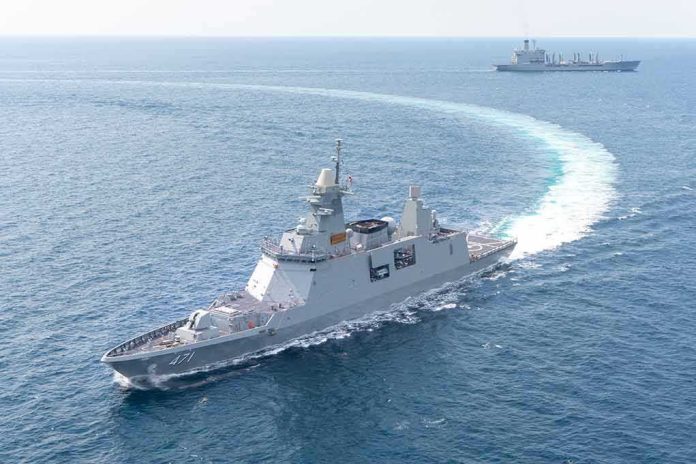
For four days in late July, a front-line U.S. destroyer drifted without power, air conditioning, or toilets in the South China Sea while its crew sweated through triple-digit heat, then got towed to port for repairs.
Story Snapshot
- Navy says USS Benfold lost power on July 24 due to a generator failure; no injuries reported.
- Crew endured four days without air conditioning, toilets, galley services, and likely limited water.
- Tow to Subic Bay began July 28; power restored July 30; repairs finished August 7; departure August 8.
- Incident highlights broader Navy maintenance strains documented by federal watchdogs.
What Happened Aboard USS Benfold
U.S. Seventh Fleet said the guided missile destroyer USS Benfold lost power on July 24 while operating in the Indo-Pacific. The Navy described an “engineering casualty” involving the ship’s generators, which killed propulsion and key services. The spokesperson said the crew had no air conditioning, no toilets, and no galley during the outage. The Navy reported no injuries and praised the crew’s response and discipline under stress. Benfold was operating near the USS George Washington Carrier Strike Group at the time.
Reporting places the tow to Subic Bay, Philippines, on July 28, with arrival soon after for repair support. Power was restored by July 30. Repairs wrapped up August 7, and the destroyer departed Subic Bay on August 8. Coverage credits the Ship Repair Facility, Japan Regional Maintenance Center, for the work. Later reports say the ship returned to duty and reached Yokosuka, Japan, resuming operations after checks and fixes were complete.
How The Crew Coped In Extreme Heat
Navy officials said essential services failed alongside propulsion. Without power, the crew lost air conditioning, toilets, and hot food preparation. Secondary reporting says potable water was also affected, forcing strict rationing and basic hygiene steps in sweltering conditions. Temperatures on metal decks can soar well above outside air readings, turning living spaces into ovens. The Navy emphasized there were no injuries, reflecting practiced damage-control habits and training that kept order through the blackout.
The four-day timeline suggests sailors prioritized safety, cooling when possible, and sanitation workarounds while awaiting tow. Crews train to handle “loss of ship service” events that hit many systems at once. Standard actions include securing nonessential loads, guarding heat stress, and protecting food stores. The absence of propulsion also raises watchstanding demands, as the ship must manage drift while keeping communications and navigation solutions available through backups until assistance arrives.
Why A Single Failure Matters For Readiness
A destroyer losing power far from home matters because it shows how one breakdown can sideline a billion-dollar asset and 300 sailors. The Congressional Budget Office has documented chronic delays and labor overruns in ship maintenance, which reduce the time ships spend ready for missions. These problems hit destroyers hardest, with a large share of service life lost to yard time and deferred work. Each unexpected casualty adds load to an already stretched repair pipeline.
The Government Accountability Office has likewise reported persistent sustainment challenges across multiple ship classes, with rising casualty reports and cannibalization of parts. Those findings align with the Benfold episode’s core lesson: when reliability slips, crews carry the burden at sea, and commanders lose options. The South China Sea is a tense neighborhood, so every day a ship sits dead in the water is a day of risk and lost deterrence value, even when no adversary is directly involved.
What We Know, And What Comes Next
Public reporting locks in the key dates: power loss on July 24, tow on July 28, power back on July 30, repairs complete August 7, and departure on August 8. The Navy said no one was hurt and credited the crew. The service has not published a technical root-cause report that explains the exact failure mode beyond “generators.” That is common early on. The pattern of dates still shows a focused repair push that returned the ship to operations within about two weeks at Subic Bay.
U.S. Destroyer USS Benfold Stranded in South China Sea for 4 Days Due to Power Outage — The U.S. Seventh Fleet confirmed the incident. pic.twitter.com/r49gaHOTSa
— Far East Post (@FarEastPos3t) August 18, 2026
The larger question is policy, not blame. Americans across the spectrum worry that government institutions talk big but fail at basics. A warship without power in key waters hits that nerve. Conservatives see evidence of aging gear and thin parts supply. Liberals see overtasked crews and a system that squeezes workers while protecting top brass. Both can agree on this: reliable ships, trained sailors, and honest maintenance budgets are not optional; they are the floor for national defense.
Sources:
zerohedge.com, opex360.com, reddit.com, rand.org, ideas.repec.org, gao.gov, stripes.com