
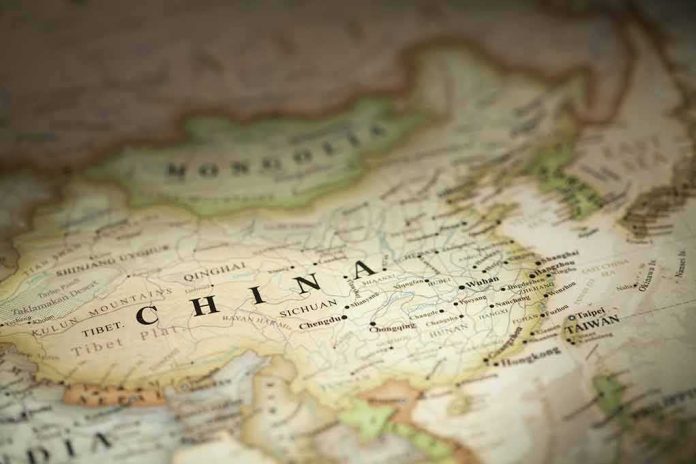
When Taiwan’s president warns of Beijing’s new “red terror” law reaching across borders, he is really spotlighting how far modern governments will go to control people far beyond their own shores.
Story Snapshot
- Taiwan’s President Lai Ching-te told his ruling party that China’s new ethnic unity law is a tool for “red terror” and long‑arm legal control.
- Lai reaffirmed that **Taiwan is already a sovereign nation** called the Republic of China and is **not subordinate** to the People’s Republic of China.
- Beijing insists Taiwan is part of China and has attacked Lai’s sovereignty claims as “heresy” and “provocation.”
- The dispute shows how powerful states use law, propaganda, and fear to tighten control — a concern many Americans already share about their own government.
Lai’s Warning About Beijing’s ‘Red Terror’
At the annual meeting of Taiwan’s Democratic Progressive Party, President Lai Ching-te urged party members to unite against what he called Beijing’s “red terror.” He said Taiwan must defend its democracy and “never become part of China,” framing the issue as a fight for basic freedom, not just a border dispute. Lai argued that China’s leaders are using fear, pressure, and new laws to push Taiwan into accepting rule from Beijing. For many in Taiwan, that sounds less like diplomacy and more like coercion dressed up as legal language.
Lai focused much of his speech on China’s new Law on Promoting Ethnic Unity and Progress, which took effect in China on July 1. The law orders all citizens to support “national unification” and to embrace a single, state‑approved Chinese identity. It also says people and groups, inside and outside China, can be held legally responsible if they “harm ethnic unity” or “promote ethnic division,” but it never clearly defines what those broad phrases mean. That vagueness is exactly what alarms Taiwan’s leaders and human rights groups, who see wide room for abuse.
A New Tool For Long‑Arm Legal Control
Lai called the ethnic unity law a weapon of “legal warfare,” warning it could justify cross‑border actions against people Beijing dislikes. Taiwan’s Foreign Ministry has also said the law is an attempt to use domestic Chinese legislation to reach across borders and punish people in Taiwan and other countries. One article in the law even states that organizations and individuals outside China may be held legally liable for actions Beijing says damage ethnic unity. It does not spell out what penalties might be used or how they would be enforced, which only deepens fears of political prosecutions and travel risks for critics of the Chinese Communist Party.
Rights group Amnesty International has warned that the same law pushes ethnic groups to adopt a single national identity dominated by Han Chinese culture, the majority group in China. For Taiwan, that matters because one provision tells Chinese officials to expand exchanges with Taiwan and to strengthen Taiwanese people’s “sense of belonging” to the Chinese nation. In plain terms, Beijing is now writing into law a plan to convince or pressure Taiwanese to see themselves as simply another part of China. Lai argues that this is not just about words — it opens the door for China to label pro‑Taiwan voices as threats to “ethnic unity” and to target them accordingly.
Competing Claims About Who Owns Taiwan
Lai’s tough language builds on earlier speeches where he declared that Taiwan is “of course” a sovereign country. In his inaugural and National Day addresses, he stated that the Republic of China, Taiwan’s official name, and the People’s Republic of China “are not subordinate to each other” and that Beijing “has no right to represent Taiwan.” He has promised to “resist annexation or encroachment” on Taiwan’s sovereignty, signaling that his government sees Taiwan and mainland China as two separate states, each with its own people, government, and territory.
Beijing’s leaders tell a very different story. The Chinese government insists that Taiwan is an inalienable part of China and repeats a “one China” principle that claims there is only one China and that the People’s Republic of China is the only legal government representing all Chinese people. After Lai’s sovereignty remarks, Chinese officials accused him of spreading “heresy,” called his speech confrontational and provocative, and vowed that nothing he says can change what they call “historical and legal fact” about Taiwan’s status. This clash of narratives is not just academic; it shapes military plans, trade decisions, and how other countries respond in the region.
Why Americans Should Pay Attention
For many Americans on both the right and the left, stories like this feel uncomfortably familiar. In China’s ethnic unity law, they see another example of elites using vague legal language to extend control over speech, belief, and identity — not just at home, but abroad. Lai’s “red terror” warning echoes worries in the United States that powerful governments and global institutions use laws, regulations, and surveillance to punish dissent, shape culture, and silence people who step out of line. When a foreign law claims authority over people on other soil, it sounds a lot like the kind of overreach many citizens already fear from their own federal agencies.
The fight over Taiwan’s status also exposes how big powers treat sovereignty as something flexible when it serves their goals. Beijing says its own legal and historical claims settle the matter forever. Taiwan’s elected leaders say only the people of Taiwan can decide their future, and they point to their functioning democracy as proof of real independence. In between stand other countries, including the United States, that rely on Taiwan for trade and technology while trying not to trigger a wider war. For American readers frustrated with both parties in Washington, the Taiwan dispute is a reminder that ordinary people often end up caught between rival elites, each claiming to defend “unity” or “freedom” while gathering more power for themselves.
Sources:
youtube.com, taipeitimes.com, reuters.com, english.president.gov.tw, globaltaiwan.org, english.news.cn, us.china-embassy.gov.cn, en.people.cn, usali.org