
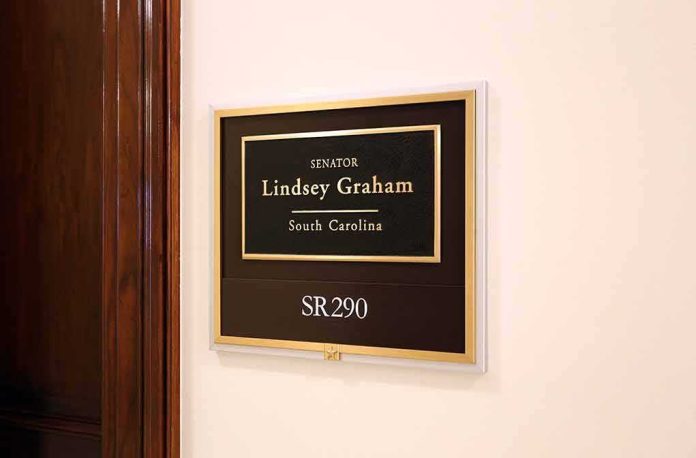
Lindsey Graham turned an old political fight into a fresh one by openly backing a national abortion limit and defending Ukraine at the same time.
Quick Take
- Graham said abortion is not a states’ rights issue and backed a federal minimum standard.
- He said he would keep pushing for a 15-week abortion limit with narrow exceptions.
- His office said he opposed late-term abortion before and after the Supreme Court’s Dobbs ruling.
- The provided record also says Graham had been a longtime supporter of Ukraine.
Abortion Fight Reopens Inside the Republican Party
Graham’s abortion stance was not subtle. In a Senate statement, he rejected President Trump’s states-rights view and said he would keep pushing for “a national minimum standard limiting abortion at fifteen weeks.” He also said the pro-life movement is about “the wellbeing of the unborn child — not geography,” which placed him squarely against the idea that each state should handle the issue alone.
That position matched his earlier public record. In 2022, Graham introduced a Senate bill to ban most abortions after 15 weeks, and reporting at the time said the measure was meant to unify Republicans after the Supreme Court overturned Roe v. Wade. He later told reporters that he opposed late-term abortion before Dobbs and still opposed it after the ruling, arguing that federal action remained possible.
Why Graham’s Position Matters
Graham’s comments mattered because they exposed a split that runs through modern abortion politics. Some Republicans treat Dobbs as a reason to leave the issue to the states. Graham argued the opposite and said federal limits still made sense. That disagreement is not just legal. It also shows how abortion remains one of the clearest tests of whether a politician is driven by principle, party pressure, or both.
The record supplied here shows a consistent pattern on abortion, even if the politics around it changed. Graham had backed national restrictions for years, including earlier anti-abortion bills, and he continued to describe his own approach as a moral one tied to unborn life and pain. His critics saw a harder line, but the documents provided do not show him backing away from the basic goal of a federal limit.
Ukraine and the Image of a Hawkish Senator
The Ukraine part of the story is thinner in the supplied material, but the broader record still matters. The research package describes Graham as one of Ukraine’s most vocal supporters in Washington, and it notes that Russia issued an arrest warrant after his comments during a trip to Kyiv. That history fits the same political image: Graham as a senator willing to take hard public stands and absorb the backlash that comes with them.
Lindsey Graham was a highly influential and often polarising senator. Supporters saw him as someone who defended his principles on issues like support for Ukraine and anti-abortion policies, while critics strongly disagreed with many of his positions. Thune's remarks reflect the…
— AJ umoh (@aj_umoh) July 28, 2026
That style has long made Graham a useful ally and a regular target. Supporters view him as a politician who says what he believes and keeps pushing even when the party shifts around him. Critics on the left and right often read the same behavior as proof of a larger system where power, reputation, and message control matter more than ordinary voters. On the facts provided, Graham did speak up clearly, and he did so in a way that reopened two of the country’s most charged fights.
Sources:
facebook.com, lgraham.senate.gov, judiciary.senate.gov, thehill.com, nbcnews.com, politico.com, youtube.com, nypost.com, npr.org, americanprogress.org, bbc.com