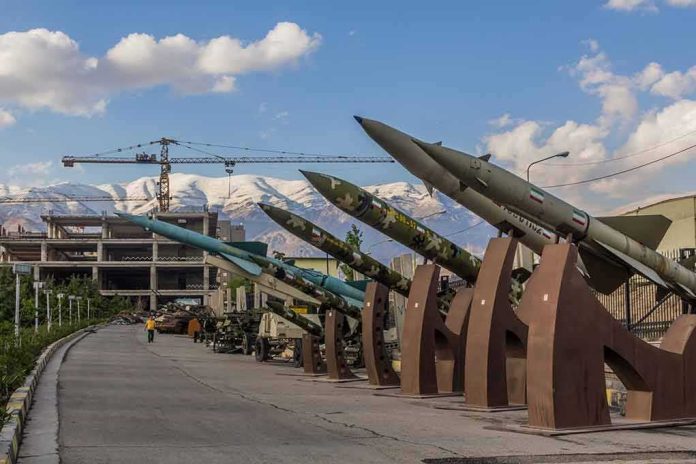
When a treaty collapses, technology rushes into the vacuum. The Intermediate-Range Nuclear Forces (INF) Treaty kept ground-launched missiles between 500 and 5,500 kilometers off the battlefield for a generation; once Washington judged Moscow in material breach and withdrew, the United States moved quickly to rebuild a capability it had deliberately given up—and the Army’s Typhon mid-range system is the result.
The Short Version
- The United States assessed Russia violated the INF Treaty by developing and fielding the 9M729 (SSC-8) cruise missile; NATO allies backed that judgment, and the U.S. withdrew in 2019 under Article XV.
- Russia denied any violation, claiming the 9M729 stayed under the 500-kilometer limit and accusing the U.S. of other treaty breaches; it never provided evidence that satisfied allies.
- Freed from INF constraints, the U.S. Army fielded Typhon, a mobile ground launcher for Tomahawk and SM-6 missiles, restoring land-based strikes in the 500–1,600+ km envelope.
- Typhon changes theater calculus: it plugs a critical range gap in Army fires, complements naval and air power, and reopens political debates about basing and escalation across Europe and the Indo-Pacific.
What the INF Treaty Banned—and Why It Unraveled
Signed in 1987 by Ronald Reagan and Mikhail Gorbachev, the INF Treaty eliminated and permanently banned all ground-launched ballistic and cruise missiles with ranges between 500 and 5,500 kilometers. Verification was unusually intrusive by Cold War standards, and by 1991 both sides had destroyed 2,692 missiles. Arms control, however, is a living regime, not a time capsule; it succeeds only while incentives and verification hold. From 2014 onward, the U.S. concluded Russia had developed and fielded a noncompliant ground-launched cruise missile, identified publicly as the 9M729 (NATO: SSC-8), and spent years pressing Moscow to return to compliance. NATO ultimately aligned with Washington’s assessment; restoration proved elusive. In February 2019, the United States suspended its obligations and formally noticed withdrawal per Article XV; the exit took effect that August on the grounds of Russia’s continuing violation.
Russia rejected the charge at every turn, contending the 9M729 stayed within the treaty’s 500-kilometer ceiling and had never been tested to prohibited ranges. Moscow even staged a public display of the missile and asserted technical constraints kept it compliant. Those statements, however, were not accompanied by verifiable data or inspections that could persuade skeptical counterparts; NATO recorded “no credible response or demonstrable steps toward compliance.” Denial without transparency is not confidence-building; arms control cannot run on trust alone.
How the United States Responded: From Treaty Exit to Typhon
Strategically, once a class of weapons is unconstrained for an adversary, the question becomes whether to rebuild the capability or accept permanent asymmetry. Washington chose to rebuild—prudently, by repurposing mature naval missiles on land rather than pursuing exotic clean-sheet designs. The Army’s Mid-Range Capability (MRC), commonly called Typhon, anchors this approach. Typhon is a mobile battery that adapts the Navy’s Mk 41 launcher architecture and Aegis-derived fire-control for ground use, firing two proven munitions: the Tomahawk land-attack cruise missile for deep, precise strikes beyond 1,000 kilometers, and the multi-mission SM-6 for fast, versatile engagements out to several hundred kilometers, including anti-ship roles. In the Army’s long-range precision fires portfolio, Typhon deliberately bridges the range gap between the Precision Strike Missile and the Long-Range Hypersonic Weapon. That gap—exposed by the INF’s demise—is where many critical targets live.
Mechanically, the choice to field Navy missiles ashore buys time and credibility. It trims technical risk, leverages existing production lines, and shortens fielding cycles; initial capability arrived within a few years of withdrawal, not a decade. Operationally, Typhon complicates adversary planning: mobile, concealed on trucks, and capable of salvo fires, it forces an opponent to allocate intelligence, surveillance, and air/missile-defense resources across a wider set of launch points. Strategically, it breaks a longstanding assumption—that long-range conventional land attack would come only from ships, submarines, or aircraft—thus thickening deterrence by presenting more axes of approach for precision strikes.
The Dispute Over Russia’s 9M729: What Each Side Argued
The center of gravity in the compliance dispute is the 9M729. The U.S. intelligence community and the State Department argued that Russia both tested and deployed a ground-launched cruise missile of prohibited range, and that Moscow then obfuscated—denying the missile’s existence, later acknowledging it, but still refusing steps needed to restore confidence. NATO allies publicly concurred that Russia had developed and fielded a violating system. This is not the usual fog of rumor; it reflects allied alignment after years of bilateral engagements.
Moscow’s case was consistent but thin: it insisted the missile’s range did not exceed 500 kilometers, that tests were compliant, and that technical features constrained performance. It coupled those claims with counter-accusations—most notably that U.S. missile-defense systems in Europe were themselves treaty-breaching. Without independent verification or access that could falsify or confirm these assertions, the Russian narrative failed to shift allied views. In the politics of arms control, denials unmoored from reciprocal transparency rarely survive.
What Typhon Means for Modern Deterrence
Typhon’s significance is not that it revives a Cold War template; it is that it integrates land-based fires into a 21st-century, multi-domain deterrence architecture. In Europe, the range class once banned by INF can hold at risk air bases, command-and-control nodes, logistics hubs, and maritime choke points from dispersed, survivable launchers on allied soil. In the Indo-Pacific, where maritime geography and anti-access/area-denial tactics dominate, a road-mobile launcher firing Tomahawk and SM-6 extends the reach and resilience of allied strike networks, complicating adversary efforts to concentrate naval power uncontested. These are classic competitive dynamics: restore a denied capability, force the other side to defend more targets, and raise the costs of coercion.
The caveat is political, not technical. Basing decisions reignite public debates reminiscent of the 1980s—host-nation consent, escalation risk, and the tradeoffs between forward deterrence and becoming a target. The difference now is the conventional focus: the United States and allies emphasize non-nuclear payloads and mission sets, which lowers the escalatory ladder’s first rung even as it sharpens conventional options. Still, escalation management depends on doctrine, signaling, and alliance unity as much as on hardware. Capabilities shape choices; they do not dictate them.
The Larger Lesson for Arms Control
The INF’s end was not a bolt from the blue; it reflected a broader pattern in which verification regimes atrophy, geopolitical incentives change, and technical ambiguity becomes a refuge for noncompliance claims. Public disputes rarely culminate in a neat technical adjudication; they end politically, when accumulated evidence convinces allies that confidence cannot be restored. That is what happened here. The United States withdrew through the treaty’s mechanism, then rebuilt the capability it had forsworn, using mature components to move fast and restore deterrence in a contested range band. The next arms-control agenda will have to reckon with this reality: any durable limits will require verifiable transparency on dual-capable, multi-domain systems and the political will to enforce consequences when trust is broken.
Sources:
19fortyfive.com, 2017-2021.state.gov, war.gov, commonslibrary.parliament.uk, voanews.com, reuters.com, bbc.com, seapowermagazine.org, battlepolicy.com