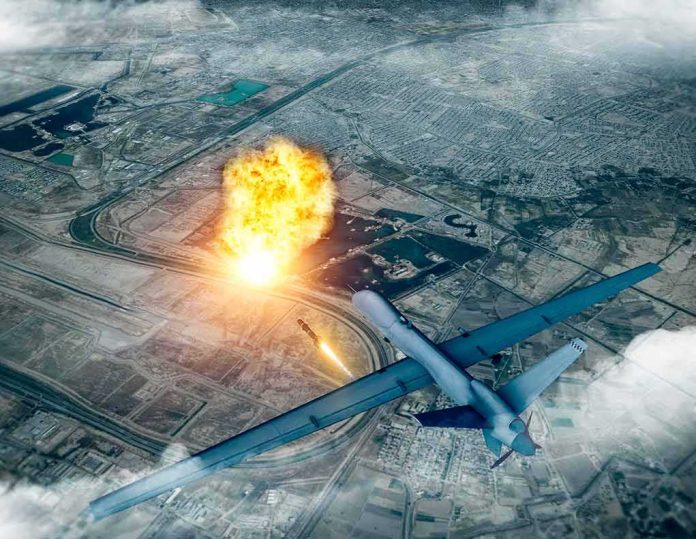
Ukraine’s drone campaign has now reached deep into Russia’s oil network, but the claim that every one of the country’s eleven biggest refineries was hit is stronger than the public record fully proves.
Quick Take
- Reuters, the British Broadcasting Corporation, and other outlets have reported strikes or fires at many major Russian refineries, including Moscow, Omsk, Saratov, Syzran, Ilsky, Yaroslavl, Bashkortostan-area plants, and Tatarstan facilities.
- Reuters reported that refinery attacks doubled since the start of 2026 and helped cut gasoline, diesel, and jet fuel output.
- BBC Verify said 21 of Russia’s 38 large refineries had been hit since January, with at least 10 forced to halt or scale back operations.
- Russian officials have often said drones were intercepted or that fires came from debris, which keeps the damage question contested.
What the reporting does show
The strongest part of the story is not a single blast. It is the pattern. Reuters, the Associated Press, the British Broadcasting Corporation, and CNBC have all described repeated long-range Ukrainian strikes on named Russian refineries, with fires, shutdowns, or partial outages following some of them. That reporting makes clear that Russia’s fuel system has been under sustained pressure, not hit only once or twice.
Several incidents were large enough to affect daily life inside Russia. Reuters reported that attacks on refineries had doubled since the start of 2026 and were linked to lower output of gasoline, diesel, and jet fuel. The British Broadcasting Corporation said the wave of strikes has contributed to shortages and price rises, while the Associated Press reported that President Vladimir Putin acknowledged a “certain deficit” of fuel.
Where the evidence is strongest and where it is thinner
The claim that all eleven of Russia’s biggest refineries have been hit is not directly confirmed by the provided sources. Some outlets and research groups say Ukraine has struck all of the top eleven, but the materials here do not provide a complete refinery-by-refinery checklist with independent confirmation for each plant. Reuters and BBC reporting support a broad campaign against major refineries, yet that is not the same as a fully verified ledger.
That gap matters because wartime claims are often tangled. Russian officials frequently say they intercepted drones or that debris caused the fire, while Ukrainian officials say the strikes were successful. Reuters has also noted that it often relies on official statements, social media, and its own calculations because direct access is limited. In plain terms, the fires and shutdowns are real enough to report, but the full scale of damage is still hard to measure.
What this means for Russia’s fuel system
Even with that caution, the campaign appears to be hurting Russia’s refining sector. Reuters reported in May that the combined capacity of refineries fully or partly halted after strikes was more than 83 million metric tons a year, or about one quarter of total refining capacity. BBC Verify later said at least 10 refineries had fully or partly suspended operations since August. Those figures point to serious disruption, even if they do not prove permanent destruction.
🚨🇺🇦🇷🇺 UKRAINE STRIKES DEEP INSIDE RUSSIA
Russia’s Orsknefteorgsintez oil refinery in Orsk was reportedly hit by a Ukrainian long-range drone strike, with a fire breaking out at the facility afterward.The refinery sits roughly 1,400 km (870 miles) from Ukraine, underscoring… pic.twitter.com/AwLSTyIyVd
— Mossad Commentary (@MOSSADil) August 11, 2026
That is why the political meaning of the campaign reaches beyond the battlefield. Oil refining helps fund the Russian war effort, so every outage can ripple into fuel supply, prices, logistics, and public pressure. At the same time, the reporting also shows a familiar wartime pattern: one side claims success, the other claims interception, and outside observers try to piece together the truth from smoke, satellite images, and partial official statements.
Sources:
19fortyfive.com, nbcnews.com, reuters.com, apnews.com, themoscowtimes.com, bbc.com, carnegieendowment.org, dw.com