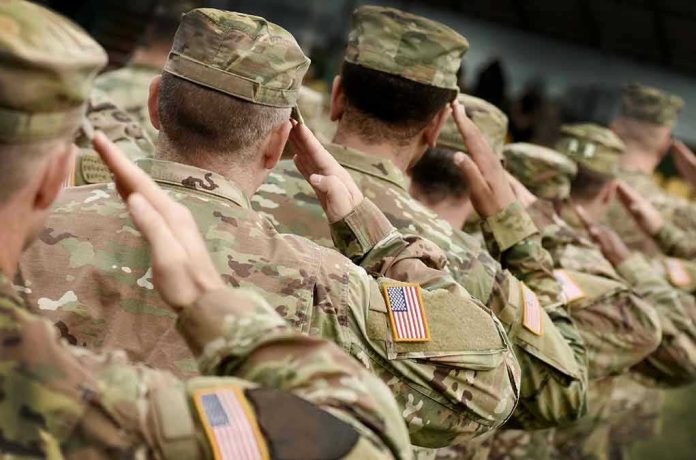
Trump’s decision to pull 5,000 U.S. troops out of Germany turns America’s NATO security guarantee into fresh leverage—right as war tensions and alliance politics collide.
Quick Take
- The Pentagon confirmed about 5,000 U.S. troops will leave Germany over the next 6–12 months after a force posture review.
- The move follows a public dispute between President Trump and German Chancellor Friedrich Merz tied to NATO support during the U.S.-Iran war.
- Officials described the drawdown as one brigade-sized element, with at least one long-range fires battalion reassigned; Landstuhl’s medical mission is not expected to be hit.
- Supporters call it overdue burden-sharing pressure; critics warn it strains NATO cohesion and complicates Europe-and-Middle East logistics routed through Germany.
Pentagon confirms a 6–12 month drawdown tied to “theater requirements”
Pentagon spokesman Sean Parnell said the U.S. will withdraw roughly 5,000 troops from Germany over the next six to twelve months, framing the move as the outcome of a broader force posture review and “theater requirements.” Reports describe the reduction as roughly brigade-sized, a meaningful cut but still a fraction of the total U.S. footprint in Germany—often cited at roughly 36,000 to 38,000 personnel across multiple bases and commands.
Germany has been the central U.S. hub in Europe since World War II, and it remains a key platform for command-and-control and logistics. Ramstein Air Base and nearby facilities support movements into Europe and the Middle East, while Landstuhl Regional Medical Center has long served as a critical treatment and transfer point for wounded service members. Multiple reports stressed Landstuhl would not be significantly impacted by this planned reduction, though unit-level details remain limited.
The Trump–Merz feud brings alliance burden-sharing back to the forefront
The withdrawal lands in the middle of a political dispute between Trump and Merz that escalated over several days. Merz publicly criticized the U.S. approach to the Iran conflict, and Trump responded on social media with sharp attacks on Merz and Germany, including accusations tied to Iran’s nuclear ambitions. In that context, troop levels become more than force planning; they become negotiating leverage, especially when allies hesitate to join a U.S.-led campaign.
This tactic fits a pattern voters have watched for years: Washington using overseas deployments to signal that U.S. protection is not an unlimited entitlement. Conservatives who have long argued that allies “free-ride” on American defense spending will see an attempt to align commitments with tangible support. At the same time, the reporting does not show a formal NATO policy shift or an imminent U.S. exit; a 2023 law requiring congressional approval for leaving NATO still constrains unilateral action.
Operational effects: one brigade out, but Germany remains a major hub
Operationally, the immediate impact appears contained. Reporting indicates the drawdown equals about 14% of the U.S. personnel in Germany, and some defense officials suggested the European security effect could be limited because European states have increased defense investment since Russia’s invasion of Ukraine. Still, any removal of ready forces can matter in a crisis, and the timeline—six to twelve months—suggests planners aim to avoid abrupt disruption.
Where the move could bite is logistics and contingency planning. Even if Ramstein and core headquarters functions remain, fewer troops can mean fewer enablers for surge scenarios, training, and rapid reinforcement. Some reports also indicate certain forces may return stateside and later redeploy to other priorities, including the Indo-Pacific. That potential reallocation aligns with a long-running U.S. debate: whether Europe’s defense posture should remain America’s main burden.
Political and economic ripple effects on both sides of the Atlantic
On the German side, fewer U.S. troops can translate into fewer local jobs and less revenue in communities built around bases—an issue that rarely makes headlines until drawdowns begin. On the U.S. side, troop moves affect families, schools, and stability for service members asked to relocate on a short planning runway. Those human costs are real regardless of party, and they often get lost in high-level arguments over strategy and alliance messaging.
Politically, the episode highlights a frustration shared across the electorate: major national-security choices are increasingly made through friction between leaders, social-media escalation, and reactive messaging, rather than transparent debate about objectives and end-states. The sources available provide limited detail on the specific units beyond a brigade element and a long-range fires battalion, and they do not fully explain where every departing unit will go. That lack of clarity is likely to fuel further skepticism about whether government institutions are planning for citizens—or for headlines.
Sources:
Pentagon orders withdrawal of 5,000 U.S. troops from Germany as Trump escalates feud with Merz
Hegseth withdrawal US troops Germany