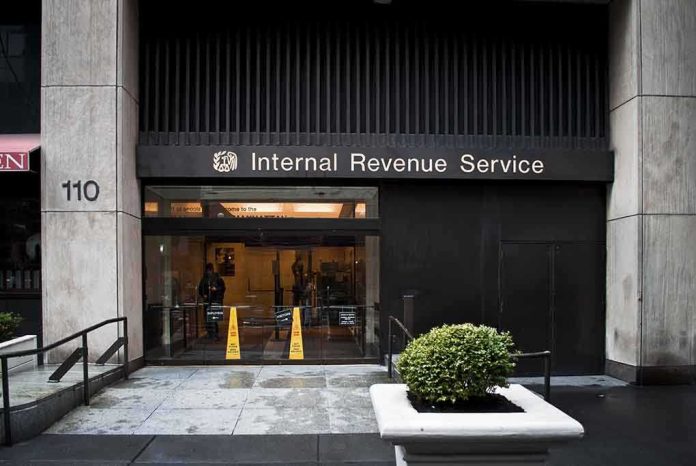
The IRS’s own watchdog says employees searched high-profile tax accounts and the agency still lacked tools to stop or quickly spot it.
Story Highlights
- Auditors flagged 86 suspicious searches tied to 30 high-profile taxpayers from 2022–2025.
- Investigators say the IRS had no system to block or auto-detect browsing of celebrities or officials.
- The IRS says it is improving logging, access controls, and data safeguards, but gaps remain.
- Past reviews show hundreds of unauthorized-access probes each year, with mixed substantiation rates.
What the Watchdog Found About High-Profile Account Lookups
The Treasury Inspector General for Tax Administration reviewed audit logs from 2022 through November 2025 and identified 86 suspicious accesses by 52 employees involving 30 high-profile taxpayers, including public officials, business leaders, and entertainers. The report says the Internal Revenue Service had no mechanism to prevent or systematically detect employee browsing of celebrity accounts during that time. The finding focuses on the Integrated Data Retrieval System, which holds sensitive tax data used by many staff to serve taxpayers.
The inspector general also reviewed how the Internal Revenue Service handled cases after suspicious access occurred. In 2025, the agency closed 122 unauthorized-access cases. Auditors found the agency properly notified 64 taxpayers in 39 of those cases, which is about one-third, suggesting many affected taxpayers did not get timely notice. The audit cites the Taxpayer Browsing Protection Act, which makes willful unauthorized access a crime. It also outlines Internal Revenue Service policy duties to report, refer, and, when needed, notify.
Why These Gaps Matter for Privacy and Trust
Tax returns hold a person’s most private financial details. When employees can search famous names without an approved need, it invites curiosity clicks and worse. The Government Accountability Office found that from fiscal years 2012 to 2021, the Internal Revenue Service completed 1,694 investigations into willful unauthorized access, and about 27 percent were substantiated as violations. That history shows repeated risk inside a large system where many workers have broad data access to help millions of filers.
People on the left and right already doubt whether powerful insiders play by the rules. A failure to block or quickly flag browsing of well-known people feeds that view. It also raises a fairness question. If the Internal Revenue Service cannot reliably protect celebrities, officials, and executives, how safe are the records of small business owners, retirees, and working families? Privacy laws carry criminal and civil penalties, but those matter most when monitoring can spot problems fast.
What the IRS Says It Is Doing Now
The Internal Revenue Service told auditors it is working to better protect federal tax information. Steps include tighter internal sharing, stronger encryption, better audit logging, limits on external storage, and more training on data protection duties. The agency’s internal manual bars employees from browsing any taxpayer account, including celebrities and politicians, without a need to know for an official task. The inspector general says progress is real but not enough to close key gaps yet.
The watchdog also reported no attempts by the Internal Revenue Service to interfere with its independent work during the latest review period. That matters because independent oversight helps keep pressure on fixes. Still, the core problem is technical and cultural. Systems must block or alert on risky searches, and managers must act on alerts. Training helps, but controls need to make the wrong click hard, and the right follow-up quick.
What Reforms Could Help Close the Holes
Clearer “high-risk” flags on the accounts of public figures could trigger extra approval before any lookup. Tighter role-based access could narrow which employees can see which data fields. Real-time alerts to the Treasury Inspector General for Tax Administration when famous names are queried could speed probes. A simple rule could also help trust: notify every affected taxpayer unless law enforcement needs a short, specific delay, and document those delays for later review.
Lawmakers should require public progress reports. The Government Accountability Office has issued hundreds of security recommendations to the Internal Revenue Service over the years, and tracking closure rates would show if risk is shrinking. Tax privacy is not a partisan issue. Both sides worry about insider abuse and selective leaks. Stronger guardrails protect political foes and friends the same way, which is the only path that keeps faith with equal justice and the rule of law.
Sources:
pjmedia.com, dailycaller.com, irs.gov, gao.gov, tigta.gov, home.treasury.gov