A rare clash between a Republican White House and an American pope is exposing how quickly foreign policy arguments can turn into culture-war fuel—while a key human-rights name, Jimmy Lai, gets left out.
Story Snapshot
- President Donald Trump criticized Pope Leo XIV in a radio interview, arguing the pontiff focuses on opposing the U.S.-Israel war with Iran instead of pressing for Jimmy Lai’s release.
- Trump also claimed the pope effectively supports Iran obtaining nuclear weapons—an assertion Catholic outlets report is inconsistent with the Church’s long-standing anti-nuclear position.
- Pope Leo responded from Castel Gandolfo by urging “truthful” criticism and reiterating the Church’s mission to preach peace and oppose nuclear weapons.
- The pope did not mention Lai in his public response, despite Lai being raised in the interview context.
Trump’s Critique Targets Iran, China, and a High-Profile Catholic Prisoner
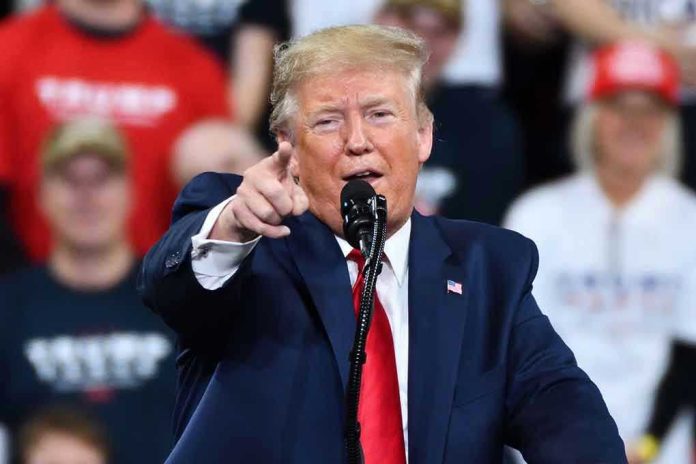
President Trump’s latest broadside at Pope Leo XIV surfaced in a Hugh Hewitt radio interview tied to two pressure points for conservative voters: war with Iran and accountability for China. Reports say Trump criticized the pope for emphasizing opposition to the U.S.-Israel conflict with Iran while, in Trump’s telling, failing to advocate loudly for Jimmy Lai, the imprisoned Hong Kong Catholic pro-democracy figure. Trump has said he plans to raise Lai’s case during a China trip.
The most consequential detail is Trump’s allegation that Pope Leo would rather talk about Iran “having a nuclear weapon,” and that this posture “endangering” Catholics. Catholic coverage characterizes that as a false framing of the pope’s position, because the Vatican’s public doctrine has repeatedly opposed nuclear weapons in general. That dispute matters politically because it turns a theological principle into a national-security talking point—one that can harden partisan lines heading into a busy election cycle.
Pope Leo’s Reply: “Criticize… Truthfully,” Preach Peace, Reject Nukes
Pope Leo responded on May 5 while leaving Castel Gandolfo, speaking in measured language rather than trading barbs. Accounts of his remarks emphasize three themes: the Church’s “mission” to proclaim the Gospel, the call to preach peace, and a request that critics speak truthfully. He also reaffirmed that the Church opposes all nuclear weapons. The response avoided engaging Trump’s interview claims line-by-line, signaling a preference for restating doctrine over debating personalities.
The omission that stood out was what the pope did not say. Despite Lai being central to the interview’s framing—Hewitt raised Lai, and Trump used that prompt to criticize Leo—the pope did not mention Lai publicly in this exchange. That silence will land differently across the Catholic spectrum. For many conservatives, Lai’s imprisonment under China’s national security framework symbolizes a broader fight against authoritarian censorship; for others, the Vatican’s habit is to speak universally about peace rather than highlight individual cases.
Why Jimmy Lai’s Absence Fuels Distrust of Institutions Across the Right and Left
Jimmy Lai’s case sits at the intersection of religious liberty, free speech, and geopolitical leverage. The research summary states Lai was sentenced to 20 years in 2025 and has become a symbol for lawmakers who say Beijing uses national security language to silence dissent. Pope Leo previously met Lai’s family after a 2025 audience, which makes the lack of a direct reference in his latest comments more noticeable. Still, the available reporting does not show a new papal statement on Lai as of May 5.
That gap feeds a familiar public frustration: powerful institutions often appear selective about which victims become priorities. Conservatives tend to read elite caution as moral evasiveness; many on the left interpret state power as corrupt and self-protecting. Either way, the episode highlights how global bureaucracies—governments, media ecosystems, and even major international institutions—can look more concerned with managing optics than delivering accountability. Based on the available sources, however, readers should be careful not to overreach beyond the documented fact: the pope simply did not address Lai in this specific reply.
What to Watch Next: Diplomatic Fallout and the Rubio Meeting
The near-term impact is diplomatic and domestic. The reporting notes heightened friction between Washington and the Holy See ahead of a planned meeting between Pope Leo and Secretary of State Marco Rubio on May 7, framed as an opportunity for dialogue marked by “trust and openness.” The public fight also risks turning a serious debate—war aims, deterrence, and human-rights leverage—into a proxy battle over “America First” politics versus universalist moral language.
One unresolved detail is timing: accounts differ slightly on whether the Hewitt interview was recorded May 4 and aired May 5, but the substance of the exchange appears consistent across the Catholic outlets cited. For voters, the larger takeaway is practical. The president is signaling he will confront China directly on Lai, while the pope is signaling he will stay anchored to peace-and-anti-nuclear doctrine. That split could intensify as the Iran conflict and U.S.-China negotiations evolve.
Sources:
Pope Leo asks for truth after new criticism from Trump
Trump renews attacks on Pope Leo, accuses him of endangering Catholics with Iran war opposition
Trump renews attacks on Pope Leo, accuses him of endangering Catholics