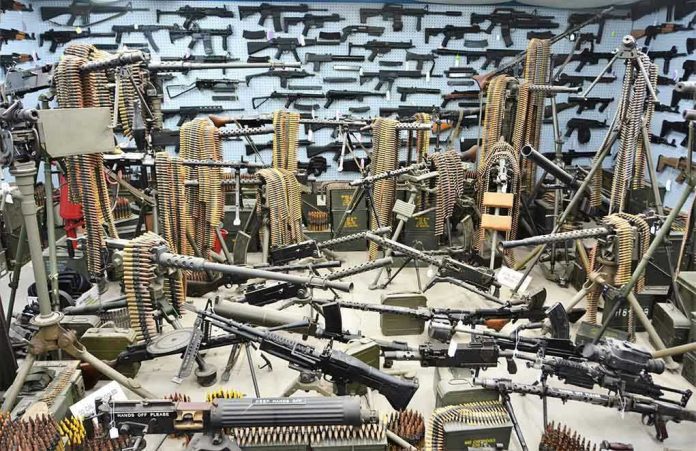
Military-grade machine guns and grenade launchers sat unguarded overnight in a California Air Force annex, exposing a glaring security lapse at a key logistics hub.
Story Highlights
- DoD Inspector General uncovered weapons stored up to one week in non-compliant Travis AFB building lacking overnight guards and intrusion detection.
- High-risk Security Risk II arms, including M249s, M2 .50 cal machine guns, and Mk 19 grenade launchers, vulnerable to theft in unmanned facility.
- Air Mobility Command vows fixes using available funds, with security review due June 26 amid interim risk measures.
- Travis AFB handles 50,000 tons of cargo yearly but lacks dedicated secure storage, forcing improvised solutions.
Security Vulnerabilities Exposed at Travis AFB
Department of Defense Inspector General officials inspected Travis Air Force Base on September 24-25, 2025, and found weapons shipments stored in an annex building failing Air Force physical security standards. The facility lacked overnight security from midnight to 7 a.m. and had no intrusion detection system. Security Risk II weapons, such as M249 Squad Automatic Weapons, M2 .50 caliber machine guns, and Mk 19 grenade launchers, remained there for 12 hours to one week. This gap at a major transit hub underscores risks to national defense assets.
Base Operations Clashed with Storage Needs
Travis Air Force Base in Fairfield, California, serves as a critical Air Mobility Command hub, processing 50,000 tons of cargo annually in 2020. As a logistics node, it handles in-transit military equipment including weapons, yet lacks a dedicated compliant storage facility. Personnel resorted to the non-secure annex due to this shortage. Air Force standards require 24/7 personnel, intrusion systems, and controlled access, all absent here. Such lapses erode trust in military readiness, a core conservative priority for strong national defense.
Official Response and Remediation Efforts
Air Mobility Command acknowledged the April 30, 2026, Management Advisory Report (DOWIG-2026-077) on May 6. The 60th Air Mobility Wing received orders to fund annex repairs and modifications. Interim risk-mitigation procedures now protect in-transit assets. AMC launched a comprehensive airfield security review, due June 26, to guide future budgets. Officials explore workarounds like added staffing or equipment. These steps address immediate threats but highlight ongoing institutional strains from resource limits.
Brig. Gen. Anthony Babcock, AMC Director of Logistics, oversees remediation strategy. Travis leadership implemented temporary measures pending permanent infrastructure. DoD IG’s independent oversight ensures accountability, though the extended exposure period raises questions about prior internal checks. Enhanced protocols could model fixes for other hubs, bolstering supply chain security vital to American military strength.
Air Force transit hub stored weapons shipments in unguarded building, IG finds https://t.co/4eQWDx8uFr
— Jeff_Schogol (@JSchogol73030) May 6, 2026
Broader Implications for Military Logistics
Short-term, remediation may delay shipments through Travis, increasing costs for staffing or gear. Long-term, facility upgrades demand capital for secure storage, intrusion systems, and maintenance, competing with defense priorities. The incident signals systemic gaps in temporary weapons handling across Air Mobility Command facilities. Political oversight looms, as Congress eyes DoD budgets amid frustrations with government inefficiencies on both sides of the aisle. Stronger compliance protects taxpayers’ investments in defense.
Sources:
Air Force vows to fix facility where weapons were improperly stored
Management Advisory: Physical Security Concerns Identified at Travis Air Force Base
DoD IG Report D2026-DEV0PC-0071 (Redacted)
Air Force Inspector General Publications