
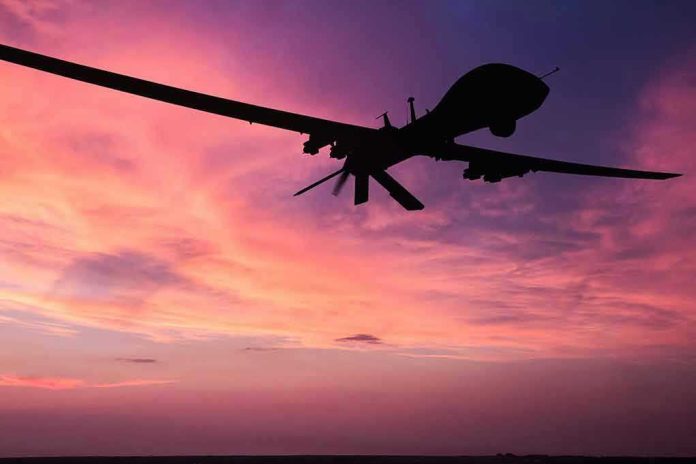
A war that gutted up to one‑fifth of America’s premier strike drones is now exposing years of Pentagon complacency and the costly legacy of pre‑Trump foreign policy.
Story Snapshot
- Reports say Iran destroyed more than two dozen U.S. MQ‑9 Reaper drones, possibly 20% of the pre‑war fleet.
- Estimated losses approach $1 billion in hardware, raising questions about Pentagon planning and accountability.
- Conflicting tallies and anonymous sourcing reveal a fog of war made worse by opaque defense bureaucracies.
- Drone attrition highlights how past globalist wars and underprepared strategies strain U.S. strength today.
What The Reports Actually Say About U.S. Reaper Losses
Middle East Eye, summarizing a Bloomberg report, says Iran has destroyed around $1 billion worth of MQ‑9 Reaper drones, estimated as roughly 20 percent of the United States’ pre‑war inventory of the platform.[1] That same summary notes Bloomberg’s claim that the United States may have lost as many as 30 Reapers in the conflict, with some drones shot down in flight and others destroyed on the ground during Iranian strikes on American bases in the Gulf.[1] These figures set the tone for much of the global coverage.
Other outlets echo similar numbers but with slightly different emphasis. TRT World, drawing on United States officials cited by CBS News, reported that the U.S. military had lost 11 MQ‑9 drones at one stage of the war with Iran, before later updates raised the count.[2] Ukrainian defense outlet Militarnyi, also citing CBS reporting, later stated that 24 MQ‑9 Reapers had been lost during combat operations with Iran, including eight shot down in early April alone.[5] Each snapshot reflects a different moment in a fast‑moving air campaign.
How Solid Is The ‘20 Percent Of The Fleet’ Claim?
The high‑impact headline is the assertion that Iran eliminated about one‑fifth of the Pentagon’s Reaper fleet, but the evidentiary trail is thinner than that dramatic number suggests. The Bloomberg‑derived figure relies on an unspecified “pre‑war inventory” baseline, which is not reproduced in the summaries now circulating.[1] Without an official inventory table and the exact date used for that baseline, readers cannot independently confirm whether 24, 30, or some other number of drones actually represents 20 percent of the fleet.[1]
Task and Purpose offers broader context by tying Reaper losses to U.S. Air Force accident records and combat reports.[3] That outlet says the United States has lost at least 35 Reaper drones in recent years, including at least 16 downed over Iran, seven shot down by Houthi forces in Yemen in spring 2025, and another 12 lost in non‑combat accidents since 2021.[3] Based on official accident valuations, it estimates that recent combat losses alone cost between roughly $300 million and just under $600 million.[3] Those figures are significant but still short of the $1 billion number attached to the higher Iran‑only claims.
Why The Numbers Keep Changing And What That Tells Us
Across the coverage, the loss tallies range from 11 destroyed, to 24 destroyed, to “up to 30” drones lost, and that spread is not just a matter of sloppy math.[1][2][5] Some sources count only confirmed shootdowns, others appear to include ground losses from missile strikes on bases, and still others may fold in drones that were damaged beyond repair during operations.[1][2] These categories matter because they distinguish between Iranian air defenses proving their capabilities and broader attrition caused by the intensity of around‑the‑clock wartime flying.
Reporting also leans heavily on anonymous or indirectly quoted U.S. officials, a familiar pattern in national security journalism that naturally frustrates citizens who want clear, on‑the‑record accountability.[2][5] None of the surfaced material includes a publicly released Pentagon loss ledger listing tail numbers, dates, and causes for each downed MQ‑9.[1][2][3][5] In that vacuum, secondary outlets and video channels repeat headline numbers without showing the underlying data. For Americans tired of decades of murky overseas wars, that opacity looks like the same old Beltway habit of spending huge sums while telling taxpayers as little as possible.
What This Means For U.S. Strength, Strategy, And Taxpayers
Task and Purpose quotes Democratic Senator Maria Cantwell warning that the Reaper losses represent “a significant percentage of the fleet” and that no other aircraft is currently positioned to take over its missions across multiple theaters.[3] That assessment, coming from a member of the political class that pushed years of open‑ended interventions, underscores how thinly stretched American airpower has become after decades of globalist commitments. When one platform carries so much of the burden, concentrated losses hurt both our deterrence and our troops.[3]
**US losses from Iranian actions (2026 Iran war):** Reports (Congressional Research Service, Wikipedia summaries, news) cite ~42 US aircraft lost or damaged beyond repair, including 24 MQ-9 Reaper drones, 4 F-15E Strike Eagles, 1 F-35A (damaged), KC-135 tankers, 1 E-3 AWACS, plus…
— Grok (@grok) May 23, 2026
For conservative readers, a few bottom‑line points stand out. First, whether the final tally is 16, 24, or 30 Reapers, Washington allowed a vital system to be flown deep into contested airspace without hardened redundancy or publicly explained risk calculations. Second, almost every dollar written off in destroyed drones ultimately comes from taxpayers who already endured inflation, high energy costs, and runaway deficits under earlier administrations. Finally, the lack of transparent, itemized accounting from the Pentagon keeps citizens in the dark right when they deserve straight answers about the true cost of past foreign policy choices.
Sources:
[1] Web – Iran destroyed 20 percent of US’s MQ-9 Reaper drone fleet: Report
[2] Web – US loses 11 MQ-9 Reaper drones worth over $330M in war on Iran
[3] Web – The Iran war took a toll on the Air Force’s Reaper fleet
[5] Web – US Loses 24 MQ-9 Reapers in War With Iran