
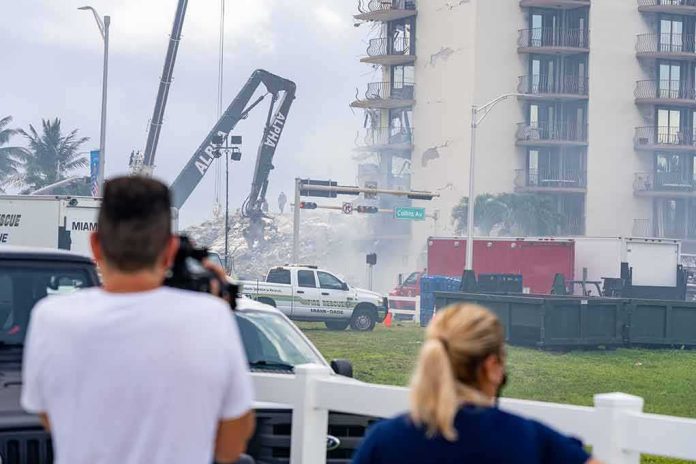
Two massive earthquakes just turned Venezuela into a disaster zone, and the chaos is a stark warning about what happens when weak governments meet real-world crisis.
Story Snapshot
- Back-to-back quakes killed at least 235 people and injured about 4,300, with more feared dead.[2]
- Hospitals are overwhelmed, hundreds remain trapped, and ordinary citizens are digging through rubble to find survivors.[3]
- Confusing, shifting death tolls highlight how fragile information and trust are in unstable regimes.[3]
- International teams, including from the United States, are rushing in as Venezuela declares a state of emergency and shuts its main airport.[2]
Deadly Twin Quakes Turn Northern Venezuela Into Rubble
Two powerful earthquakes, measured at magnitude 7.2 and 7.5, slammed into northern Venezuela on Wednesday evening, striking near the capital city of Caracas and the coastal state of La Guaira.[2] The United States Geological Survey said the second, stronger quake hit only 39 seconds after the first, turning the pair into a “doublet” that gave people almost no time to react.[2] Acting President Delcy Rodriguez called the quakes among the strongest to hit the country in more than a century.[4]
By Thursday, Venezuela’s health minister Carlos Alvarado told state media that about 235 people were dead and around 4,300 were injured, with many victims dying on the way to overwhelmed hospitals.[2] These numbers match updated counts shared by international outlets, including Al Jazeera and other networks tracking the crisis.[4] Officials warned the toll is likely to rise as rescuers comb through collapsed apartment blocks and offices in and around Caracas and the northern coast.[2]
Rescue Efforts Struggle Against Time, Debris, and Aftershocks
Rescue crews and local residents spent the night and following day digging through concrete, twisted metal, and dust in a desperate search for survivors.[3] Venezuela’s top lawmaker Jorge Rodriguez said more than 200 people were still trapped under damaged or collapsed buildings, many in hard-hit areas like La Guaira and neighborhoods in eastern Caracas.[3] International search teams from countries such as Brazil, Mexico, Canada, and the United States were mobilized to join the hunt.[4]
Large aftershocks shook the region after the main quakes, forcing teams to halt work at times because unstable structures began to shed debris.[3] Volunteers described scenes where firefighters lacked heavy machinery and basic protective gear, so citizens bought their own masks and gloves to help.[3] One volunteer said the “system is absolutely collapsed,” pointing to crowded hospitals and slow coordination across agencies already strained by years of economic crisis.[3]
Hospitals Overflow as State of Emergency Exposes System Weakness
Health Minister Carlos Alvarado reported that hospitals near the epicenter and in Caracas were “full of patients,” with doctors treating the injured in hallways and outdoor areas after some facilities were evacuated due to structural damage.[4] Acting President Rodriguez declared a nationwide state of emergency late Wednesday, canceling classes and pledging to deploy all available resources to the disaster response.[2] Venezuela’s main international gateway, Simón Bolívar Airport near Caracas, suffered serious damage and was closed to traffic.[2]
International groups moved quickly to step in where Venezuela’s battered institutions could not keep up. The International Federation of Red Cross and Red Crescent Societies released $2.5 million to support the response, and United Nations-certified rescue teams were cleared to join local crews.[4] The United States promised a “whole-of-government response,” including warships, transport planes, and helicopters, along with a pledge of $150 million in aid.[4] Other nations, including China and Cuba, announced rescue teams and medical support.[4]
Shifting Numbers and Deep Crises Raise Hard Questions
Early reports showed how fragile information can be during a major disaster in a troubled state. Some outlets and social posts first cited 32 deaths, then 164, then 188, before officials settled on at least 235 dead and 4,300 injured.[3] This confusion reflects a larger pattern in Latin America, where big quakes often see casualty figures jump for days as new areas are reached and records verified.[19] That pattern feeds public doubt, especially when governments already face low trust.
CHILEAN FIREFIGHTERS ARRIVE IN VENEZUELA FOR RESCUE OPERATIONS
The specialized USAR team from Chile's Fire Department is already in the country fine-tuning logistical planning. They will be deployed to La Guaira, one of the areas hardest hit by the powerful earthquake, with the…
— Reynold Caldera Nava (@reynoldkevin_) June 26, 2026
The United States Geological Survey’s modeling warned that, based on similar past events, deaths could reach between 10,000 and 100,000, with about a 40 percent chance of being in that range, even though those estimates do not yet match confirmed figures on the ground.[3] International disaster studies note that Latin America averages about 7,500 deaths per year from natural disasters and has suffered hundreds of thousands over recent decades, showing how exposed the region is.[20] For conservative Americans, Venezuela’s tragedy is a reminder that strong infrastructure, honest reporting, and capable institutions are not luxuries; they are safeguards for families when nature strikes.
Sources:
[2] Web – Venezuela rocked by 7.5 and 7.2 earthquakes: What we know
[3] Web – Venezuela earthquakes live updates: At least 235 dead and over …
[4] Web – Venezuela declared a state of emergency after back-to – Facebook
[19] Web – At least 164 dead after powerful earthquakes hit Venezuela
[20] Web – Latin America’s 10 deadliest earthquakes | Reuters