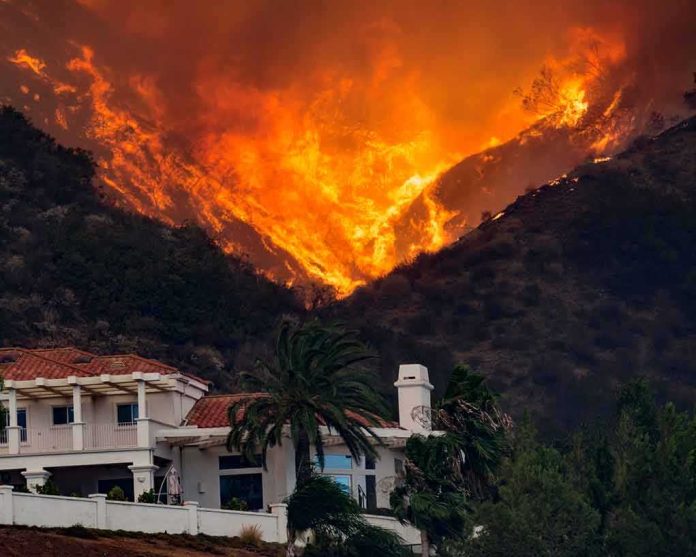
As Utah’s Cottonwood Fire rips through tens of thousands of acres with zero containment, many Americans see yet another disaster exposing how fragile, confused, and overwhelmed our fire system has become.
Story Snapshot
- The Cottonwood Fire in southern Utah is the largest active wildfire in the United States, with reports now topping 92,000 acres.[6]
- Officials say the blaze is human-caused, yet the exact ignition source is still unknown, fueling public distrust and speculation.[11]
- Governor Spencer Cox has declared a state of emergency, called the fire Utah’s most destructive for property loss, and ordered July 4th fireworks bans.[12]
- Conflicting media reports, workforce cuts, and red flag warnings across the West highlight a fire system many feel is stretched past the breaking point.[8]
Utah’s Largest Active Fire And A Community On Edge
Reporters in Utah now describe the Cottonwood Fire as the nation’s largest active wildfire, burning over 92,000 acres across Beaver and Piute Counties in southern Utah.[6] Strong, shifting winds have pushed flames toward small communities like Marysvale and North Creek, with firefighters warning the fire could grow even faster if weather worsens.[8] Evacuation orders have moved families out of harm’s way, sometimes more than once, leaving people tired, worried, and unsure what they will find when they return home.[8]
Governor Spencer Cox traveled to the fire zone and said the blaze behaved in ways crews had rarely seen, describing it as “almost impossible to protect those assets.”[9] He officially labeled the Cottonwood Fire the most destructive wildfire in Utah history in terms of property loss, in part because it destroyed a popular southern Utah ski resort and many nearby structures.[12] Yet, despite the scale of the damage, state officials say there have been no deaths linked directly to this fire, crediting fast evacuations and aggressive early warnings.[9]
Human-Caused, But Still Not Fully Explained
Utah’s wildfire authorities have formally classified the Cottonwood Fire as human-caused, a category that includes everything from equipment sparks to target shooting to campfires.[11] At the same time, investigators admit they still do not know the exact ignition source or the precise chain of events that led the first flames to escape control.[11] That gap between a broad human label and specific proof has fueled debate and suspicion, especially online, where some users point to unconfirmed reports of target shooting without solid evidence.[7]
This pattern fits a larger trend. State fire officials say humans caused 270 of Utah’s 367 fires in a recent year, and more than 75 percent of the state’s wildfires are now classified as human-caused.[14][18] National studies show similar results in other Western states, where human activity dominates modern ignition records even as climate change drives hotter, drier conditions that make every spark more dangerous.[15][19] For many citizens, that mix of real human responsibility, broader climate pressures, and vague official language feels like a system that blames “people” in general without clearly explaining who, what, or why.
Emergency Measures, Fireworks Bans, And Growing Public Frustration
To slow new fires during this crisis, Governor Cox has declared a statewide emergency and ordered fireworks bans around July 4th, a holiday when sparks and dry grass often mix with deadly results.[4] Utah’s move follows years of data showing that simple human choices — like shooting in dry brush or lighting fireworks near homes — can trigger large fires that cost tens of millions of dollars to fight.[4] State reports show human-caused fires account for the vast majority of burned acres in some seasons, even when most of those fires are caught early.[4]
These rules land in a country already tense. Many conservatives see fireworks bans and other limits as yet another sign that ordinary people pay the price while elites and agencies avoid blame. Many liberals see the same bans as proof that leaders talk tough about “personal responsibility” but dodge bigger issues like climate policy, land use, and underfunded emergency services. Both sides share a sense that the government responds in bursts of panic rather than long-term planning, with citizens left to guess when and why rules will suddenly change.
A Fire System Under Strain And Mixed Messages From Media
News about the Cottonwood Fire has also been confusing. Different outlets have cited fire sizes ranging from about 60,000 to nearly 100,000 acres, and some reports mixed details from a separate Cottonwood Fire in Nebraska, which is a different blaze with its own incident teams.[2][4][10] When people see major stations presenting clashing numbers and even mixing up states, it feeds the belief that officials and media do not have a clear, reliable handle on the situation. That confusion is especially troubling in fast-moving disasters, where local families depend on accurate maps and updates.
Behind the scenes, the fire workforce is under real strain. National reports describe several thousand fewer wildland firefighters than just a few years ago, along with criticism that complex incident management teams have been weakened by cuts and reshuffling.[10] At the same time, federal and state data show red flag warnings — periods of dangerous fire weather — covering wide parts of the West more often as climate-driven heat and drought increase.[19] In this environment, each large fire feels less like a surprise and more like a symptom of a system that has been stretched thin for years.
Shared Concerns On The Left And Right
Many Americans now watch the Cottonwood Fire and see more than just flames. They see power shutoffs in some areas but not others, evacuation orders that may be necessary but still upend lives, and agencies that seem quick to call a fire human-caused while slow to share detailed proof or full damage reports.[8][12] People across the political spectrum worry that ordinary families shoulder the risk, smoke, lost homes, and job disruption, while higher-level leaders focus on press conferences and blame.
I’m back home after a weekend in California. The news of the fires spreading in Utah stayed with me and I even caught a glimpse of the Cottonwood Fire as I flew south Thursday. pic.twitter.com/pJEwlqDq3d
— Kristen McPeek KUTV (@KristenMcPeekTV) June 29, 2026
Research from Utah and national science agencies shows that human actions and climate change together have made fire season longer and more dangerous, and that large, intense fires are likely to increase without major changes in policy and behavior.[19][21] For citizens, that message raises hard questions: Who is truly responsible, and who is truly protected? As the Cottonwood Fire continues to burn, the answers will depend not only on weather and wind, but on whether leaders move beyond labels and bans to deliver honest information, stronger planning, and real accountability.
Sources:
[2] Web – Human-Caused Fire | Investigation Ongoing Utah The Cottonwood …
[4] Web – CottonwoodFire MIDDAY UPDATE, June 24,2026 The fire is …
[6] Web – Investigations | Cottonwood, AZ
[7] Web – The Cottonwood Fire burned through structures as it exploded in …
[8] Web – The Cottonwood Fire burned through structures as it exploded in …
[9] Web – Human-Caused Fire | Investigation Ongoing Utah The Cottonwood …
[10] YouTube – Cottonwood Fire expands to over 27,000 acres, determined as …
[11] Web – Cottonwood Fire might set cost records after destroying southern …
[12] Web – Uncontained Cottonwood Fire burns 92,000 acres in Southern Utah
[14] Web – Cottonwood Fire Map – Watch Duty
[15] Web – July-August human-caused wildfire comparisons: 159 in 2021 471 …
[18] Web – [PDF] All About Wildfires – Natural History Museum of Utah
[19] Web – More than 75% of Utah’s wildfires are human-caused, which means …
[21] Web – Wildfires | Our World in Data