
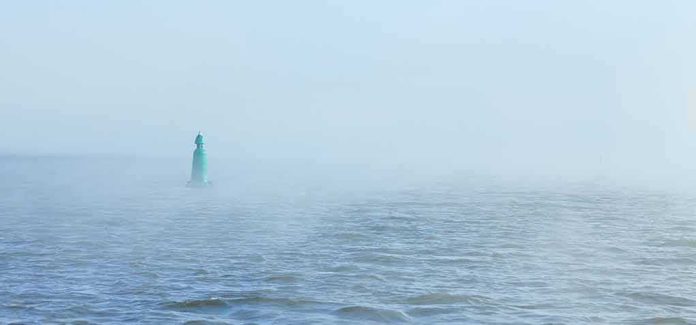
A commercial tanker burned in the Strait of Hormuz after a claimed drone strike, exposing how fast great-power brinkmanship can endanger ordinary trade and raise costs for everyone.
Story Snapshot
- Iran’s Islamic Revolutionary Guard Corps (IRGC) says it struck the Honduran-flagged tanker Athe Nova near Hormuz.
- Iran claims the ship supported U.S. forces; no independent evidence confirms that link.
- Maritime trackers note prior Iran links and odd movement by the ship before the blast.
- U.S. officials framed the incident as aggression against commercial shipping and signaled response.
What happened in the Strait of Hormuz
Iran’s Islamic Revolutionary Guard Corps said it hit the asphalt tanker Athe Nova near the Strait of Hormuz, and a fire followed on board. Iran framed the ship as an “American ally” and claimed it supported the United States Navy with fuel. Reporters could not reach the registered owner, and officials did not share records to prove that claim. The ship sails under a Honduras flag and is managed from the United Arab Emirates, not the United States.
Maritime reporting traced the vessel’s identity and past activity. Analysts noted that Athe Nova has a history tied to Iranian energy shipping networks. They also flagged Automatic Identification System data that looked like loitering or distress before the strike zone, which can suggest confusion, breakdown, or tactical maneuvering. These details do not prove U.S. coordination, but they set the scene for risk in a tight, contested waterway.
What each side is claiming—and what we know
Iran said the attack was part of a wider retaliation campaign against the United States and Israel after earlier strikes in the region. That gives a motive for hitting ships Iran labels as aligned with those countries. But there is no public proof that Athe Nova supplied the United States Navy, and Iran’s own spokesperson did not clearly confirm drone use on state television. The gap between claims and hard evidence remains wide for now.
Western outlets reported the fire and damage without confirming Iran’s allegation of U.S. links. United States officials cast the strike as another instance of Iranian pressure on commercial shipping. That stance matches past statements after similar events. The messaging duel is familiar: Iran claims defense of its waters and sovereignty, while others stress freedom of navigation and market stability in a vital oil lane.
Why this chokepoint keeps boiling over
The Strait of Hormuz is a narrow passage that carries a large share of global energy. Iran has pushed to control routes and impose conditions, including demands that ships coordinate passages. Warnings, boardings, and sporadic attacks have raised insurance costs and slowed trade. Each incident feeds a cycle: Iran seeks leverage; outside powers push back; and ship crews, consumers, and small businesses pay more at the pump and in freight bills when risk spikes.
🇮🇷 Iran Strikes Tanker Attack Tightens Grip on Hormuz
A Saudi tanker was struck by an unidentified projectile off Oman on July 7, the second ship hit in the Strait of Hormuz in less than 24 hours. The vessel sustained structural damage, but no injuries were reported.
Iran has… pic.twitter.com/y3h5MQellW
— Ryan Rozbiani (@RyanRozbiani) July 7, 2026
For years, the pattern has been the same. Iran labels certain ships as hostile to justify action. Outside governments reject that claim and keep traffic moving. Investigations often lag behind headlines, so rumor fills the gap. This erodes trust. People across the political spectrum see powerful actors playing power games while basic needs—safe trade, affordable fuel, and steady prices—get squeezed. The Athe Nova case fits that pattern, with facts still developing and costs already real.
How to read the evidence so far
Strong claims need strong proof. Here, Iran provided a motive and an accusation but no documents, radio logs, cargo lists, or images to confirm U.S. support by the tanker. Reporters have not reached the owner, and managers have not confirmed coordination. The ship’s flag and management point away from direct U.S. ties. Movement data and past Iran links raise questions but do not answer them. Expect flag-state and insurance probes to look at crew logs and cargo records next.
What this means for Americans
Events like this rarely stay “over there.” Energy prices react to fear and to choke points. A few explosions can raise costs for truckers, farmers, airlines, and families. When government strategies fail to keep lanes safe, citizens feel it in rent, food, and fuel. People on the right and left both see a system that protects insiders while everyday workers absorb the shock. Clear rules, transparent probes, and steady escorts can reduce risk, but follow-through matters more than press releases.
What to watch next
Watch for verified photos, cargo manifests, and radio traffic logs. Look for statements from the Honduras flag authority and the ship’s United Arab Emirates manager. Track whether the United States Central Command releases movement data to counter Iran’s story. Pay attention to insurance surcharges on Gulf routes. If those jump, fuel and freight costs at home may climb within weeks. If escorts expand or routes shift, risk might ease—but only if all sides hold fire.
Sources:
military.com, timesofisrael.com, aa.com.tr, hstoday.us