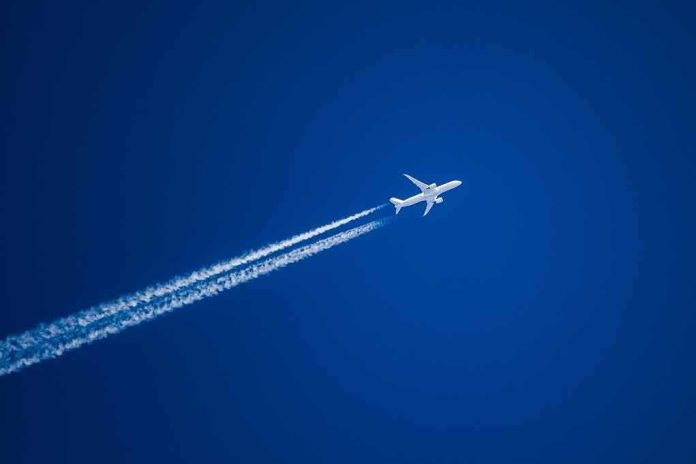
Backed by the United Kingdom and powered by Google’s tools, a new trial will re-route North Atlantic flights this winter to cut warming contrails across an entire oceanic airspace.
Story Highlights
- The United Kingdom and Google launched “Operation Blue Skies” to reduce warming contrails over Shanwick airspace.
- The 30-month program will test small altitude and route changes on winter transatlantic flights.
- Early studies found large contrail cuts with modest fuel trade-offs, but system-wide gains must be proven.
- Partners include the United Kingdom government, Google, the Met Office, and National Air Traffic Services.
United Kingdom-backed trial targets contrails over the North Atlantic
Google and the United Kingdom government announced Operation Blue Skies, a state-backed test to cut warming contrails at the scale of an entire oceanic airspace. The trial centers on Shanwick airspace, which covers the eastern half of the North Atlantic corridor used by many transatlantic flights. The program will run for 30 months and aims to send planes around the thin, humid layers where long-lasting contrails form and trap heat. Organizers say winter months offer clearer results.
The plan uses weather models and forecasting to predict where contrails will form. Flight planners will then adjust routes or altitudes to pass above, below, or around those layers. The changes are small, but they can matter. Past work shows even a few hundred feet up or down can avoid the worst layers. The United Kingdom’s Met Office will support the weather intelligence, while National Air Traffic Services will manage traffic shifts in busy international lanes.
Evidence from earlier trials points to real but measured gains
Several studies have shown contrail avoidance can work in practice. A randomized commercial trial found about 64 percent fewer detectable contrails on treated flights compared with controls. A European program reported fewer and shorter contrails per flight kilometer, paired with about a 2 percent rise in fuel burn. A review by the International Civil Aviation Organization noted strong agreement that persistent contrails warm the planet, though the exact size of the effect can vary by region and time.
Google’s announcement frames Blue Skies as the first state-backed attempt to scale avoidance across an entire oceanic airspace. The scale matters because the North Atlantic carries dense daily traffic. Proving climate benefit at this scope requires careful measurement. Project partners plan to compare forecast “hot spots” with satellite images and aircraft data. The trial window is expected to emphasize November through February, when contrails are more common and easier to track across consistent weather patterns.
How the rerouting works and what travelers may notice
Flight planners will use forecasts to spot thin ice-supersaturated layers that cause persistent contrails. Dispatchers and pilots will then request small altitude or routing changes to miss those layers. Air traffic controllers will clear the moves when safe. Most changes will be modest and may add a few minutes or a small amount of extra fuel. Travelers should not expect large detours. Safety standards, separation, and oceanic procedures remain the top priority for every flight.
Costs and trade-offs will be tracked. Past tests suggest a small fuel penalty can still net climate gains if it avoids long-lived contrails that trap heat for hours. But the total benefit depends on daily weather, airline schedules, and crowded airspace. That is why this state-backed trial aims to collect broader data over multiple winter periods. The design reflects earlier guidance that called for real-world testing across time of day and fleet types to judge repeatable value.
Why both sides should care about the results
Americans frustrated by higher costs and empty promises want solutions that work. If small adjustments cut warming without wrecking schedules, airlines could lower climate impact with limited new hardware. That could mean fewer complex mandates and fewer fees passed to customers. If the gains are weak or too costly, leaders can stop and try other fixes. Either way, the data comes from real flights, not press releases or guesswork.
Operation Blue Skies is the world’s first trial to deploy contrail avoidance measures across an entire airspace, aiming to lower the climate impact of flights on a large scale https://t.co/3YXYCTYhwN
— New Scientist (@newscientist) August 18, 2026
The larger question is governance. Aviation has often promised cleaner flying, while the public sees more delays, more fees, and little trust. A public trial across a major corridor, with clear partners and measured targets, tests whether agencies and industry can deliver a practical win. Supporters say contrails may drive a large share of aviation’s warming, so cutting them could help now while cleaner fuels and engines scale over years. The results will show if that hope holds up in busy skies.
Sources:
newscientist.com, bbc.com, blog.google, pdfs.semanticscholar.org, blue-lines.org, aviationweek.com, arxiv.org