
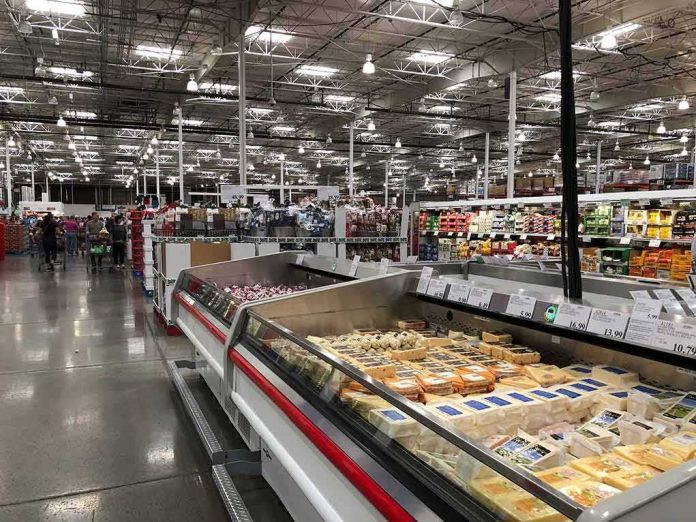
When digital control meets cold chain physics, failure is not a frozen screen—it is melted inventory, store closures, and even smoke in the aisles. France’s supermarket freezer incident put that truth on public display: connected operational technology, long optimized for cost and convenience, is now a front-line target with real-world consequences.
At a Glance
- French authorities opened a criminal probe into a large-scale cyberattack that manipulated supermarket refrigeration controls across multiple retail chains.
- The prime minister’s office tasked ANSSI, France’s national cyber agency, to investigate and coordinate with European counterparts.
- Reporting and supplier statements converge on legacy Danfoss controller families, with incidents linked to outdated firmware on certain systems.
- Pattern of impact—simultaneous temperature spikes, food losses, and operational disruption—matches remote manipulation of connected OT rather than isolated equipment failure.
What happened: a coordinated strike on the cold chain
French prosecutors announced a criminal investigation into a “large-scale cyberattack” that hit refrigeration in several major retail chains, driving connected fridges and freezers to abnormal temperatures and forcing product disposal across hundreds of stores. The anti-cybercrime section is leading the case, with investigators working to catalogue victims and link reported losses to the attack. The prime minister’s office directed ANSSI to take point on the technical response and coordinate with European peers—an institutional signal that the event was not a routine outage but a matter of national cyber concern.
Early technical threads converge on a shared supplier. Multiple outlets cited preliminary findings pointing to Danfoss refrigeration-management controllers—specifically AK-SM800 and AK-SC355 lines—with at least one variant running outdated firmware. Danfoss, for its part, acknowledged “incidents in France affecting a limited number of refrigeration management systems,” and tied impacted units to unsupported or out-of-date firmware; the company said it advised customers to update maintained products and migrate legacy systems. The incident profile—synchronous setpoint manipulation across dispersed stores—aligns with remote compromise of centralized or networked control rather than random component failures.
How the attack likely worked: from setpoints to spoilage
Modern supermarket cold chains are orchestrated by supervisory controllers that integrate compressors, evaporator fans, defrost cycles, and alarm telemetry. These controllers—often internet-reachable for remote monitoring and contractor maintenance—expose human-machine interfaces (HMIs) and APIs that accept authenticated changes to temperature setpoints, defrost schedules, and protective interlocks. If an attacker reaches those interfaces with valid credentials or via a software flaw, simple commands suffice to turn a freezer into a heater: force an extended or repeated defrost, raise setpoints, disable alarms, or stage compressor lockouts. Hours later, proteins sweat, ice creams slump, and display cases turn into warmers.
That is why this attack pattern looks classically “OT”: minimal payload sophistication can yield maximal physical effect when the target is a control loop. The reports from France describe temperature excursions to 40–50°C and widespread spoilage—outcomes entirely consistent with manipulated defrost cycles or elevated setpoints on connected systems. The scale across chains implies either compromise of a common remote-management surface or opportunistic exploitation of identically configured, internet-exposed controllers. This is not hypothetical; industrial and commercial controls have repeatedly been abused once network reachability and weak update hygiene align.
Why the cold chain is exposed: convenience, lifecycle, and reachability
Retail refrigeration has modernized around remote serviceability—OEMs and integrators tune systems, push configs, and respond to alarms without rolling trucks. That operational efficiency, however, introduces three systemic exposures. First, lifecycle drift: controllers can run a decade or more, outliving firmware support windows and defense expectations. Second, perimeter porosity: vendor portals, third-party managed networks, and hastily configured VPNs can expand the exposed attack surface. Third, uniformity at scale: thousands of near-identical devices, often deployed with default or inherited configurations, are a tempting monoculture for attackers.
Independent studies and advisory bodies have warned for years that OT environments—from utilities to food logistics—lag IT in patch cadence, segmentation, and identity controls. The food supply specifically has been flagged as vulnerable to refrigeration attacks, with likely high-impact outcomes due to rapid product perishability. The French episode fits that pattern uncomfortably well, and echoes a decade of ICS cases where digital intrusions precipitated material-world harm, outages, or safety questions.
Evidence so far: what is established and what matters most
Some facts now sit on solid ground. Prosecutors confirm the criminal nature and national scope of the event, and ANSSI’s assignment shows state-level engagement. Multiple retailers experienced simultaneous anomalies in refrigeration behavior resulting in product loss, matching a cyber-induced manipulation rather than coincidental mechanical failures. Reporting identified Danfoss controller families as prevalent in affected sites, and the manufacturer connected impacted systems to outdated firmware, pointing to lifecycle management as a meaningful risk vector. Those elements—scope, coordinated effect, and the legacy-tech throughline—are enough to define the incident’s character.
Two frequently cited details deserve measured treatment. First, the precise intrusion vector remains to be publicly detailed; whether exploitation hinged on a specific software vulnerability, weak authentication, exposed interfaces, or a third-party compromise is for investigators to finalize. Second, reports of fires associated with overheated units were included among described damages; causality will ultimately rest on site-level technical analysis. Neither caveat shifts the core conclusion: this was a cyberattack on connected refrigeration controls, not a spate of coincidental breakdowns.
Operational lessons retailers can act on now
Cold-chain resilience does not require reinventing industrial cybersecurity; it requires applying established OT practices with discipline. Start with reachability: remove direct internet exposure of controllers and HMIs, place them behind properly configured, monitored network segments, and require brokered access with MFA for vendors. Address lifecycle: inventory controller models and firmware, migrate end-of-support units, and institute a scheduled update and validation program that treats defrost logic and setpoints as safety-critical configurations. Engineer independence: deploy out-of-band temperature telemetry and alarming that cannot be silenced by the same controller that regulates the case; if the supervisory brain misbehaves, a secondary sensor should still call for help.
Finally, exercise response. Tabletop and live drills—pulling remote access, reverting to safe default setpoints, and executing controlled shutdowns—turn chaos into choreography on the night it matters. The French incident’s overnight timing underscores the cost of staffless hours without independent alarms or human-in-the-loop procedures. None of this negates the gains of connected service; it simply prices in the security debt that connectivity incurs.
Cyberattack Disables Refrigeration Across French Supermarkets
A cyberattack on supermarket cooling systems across France caused fires, empty shelves and losses estimated in the millions of euros.#France #Cyberattack #CyberSecurity
Read more: https://t.co/UOgPrR0WY2— Minute Brief (@theminutebrief) October 14, 2026
Why this will not be a one-off
Once an adversary realizes that a handful of commands can translate into truckloads of waste, insurance claims, and reputational damage, the incentive landscape changes. The same convenience layer that enables national-scale maintenance enables national-scale disruption if left unguarded. Similar exposures exist beyond grocery aisles: refrigerated transport, cold warehouses, hospital pharmacy storage, and even building HVAC present paths from keyboard to consequence. In other words, the attack surface is not the brand of controller; it is the business model that assumes data-plane connectivity without control-plane hardening.
The remedy is not fear but rigor. France’s response—criminal investigation paired with national-cyber coordination—is the correct frame for an event that crossed the digital-physical boundary. The lesson for retailers is equally direct: treat refrigeration controls as industrial systems, not appliances. When you connect physics to the internet, security architecture becomes food safety policy.
Sources:
townhall.com, dw.com, afp.com, france24.com, insurancebusinessmag.com, timeslive.co.za