
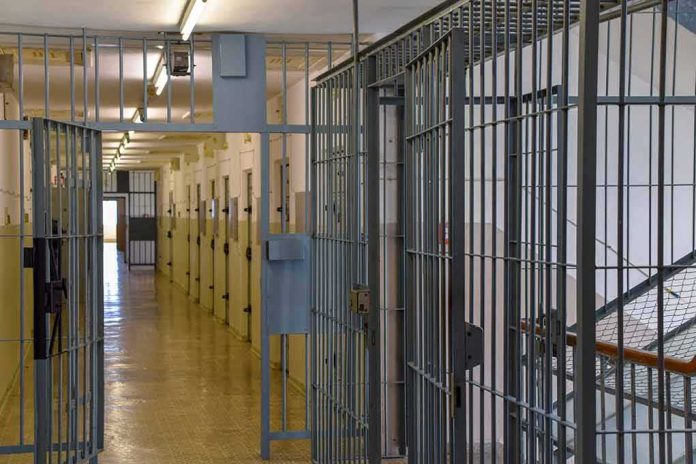
The hard question at the center of the current debate is not whether rhetoric is overheated; it is whether the country’s existing detention machinery, already capable of holding tens of thousands of people on civil grounds, could be scaled and repurposed in ways that place due process at risk far beyond immigration cases. The warning that ignited this round — Rachel Maddow’s on-air scenario of seven to ten mega-facilities holding 10,000 people each — forces a sober examination of what the government can already do, what it has recently contemplated, and where constitutional brakes have actually engaged.
At a Glance
- Rachel Maddow outlined a specific scenario of seven to ten large detention sites capable of indefinite, no-counsel confinement, linking it to reported “mega-facility” concepts under discussion.
- Federal courts have recently ordered releases and bond hearings for people held in civil immigration detention, underscoring that prolonged detention is legally contestable.
- Due process limits exist: courts analyze prolonged civil detention under the Fifth Amendment and require special justifications to outweigh liberty interests.
- The record documents risks of mistaken or unlawful detention — including of U.S. citizens — but not the establishment of citizen-focused “concentration camps.”
What Maddow Actually Claimed — And Why It Resonated
Maddow did not merely offer a generalized fear about creeping authoritarianism; she framed a concrete capacity-and-authority scenario: if the executive branch obtains seven to ten national facilities, roughly 10,000 beds each, with authority to hold people indefinitely without counsel, the pool of detainees will not stop with immigrants. That specific formulation appeared during a late-2026 interview, and subsequent coverage amplified her references to warehouse-scale facilities capable of housing “five, six, seven, ten, 14,000 people.” The point was not numeric flourish; it was institutional design — centralized, high-volume sites plus loosened procedural controls can change what is possible, quickly.
The claim maps onto contemporaneous reporting about proposals for very large detention complexes, including a high-capacity site contemplated in Social Circle, Georgia. Even where specific projects were contested or canceled, the procurement and planning posture matters: it signals an appetite for scaled infrastructure that can be adapted faster than new legal frameworks are debated in public.
The Legal Machinery: Civil Detention, Due Process, and the Role of Habeas
Immigration detention in the United States is civil, not criminal; it is meant to ensure appearance for proceedings and effectuate removal, not punish. That distinction anchors the constitutional analysis: under the Fifth Amendment’s Due Process Clause, the government must justify continued restraint of liberty, and the further detention drifts from a near-term proceeding or removal, the heavier the justification must be. Recent federal habeas filings have pressed that point with success.
In California City and Otero County cases, federal courts ordered release or compelled the government to provide bond hearings with notice before any re-detention. Those rulings do not convert immigration detention into punishment, but they do reassert that detention is not unbounded; if the government cannot provide process commensurate with the deprivation, courts will intervene. The mechanism is practical: habeas corpus — the ancient writ that allows a detainee to challenge the legality of custody — and its modern, expedited use to curb prolonged civil confinement.
Capacity, Control, and the Precedent That Worries Civil Liberties Lawyers
The operational concern Maddow dramatized — high-volume facilities plus diminished access to counsel — is not hypothetical in its components. Litigation across districts has documented periods when people in civil custody faced prolonged detention and significant barriers to legal process. Courts have reiterated that civil detainees cannot be warehoused indefinitely; the government must meet constitutional and statutory standards, and judges have ordered releases when it has not.
The legal floor is clearer than the operational ceiling. A system that adds tens of thousands of beds, concentrates detainees far from counsel, and accelerates transfers can make the right to a hearing difficult to exercise. Even when rules on paper permit attorney access, everything from facility location to phone access to mail handling can function as a de facto brake on due process. That is why the recent caselaw — orders compelling hearings, or freeing people outright — matters beyond the individual litigants; it signals how the judiciary reacts when civil detention slides toward prolonged, minimally reviewed confinement.
MSNBC host Rachel Maddow expressed concern during an appearance on The Daily Show that large-scale ICE migrant detention centers planned by the Trump administration could eventually be repurposed to imprison U.S. citizens without trial pic.twitter.com/VhawISqCx7
— Sandy (@SD73660) November 11, 2026
Where the Line Is — And Is Not — Today
Two distinctions keep this conversation tethered to the record rather than to caricature. First, the strongest factual backbone concerns immigration detention, not citizen-focused incarceration in new mega-sites. The documented pattern is expansion followed by litigation and partial correction, not the establishment of facilities designed to hold citizens without trial. Second, the country does have a documented problem with mistaken or unlawful detention — including of U.S. citizens misidentified or mishandled by immigration authorities — which underscores the stakes if capacity and operational discretion grow faster than safeguards. Both truths can hold: the extreme end-state Maddow sketches has not been implemented, and existing practice has verifiably harmed people who should never have been detained.
The jurisprudential posture is consequently narrow but consequential. Courts treat civil detention as exceptional and time‑sensitive; they demand hearings when the government’s custody rationale grows thin and require procedures that keep due process real, not theoretical. Recent orders out of California and New Mexico enforcing release, notice, and bond hearings reflect that discipline. For policymakers, the implication is straightforward: scale without embedded, auditable safeguards will not withstand judicial scrutiny. For the public, the take‑home is equally clear: the right to counsel and to court review is the difference between a holding facility and a carceral black hole.
How We Got Here: The Infrastructure Outran the Debate
Across four decades, the immigration detention system evolved from an ad hoc response to a standing apparatus, aided by statutory changes and intergovernmental cooperation. Each round of capacity growth brought downstream issues — remote siting, contractor variability, transfer churn, and the practical availability of legal process. The recent proposals for very large, warehouse‑style sites are the logical extension of that trajectory, promising logistical simplicity at the cost of due‑process friction unless design choices, access protocols, and independent oversight are locked in from the start.
That history explains both the alarm and the countervailing constraint. Alarm, because once built, capacity creates its own policy gravity; beds often get filled. Constraint, because the courts have repeatedly refused to treat immigration detention as an executive blank check. The most durable solution is not rhetorical escalation but institutional design: clear custody authority, categorical limits, enforceable attorney‑access rules, transparent transfer logs, and automatic, time‑bound review — all memorialized in contracts and monitored by inspectors with teeth. The recent court orders are a map of the minimums; good policy builds above them.
What It Means Going Forward
Maddow’s scenario landed because it translates a complex policy fight into a testable proposition: what happens when capacity, discretion, and distance from counsel converge? The credible record supports a narrower but urgent conclusion: the system already produces prolonged civil detention that courts must unwind case by case, and documented errors have swept in people with legal claims up to and including citizenship. Expanding capacity without codified safeguards multiplies those stakes.
The action items are concrete. For Congress and oversight bodies: require any high-capacity facility to hard-code attorney access, notice, and periodic custody review into operating agreements, with public reporting. For courts: continue the recent practice of swift habeas relief when process lags reality. For the executive: publish the legal authorities, capacity plans, and counsel-access protocols for any contemplated mega-site before contracts are let. The bright line between civil detention and punishment — between a constitutional holding regime and something the public will call a camp — is not drawn by labels. It is drawn by process, power, and proof that both are working under load.
Sources:
thegatewaypundit.com, supreme.justia.com, law.justia.com, govinfo.gov, foxnews.com