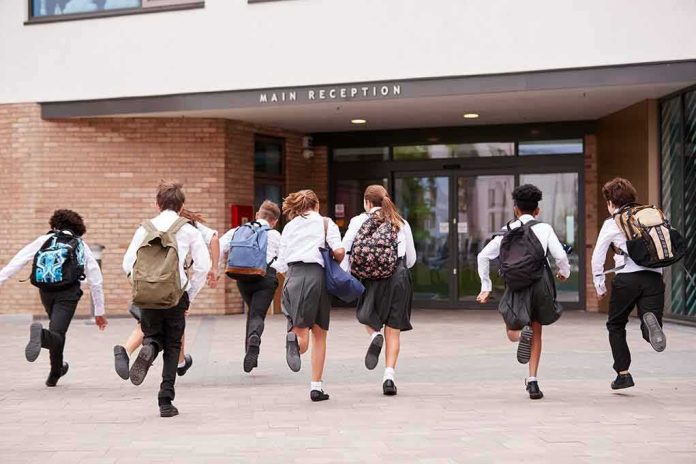
When a large men’s shelter is sited within a short walk of a middle school, the fight that follows is rarely about homelessness in the abstract; it is a concrete dispute over proximity, process, and proof—how close is too close, who gets informed when, and what evidence should decide.
At a Glance
- A 200-bed single men’s shelter is proposed for East 108th Street in Canarsie, reported as roughly a block or a five-minute walk from a middle school.
- City records cited in coverage reference a pending five-year, $61.5 million operating contract with Midway Living; opening is projected for 2028, subject to approvals.
- Parents, teachers, residents, and their council member rallied against the plan, citing student safety and a lack of meaningful consultation.
- The Department of Homeless Services frames the site as part of a citywide capacity build-out to reduce hotel use and spread shelters more evenly across boroughs.
What is actually on the table: scale, siting, and status
Reports describe a substantial facility: approximately 200 beds for single men on East 108th Street in Canarsie, Brooklyn—near Science and Medicine Middle School 366. The described distance is specific enough to animate neighborhood concern: a block, or about a five-minute walk, depending on the account. That proximity is the factual spine of the protest and the reason this is not a generic “not in my backyard” dispute; it is about children’s daily routes and a high-capacity facility conjoined in a small geography. The operator identified in procurement reporting is Midway Living, with a proposed five-year contract of $61.5 million and an anticipated opening in 2028 if the approvals proceed. The facility is not yet built; the contract, site details, and operating terms remain in a pending posture, which matters for both due diligence and leverage—final design and safeguards can still be shaped.
Two points complicate the file as presented to the public. First, there is an address discrepancy—913 versus 945 East 108th Street—across accounts. That should be resolved before anyone asserts parcel-specific claims about sightlines, lighting, or zoning. Second, while proximity and crowd size at rallies are documented, no independently verified analysis has been offered publicly on likely changes in crime or student safety attributable to a shelter of this type at that location.
How the city frames the need
The Department of Homeless Services (DHS) describes the Canarsie site as one node in a broader program: 12 new shelters across the five boroughs opening between 2027 and 2030, designed to increase “high-quality shelter capacity,” reduce reliance on commercial hotels for families, and address overcrowding and unsafe conditions in existing facilities. In short, the siting decision is being made in service of a system-level rebalancing, not as a one-off response to a local condition. DHS also emphasizes that notifying elected officials and community boards is the first step of a public process that will include community engagement—a point that acknowledges, but does not concede, opponents’ complaints about timing and transparency.
The distribution argument—placing shelters across all boroughs—tracks with long-standing “fair share” debates in New York. Courts have upheld the city’s discretion to locate shelters when grounded in a rational basis and adherence to procedural criteria, including analyses within a defined radius, though those criteria do not always require the city’s land-use review process (ULURP) for every shelter configuration. That history explains why opponents tend to argue both substance (safety, proximity) and process (notice, consultation) simultaneously; the former influences political pressure, while the latter can affect legal posture.
The opponents’ case: proximity, procedure, and perceived risk
Local resistance draws strength from specifics, not generalities. Parents, teachers, and Council Member Mercedes Narcisse rallied in Canarsie, arguing that placing a large single-adult men’s facility one block from a middle school is an avoidable risk and that the community was informed too late to shape the plan. Narcisse has stated she sought clarity for more than a year and was told only recently that a shelter was planned; parents described children walking alone along dark stretches after dismissal and expressed fear tied to that routine. These are real-world claims—observable routes and daily patterns—rather than a blanket assertion that homeless New Yorkers are dangerous. They resonate because they are tangible, even if they are anecdotal and not, by themselves, proof of elevated risk.
As evidence, the opposition points to the facility’s size, the tight radius around the school, and the cost figures from the procurement description; they also cite mental-health prevalence among shelter entrants. The latter, however, is misplaced as a safety proxy: diagnoses describe health conditions, not criminal conduct, and do not establish a causal link to student victimization risk. The case is strongest where it stays closest to concrete facts—proximity, scale, pedestrian routes—and weakest when it leans on stigma or broad political narratives unconnected to the site’s operating plan.
Where the argument should be decided: operating model and measurable baselines
Because credible crime forecasts are absent in the public record, the determinative questions should shift from stereotypes to mechanisms: exactly who will be eligible for placement at the site; what the screening, intake, and curfew rules are; how many security staff are on duty by shift; whether entry is controlled through ID checks and metal-detection; what the supervision and incident-reporting protocols require; and how the shelter will coordinate with the school, NYPD school safety, and DOT for lighting and pedestrian safety along dismissal routes. These features are not abstract; they are negotiated and enforceable through scope-of-services provisions, post orders, and contract remedies. They are also the levers that most directly affect street-level experience.
Two additional steps move the debate from speculation to accountability. First, confirm the exact site through deeds and Department of Buildings filings, then map the safest pedestrian paths used by students with a lighting and camera audit. Second, create a pre-opening baseline: calls for service, 311 complaints, school safety reports, and pedestrian counts within a defined radius and time band around arrival and dismissal. With those baselines in hand, post-opening changes—if any—can be measured rather than inferred. Without them, both sides are arguing past each other, and no one will be able to say, months later, what actually changed on those blocks.
What the law and history suggest about “near schools” disputes
New York’s jurisprudence around shelter siting is pragmatic. Courts have generally upheld siting decisions when the city demonstrates a rational basis, follows required procedures, and applies its Fair Share Criteria consistently—even when neighbors object on proximity grounds. At the same time, public processes and community-board actions frequently shape outcomes on the margins: adding security conditions, modifying entrances, enhancing streetscape lighting, or, in some cases, prompting a relocation when cumulative facility burdens can be shown. In practice, that means opponents who organize around verifiable, site-specific concerns and propose concrete mitigations often achieve material changes even if the shelter ultimately opens.
A constructive path forward
For the city, the burden is to translate its system-level rationale into a site-specific operating plan that addresses predictable local concerns without criminalizing poverty. For the community, the most effective posture is not a categorical “no,” but a hard-nosed, evidence-seeking “show us”—the contract terms, the staffing matrix, the security post orders, the school coordination plan, and the lighting upgrades—with a commitment to measure outcomes against a documented baseline. That approach keeps the debate where it belongs: on proximity, procedure, and proof, not on caricatures of the people who will live inside the building.
Sources:
nypost.com, dnyuz.com, anthonyblogan.com, wheb.iheart.com, newyork.news12.com, newjersey.news12.com, pix11.com, rock101fm.iheart.com, brooklyn.news12.com, meridian.news, schools.nyc.gov, foxnews.com, nyc.gov