
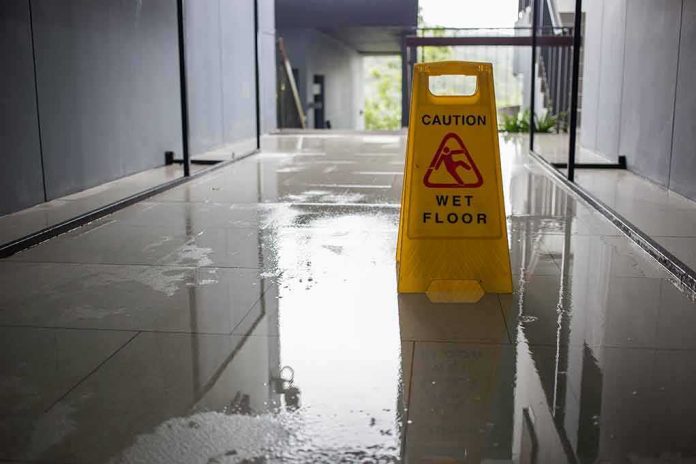
A lavatory faucet leak can sound trivial, but on a modern airliner it is a systems event: water can migrate under flooring, wick into wire bundles, and, in the wrong place, compromise electronics. That’s why a Frontier Airlines crew declared an emergency and diverted to Chicago—an unglamorous plumbing failure had become an aviation safety problem that demanded a quick, disciplined response.
The Short Version
- Frontier’s crew declared an emergency after a forward lavatory faucet leak sent water across the cabin floor; they diverted to Chicago O’Hare and landed safely with no injuries.
- ATC audio captures the captain citing concern about potential impact on electronics; the airline’s statement confirms the lavatory faucet leak.
- Passenger video obtained by local media corroborates visible water on the aisle floor, reinforcing the decision to divert.
- This kind of diversion aligns with FAA and NTSB findings that cabin or lavatory fluid can reach electrical connectors and create real hazards.
What Happened: A straightforward in-flight diversion for a water leak
En route from Denver to Detroit, the Frontier flight’s crew radioed an emergency to air traffic control and requested a diversion to Chicago O’Hare. In the recorded exchange reported by Chicago outlets, the captain described a forward-lavatory sink that “sprung a leak,” spraying so much water that it was flooding the cabin area and raising concerns about the aircraft’s electronics. Frontier’s official account matches that cockpit report: the airline stated the forward lavatory faucet began leaking and water traveled along part of the cabin floor. The airplane landed safely at O’Hare; the airline reported no injuries among passengers or crew. The sequence—departure from Denver, leak aloft, emergency declaration, diversion to O’Hare, safe arrival—was reported consistently across multiple local newsrooms on the same day.
Critically, this was not a purely “he said” radio moment. Local television obtained interior video that showed the aircraft floor wet along the aisle, visually corroborating the crew’s description of water migration in the cabin. The concrete reasons for the emergency call were operational—water spreading beyond the lavatory and the potential for systems impact—not vague discomfort or convenience.
Why water in the cabin matters: the systems pathway from drips to faults
Airliner cabins are not sealed bathtubs; beneath carpet and floor panels run conduits, control cables, and wiring harnesses that ultimately interface with avionics and electrical distribution. Fluid can move in surprising directions under galleys and lavatories. FAA guidance has long flagged waste and water system integrity as a safety-relevant concern, emphasizing design and servicing practices that prevent leakage because downstream risks include fluid intrusion and, in cold conditions, freezing that can damage components. NTSB casework provides the hard lessons behind that guidance: in documented investigations, lavatory or cabin fluid contaminated electrical connectors, producing malfunctions that ranged from faults to uncommanded roll behavior attributable to affected systems. The point is not that every leak leads to a failure; rather, the mechanisms are well-understood enough that crews treat significant water migration as a bona fide safety issue, not an annoyance.
Against that technical backdrop, the captain’s on-frequency concern about electronics was not melodrama—it reflected standard risk calculus: unknown water source severity plus uncertain flow path equals a conservative decision to land soon at an airport with robust response capability.
Inside the crew’s decision-making: conservative, coordinated, and routine by design
From the outside, an emergency declaration can sound like the brink of disaster. Inside the cockpit, it is a procedural tool that unlocks priority handling and resources. The Frontier crew communicated clearly with air traffic control, accepted vectors to O’Hare, and coordinated gate and ground support. Local reporting indicates that while the crew voiced concern about electronics, they also monitored systems and, at least at one point, reported them as normal during the descent—a sign of disciplined cockpit resource management: acknowledge the hazard, keep flying the airplane, and get it on the ground before the situation evolves. The airline confirmed the safe landing and absence of injuries; maintenance attention began on arrival.
To an experienced line pilot or maintenance controller, the logic chain is familiar. Even if the eventual inspection finds no electrical impact, that is a desired outcome of a prudent diversion, not a sign the decision was overwrought. A crewmember cannot see through floor panels or wire races in flight; the safe choice is to assume the worst plausible pathway until proven otherwise on the ground, where panels can be opened and connections inspected.
What we know—and what this incident was not
The central facts are stable across independent outlets: Frontier’s crew declared an emergency due to a forward lavatory faucet leak, water was observed along the cabin floor, the flight diverted to O’Hare, and the landing was uneventful with no injuries. There was some inconsistency in contemporaneous reporting on the specific flight number, a housekeeping discrepancy that sometimes occurs across fast-moving local coverage but does not alter the operational narrative; the airline’s description of the event is aligned with the cockpit audio reported by local CBS and others. Media accounts did not specify the precise mechanical root cause—whether it was a failed fitting, valve, or faucet component—nor the volume of water released. Those are maintenance report details, not prerequisites to understand why the diversion occurred.
What this incident was not: a systems emergency with cascading failures, a smoke-and-fumes scenario, or an evacuation on landing. It remained a contained aircraft abnormal handled conservatively—textbook risk management for line operations.
The mechanics behind lavatory leaks: how a small part can drive a big decision
Commercial lavatories combine potable water lines, gray-water drains, heaters, and seals—hardware that lives near structural members and electrical runs serving galleys, lighting, and in-seat systems. A faucet or line leak can result from a fatigued fitting, compromised seal, or vibration-loosened connection. Once flowing, water will follow gravity and pressure differentials, often under carpeting and floor panels. If it reaches connectors, capillary action can wick moisture into pin cavities; add the chemistry of “blue water” (disinfectant-laced lavatory fluid) and you have a path to corrosion or conductive residue over time. That’s precisely the sort of chain the FAA’s advisory material and past NTSB investigations seek to interrupt through preventive maintenance, robust seals, and conservative in-flight judgment calls when anomalies occur.
Airlines mitigate these risks with inspection intervals, service bulletins, and post-event checks: open-floor inspections, avionics bay surveys, and connector cleaning or replacement when contamination is suspected. A flight that diverts for a leak will typically be held until maintenance can attest that electrical and structural zones are dry, wiring is uncompromised, and the plumbing fault is corrected before return to service.
#MAYDAY: Frontier Flight 3566 diverted to Chicago O’Hare after massive water leak from forward lav.
✈️ Aircraft: Airbus A321neo N688FR (MSN 13228, Mickey the Moose livery)
📍 Route: Denver (DEN) → Detroit (DTW)
🔢 233 souls on board, ~11,000 lbs fuel remainingPilot reported… pic.twitter.com/KnUdOP6BPI
— SLCScanner (@SLCScanner) November 11, 2026
Why this matters to passengers: safety culture you rarely see
For passengers, a wet aisle and an unscheduled stop are tangible inconveniences. The more important story is cultural: modern commercial aviation is built to change plans early rather than test the margins—declare, divert, and diagnose on the ground. FAA policy and NTSB history support that posture in leak scenarios. Treating a lavatory faucet as a safety-relevant system may seem excessive until you consider the complexity beneath your feet—and the handful of cases where fluid did reach the wrong connectors with real consequences. The Frontier crew’s actions fit that safety culture precisely: identify a plausible pathway to elevated risk, use the emergency declaration to simplify the operating environment, and deliver an uneventful landing.
Sources:
nypost.com, nbcchicago.com, cbsnews.com, abc7chicago.com, viewfromthewing.com, faa.gov, data.ntsb.gov