When an airport breach disables a frontline military airlifter, the story is not just about one man with an axe; it is about how modern protest, aviation security, and military logistics intersect at a single civilian runway.
The Short Version
- Federal prosecutors have charged an Irish national, Daithi O’Corrain (also known as David Curran), with destroying a U.S. military C-130H at Shannon Airport.
- The indictment describes highly specific sabotage: cut wire bundles and hydraulic lines, smashed cockpit instruments, a crimped liquid-oxygen line, damaged ducts, and fuel-system harm.
- Crew members allegedly saw the intruder exit a roof hatch and strike the exterior with an axe; the aircraft was declared inoperable and, prosecutors say, will not return to flight.
- Multiple outlets reported the same defendant, aircraft type, location, and date, reflecting broad alignment on core facts.
What prosecutors say happened on the ramp
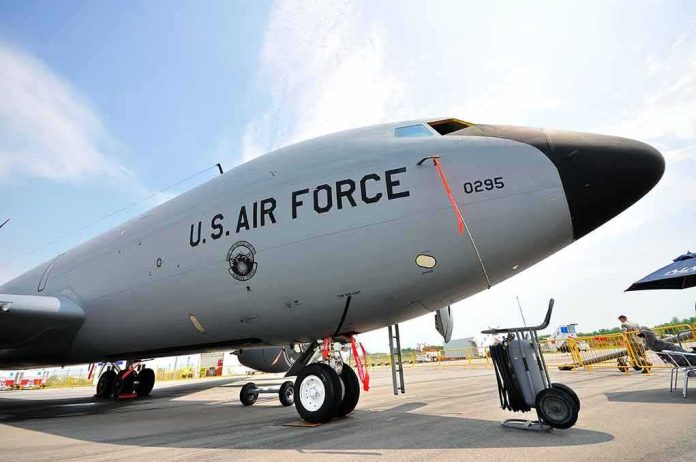
According to the U.S. Department of Justice, O’Corrain breached the secure perimeter at Shannon Airport on the morning of April 11, entered a parked U.S. C-130H Hercules, and carried out deliberate, system-by-system damage inside the aircraft before striking the exterior. Prosecutors describe a methodical attack that went far beyond superficial dents: wire looms severed, hydraulic lines cut, every cockpit gauge destroyed, a liquid-oxygen (LOX) line crimped, air ducts punctured, and elements of the fuel system compromised. These are not cosmetic scars; hydraulics power flight controls and landing gear, the LOX system feeds crew oxygen at altitude, and instrument panels integrate avionics essential for airworthiness. ABC News reported the indictment’s conclusion in plain terms: the damage rendered the aircraft inoperable, and it will not return to active flight status.
Prosecutors further recount what the crew allegedly witnessed: a man emerging through a roof hatch, then striking the aircraft’s exterior with an axe; CBS coverage references stills from a video included in the charging materials that depict a figure on the aircraft’s roof. The throughline across major outlets—CBS, ABC, the Associated Press, and the Irish Independent—is consistent on the essentials: the accused, the place, the aircraft, the date, the axe, and the scale of damage claimed by the government.
Why a C-130 is both rugged and still vulnerable on the ground
The C-130 Hercules is famed for durability: it can launch from rough fields, haul troops and cargo, and serve in disaster zones. Yet even a robust airframe is an ecosystem of interdependent systems. Hydraulics transmit force to control surfaces; avionics translate pilot intent into precise, stable flight; oxygen systems sustain crews for high-altitude legs; fuel systems are both lifeblood and, if compromised, a safety hazard. Cut a wire bundle and you disable not one circuit but many. Smash instrument clusters and flight becomes impossible until each component is replaced, tested, and certified. Damage to fuel plumbing and environmental control ducts adds structural and contamination risks that complicate repair planning, non-destructive inspection, and post-repair recertification.
Ground security, therefore, is not merely about keeping an aircraft from being flown away; it is about shielding accessible, fragile subsystems from targeted attack. A hatchet to a pressure skin can be patched; a maze of cut hydraulics and destroyed avionics can cascade into a near-rebuild—especially for aging fleets where parts, wiring harnesses, and legacy test benches are finite. That technical reality underlies the government’s assertion that this airframe will not return to service.
Shannon’s long arc of protest and exposure
Shannon Airport is not a random backdrop. For decades it has served as a refueling and transit node for U.S. military traffic, and with that role has come recurring protest activity and, at times, direct-action incursions. Local and national coverage has chronicled a quarter-century of contention over how such use comports with Ireland’s neutrality, with periodic episodes of activists entering restricted areas and targeting U.S. aircraft. The Irish Examiner’s reporting captures the tempo: protests ebb and surge, but they persist alongside the airport’s military-civil role. This backdrop does not determine criminal culpability in the present case, but it explains why a serious security breach at Shannon is legible to observers who have watched this standoff for years.
That history also matters operationally. A mixed-use airport that hosts commercial carriers and transiting military flights inherits the risk profile of both. Crowd management outside the fence, badge control and patrol patterns at the perimeter, and aircraft hardening on the ramp all adapt to cycles of activism and heightened geopolitical salience. When geopolitics runs hot, the ramp demands more than routine vigilance.
The legal contour: a federal destruction-of-property charge
The U.S. Attorney for the Southern District of New York charged O’Corrain with destruction of U.S. government property, citing the April 11 Shannon incident and the C-130H’s reported $60 million value. ABC News quotes the indictment’s valuation and its assertion that the aircraft will not re-enter the fleet; the dollar figure itself is presented as approximate in the public accounts. In cross-border cases like this, prosecutors typically anchor jurisdiction in the property’s U.S. ownership and the downstream effects on U.S. operations; investigative collaboration with Irish authorities is common when the locus delicti is abroad. Multiple independent reports name the same defendant, describe the same fact pattern, and attribute the specifics to the unsealed indictment.
As with any charge, an indictment is an allegation; adjudication will determine criminal liability. But for understanding the event’s significance, the particulars alleged—especially the targeting of subsystems inside the aircraft—are mechanistically coherent with the claimed operational outcome. That coherence is why aviation professionals take the case seriously.
Operational consequences: one airframe, many ripples
From a logistics standpoint, losing a C-130H does not cripple the Air National Guard, but it stresses a fleet where availability is a constant management problem. Each tail number supports training pipelines, mission taskings, and maintenance rotations; remove one, and the scheduling burden shifts to sister units, cannibalization risks increase, and already tight depot slots absorb fresh, unplanned demand. For crews staging through Shannon, the message is unambiguous: ramp posture must assume targeted interference is plausible, not theoretical. That means layered controls—perimeter integrity, roving patrols, aircraft access discipline, and, where mission allows, physical hardening of obvious attack surfaces and critical access points.
For civil aviation stakeholders, the incident is a case study in how a single determined actor can exploit the unique vulnerabilities of parked aircraft. The response is not to turn civilian airports into fortresses, but to align procedures with threat reality: rapid detection at access points, short response loops from alarm to interdiction, and tightened procedures any time a military tail is on stand.
What to watch as the case proceeds
Three questions will define how this episode is ultimately written into the safety and security playbook. First, whether the technical record of damage—hydraulic, avionics, oxygen, ducts, and fuel—tracks to a repairability assessment that truly ends the aircraft’s flying life, or whether a later engineering decision changes that status; prosecutors have publicly asserted the former. Second, how authorities at mixed-use airports recalibrate ramp security when transiting military aircraft raise the stakes of a breach. Third, whether the long-running protest dynamic at Shannon evolves in light of a case that, if proven, crossed decisively from symbolic dissent to the physical neutralization of a military aircraft.
Sources:
cbsnews.com, justice.gov, abcnews.com, shannonwatch.org