
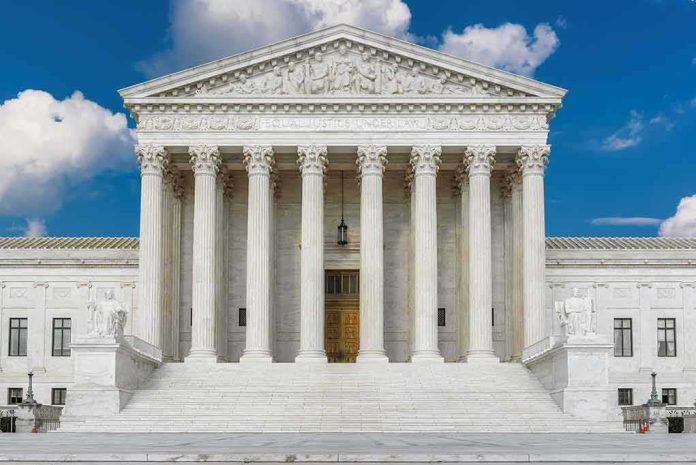
As the Supreme Court’s birthright citizenship ruling shuts one door, lawyers and migrants are already racing to pry open new ones, testing the edges of what it means to be an American on paper.
Story Snapshot
- The Supreme Court struck down President Trump’s Executive Order 14160, fully restoring birthright citizenship for nearly all children born on U.S. soil.
- A prior Supreme Court decision limiting nationwide injunctions let parts of the order move forward, fueling rushed immigration schemes and legal gray zones before the final ruling.
- Advocates now warn about a spike in “citizenship scams” that prey on confused families seeking status or papers in the wake of the Court fights.
- Both conservatives and liberals see the episode as proof that powerful insiders can twist constitutional rights while ordinary Americans bear the cost.
What Trump’s Executive Order Tried To Do
On January 20, 2025, President Donald Trump signed Executive Order 14160, called “Protecting the Meaning and Value of American Citizenship.” The order said that many children born in the United States would no longer get automatic citizenship if their mothers were in the country illegally or only on a temporary status, and their fathers were not citizens or lawful permanent residents. The policy was set to apply only to babies born at least thirty days after the order, meaning births on or after February 19, 2025.
The order rested on a new reading of the Fourteenth Amendment’s Citizenship Clause. The Trump administration argued that the phrase “subject to the jurisdiction thereof” does not cover children whose parents lack permanent legal ties to the United States, especially those here illegally or on short-term visas. Legal historians and most constitutional scholars say this flips over more than a century of practice and cases, which have treated nearly everyone born on U.S. soil as “subject to the jurisdiction” of the country.
How The Supreme Court First Limited Injunctions, Then Killed The Order
Federal courts around the country quickly blocked the executive order, issuing nationwide injunctions that stopped it from taking effect for any child, not just the people who sued. In a separate case in June 2025, the Supreme Court ruled that district courts usually cannot issue such universal injunctions unless they are truly needed to protect the actual plaintiffs. That ruling narrowed the earlier blocks and opened a path for the administration to enforce the order against families who were not covered by those lawsuits.
While that injunction decision sounded technical, it changed real lives. Without broad court orders, families outside the named cases had to face hospital staff and federal agencies unsure whether newborns counted as citizens or not. Civil rights groups warned that the ruling would let the birthright citizenship order move forward “everywhere else” until a final decision came down. That “green light in the gaps” is what critics say helped fuel rushed legal schemes and confusion on the ground.
The Final Supreme Court Ruling On Birthright Citizenship
The major showdown came in Trump v. Barbara, a nationwide class action that directly challenged the order. In that case, advocates argued that the Constitution’s Citizenship Clause, and long-standing Supreme Court precedent, guarantee citizenship to almost all children born in the United States, no matter their parents’ status. On June 30, 2026, the Supreme Court agreed, ruling that children born in the country to parents who are here unlawfully or only temporarily are still “subject to the jurisdiction” of the United States.
The Court struck down Executive Order 14160 as unconstitutional and said it could not be enforced. Advocacy groups stressed that the decision confirms the promise written into the Constitution after the Civil War: babies born here are Americans, regardless of their parents’ immigration papers. The ruling also echoed the 1898 case United States v. Wong Kim Ark, where the Court held that a man born in San Francisco to Chinese parents who were not citizens was nonetheless a citizen by birth.
Why Confusion Opened The Door To Citizenship Scams
Between the narrow injunction ruling and the final decision on the order, the law sat in a murky in-between space. Birth certificates no longer felt like rock-solid proof for everyone, and families heard mixed messages from news, lawyers, and social media. Policy experts warned that ending automatic reliance on birth certificates would force hospitals and government offices to check parents’ documents for every birth, a change they called chaotic and unworkable. That chaos created the exact gray zone scammers look for.
Birthright citizenship survives 6-3. Transgender athletics goes to the states. Campaign spending caps just fell. Mail-in ballots got a reprieve, 5-4. Then America turned 250. S3E27 is out now. ▶ https://t.co/T7SCzo6cym #Politics #SCOTUS #Trump pic.twitter.com/Kd7Pm0jcJy
— Pardon The Politics Podcast (@PardonPolitics) July 6, 2026
Advocates now report a rise in “citizenship scams,” where shady consultants or middlemen promise fake paths to papers, offer to “fix” a child’s status, or sell forged documents to scared parents. These schemes feed on fear that a baby’s American citizenship could be taken away or denied at the hospital, a fear sharpened by the executive order fight. Groups that challenged the order say they are spending more time warning families not to pay anyone who claims they can “get around” the Supreme Court or the Constitution.
What Both Sides See In The Ruling — And Why Trust Is Still Low
For many conservatives, Trump’s push was about national control and stopping what they see as abuse of the system by people who enter or stay in the country illegally. They argue that automatic citizenship draws more illegal immigration and puts extra strain on schools, hospitals, and social services funded by taxpayers. They see unelected judges and advocacy groups as blocking needed reforms and ignoring the costs born by working and middle-class Americans.
For many liberals, the order looked like another attack on immigrants, minorities, and long-settled constitutional rights. They point out that the Fourteenth Amendment was written after slavery to ensure equal citizenship, and they view attempts to narrow it as part of a broader effort to create a second class of people in the country. They worry that once the government can carve out one group of U.S.-born children, the door opens to more exceptions based on politics or race rather than law.
Deeper Concerns About Power, Elites, And The Rulebook
Despite those differences, people across the spectrum share a deeper worry: that powerful insiders can rewrite the rules of citizenship without going through the hard, honest path of a constitutional amendment. The Supreme Court’s final ruling makes clear that ending birthright citizenship would require that amendment process, which demands approval from Congress and three-fourths of the states. That is a high bar, meant to stop sudden changes driven by one President, one Congress, or one wave of anger.
Yet the path to this ruling – from the executive order, to narrowed injunctions, to years of court fights – reinforced the sense that everyday Americans are guinea pigs in power struggles they do not control. Families scrambled to understand if their newborns would count. Lawyers and scammers rushed in to fill the information void. Both right and left saw confirmation that government leaders and legal elites play games with basic rights while people on the ground live with the risk. The Court has now reset the rule, but the trust it burned will be harder to rebuild.
Sources:
pjmedia.com, asianlawcaucus.org, naacpldf.org, aclu-nj.org, brennancenter.org, aila.org, youtube.com, americanimmigrationcouncil.org, ogletree.com, latino.ucla.edu