As Xi Jinping rolled out cannons and red carpets for Vladimir Putin in Beijing, the growing China–Russia axis sent a clear warning shot at American strength and leadership.
Story Snapshot
- Xi Jinping gave Vladimir Putin a lavish state welcome in Beijing, complete with full military honors and a 21-gun salute.
- Chinese and Russian leaders used the spectacle to showcase a tightening partnership aimed at countering United States influence.
- Dozens of agreements in energy, trade, and technology deepen economic links that bypass the United States dollar.
- Trump’s stronger posture toward Beijing and Moscow now faces a coordinated challenge from two authoritarian powers.
Beijing’s Red-Carpet Signal: A Public Embrace of Moscow
Chinese and international coverage confirms that Russian President Vladimir Putin arrived in Beijing for an officially choreographed state visit, not a quiet working trip. South China Morning Post reporting describes Putin landing to a formal red-carpet reception at the airport, greeted by senior Chinese officials and marked by a public handshake that signaled warmth and status. The paper emphasizes that this is Putin’s twenty-fifth visit to China, underlining a long-term, institutionalized relationship rather than a one-off encounter.[2]
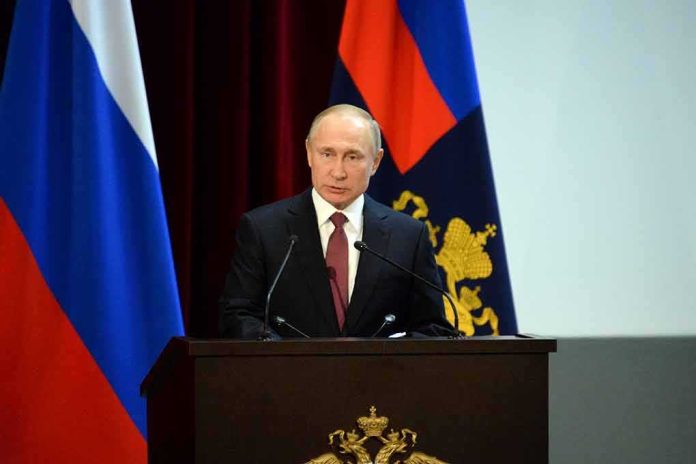
Official footage and live streams show Chinese President Xi Jinping presiding over an elaborate welcoming ceremony in central Beijing, outside the Great Hall of the People.[4][5] A military honor guard, national anthems, and carefully staged visuals reinforced the message: China is treating Russia as a top-tier strategic partner. One clip is described as a “full ceremony” capturing the entire spectacle, from troop formations to the leaders walking past lines of soldiers, giving Beijing a platform to project power and confidence to the world.[1][4][5]
Military Honors, Cannons, and Optics Meant for Washington
Video descriptions from multiple outlets converge on the same scene: a grand ceremony featuring military bands, saluting troops, and a twenty-one-gun salute echoing over Tiananmen Square and the Great Hall area.[1][4][5] Children waving Chinese and Russian flags flank the route as Xi and Putin review the honor guard and watch a march-past by the People’s Liberation Army, creating an image of unity extending from the military to the next generation. These optics are not random; they are crafted to show that Russia is not isolated, and that China is willing to stand visibly at Moscow’s side.
Coverage of the broader summit notes that the Beijing meetings were not just flag-waving. Reports describe the signing of roughly twenty cooperation documents and a joint statement that reinforces the shared strategic line between the two governments.[3][4] Commentators highlight that Xi and Putin’s teams focused heavily on energy, trade, and technology agreements, deepening mutual dependence. Russian gas exports and Chinese industrial demand form the backbone of this partnership, even as the two sides talk about a world “less dominated by the United States,” underscoring a deliberate geopolitical message.[4]
Energy, Currency, and the Push to Escape the Dollar
Analysts following the summit emphasize that Moscow needs Beijing more than the reverse, especially in energy. After losing large portions of the European energy market, Russia has pressed China to commit to projects like a second major gas pipeline often described as “Power of Siberia Two,” which would send additional Russian gas eastward.[4] Reports indicate that while a general understanding was announced, the two sides have not finalized cost and timing details, showing that Beijing still keeps leverage despite the warm public embrace.[4]
Xi and Putin nonetheless announced expanded energy trade and a serious move toward using more Chinese currency instead of the United States dollar in their transactions.[4] That shift, even if gradual, directly targets American financial influence and the leverage that comes from the dollar’s central role in global markets. For conservative Americans worried about inflation, federal debt, and the long-term health of the dollar, this is not an academic concern. A coordinated effort by adversarial powers to build alternative payment systems could, over time, weaken one of the key pillars of United States strength.
Ideological Alignment: Against “American Dominance” and for a New Order
Reports on the summit highlight that Xi and Putin issued a joint statement opposing what they call “American dominance,” tying their partnership explicitly to a challenge against the current international order.[4] Their remarks framed China and Russia as champions of a more “multipolar” world, language that often masks an effort by authoritarian governments to rewrite rules that have long favored free markets, sovereign borders, and basic human rights. They discussed wars in Ukraine and the Middle East, presenting themselves as forces for “stability,” even as their own actions fuel instability in those regions.[3][4]
President Xi Jinping held a welcome ceremony for Russian President Vladimir Putin, who is on a state visit to China.#ChinaRussia pic.twitter.com/S2kQMxS1la
— ChinaConsulateDubai (@CGPRCinDubai) May 20, 2026
At the same time, neutral context shows this summit fits a broader pattern of highly choreographed diplomacy, where ceremony doubles as messaging.[6] In tightly controlled political systems, the visuals are the message: long red carpets, disciplined honor guards, and choreographed children’s performances all reinforce the idea that Xi and Putin are respected global statesmen leading an alternative to Western leadership.[1][4][5][6] For American conservatives, this underscores the stakes of maintaining strong defense, energy independence, and a foreign policy that deters, rather than accommodates, regimes that openly work to dilute United States power.
Sources:
[1] YouTube – FULL CEREMONY: Red Carpet For Friend! Vladimir Putin …
[2] Web – Russian leader Vladimir Putin arrives in China just days …
[3] YouTube – Putin Receives Full State Welcome Upon Arrival in Beijing
[4] YouTube – China’s Xi holds welcome ceremony for Russia’s Putin in …
[5] YouTube – Xi Jinping hosts a welcome ceremony for Putin in China (full)
[6] Web – 2024 visit by Vladimir Putin to China