
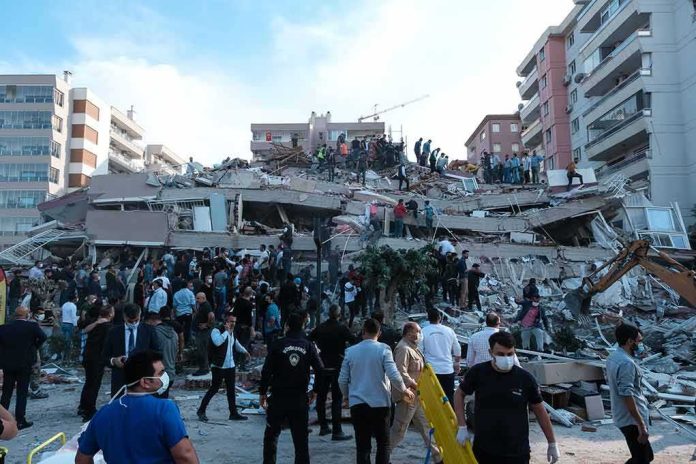
Two violent earthquakes slammed Venezuela within seconds, and the early confusion shows how quickly disaster reporting can break down.
Quick Take
- Two major earthquakes, measuring **7.2** and **7.5**, struck Venezuela in rapid succession on June 24, 2026.
- Official reports now place the death toll at **164**, with **971** injured and rescue work still underway.
- Buildings collapsed in Caracas and other hard-hit areas, and the main airport was shut down after damage.
- A tsunami warning was issued for parts of the Caribbean and later lifted.
Strong Quakes Hit Fast
The United States Geological Survey said the first quake measured 7.2 and hit near San Felipe at about 6:04 p.m. local time. The second struck only about 39 to 40 seconds later and measured 7.5. Reports placed the epicenters in western and central Venezuela, and several outlets said the pair formed a rare seismic doublet. That timing left little room for warning and much less room for organized response.
Media coverage from The New York Times, the British Broadcasting Corporation (BBC), Agence France-Presse, and others described the quakes as the strongest to hit Venezuela in more than a century. The United States Geological Survey’s tsunami warning system briefly raised concern for Puerto Rico, the U.S. Virgin Islands, and nearby islands, then later canceled the alert. The scale and speed of the event helped explain why initial casualty reports changed so fast.
Casualties Rose As Teams Reached Ruins
Acting President Delcy Rodríguez later said 164 people were killed and 971 were injured, while other reports earlier in the day put the toll much lower. That gap matters because it shows how hard it is to count victims while roads, phone lines, and rescue routes are still in chaos. The United States Geological Survey’s disaster model also warned that deaths could climb sharply, which made the first hours look even worse.
Those early numbers changed as crews pulled people from rubble and reached more neighborhoods. Reuters-style video, broadcast clips, and live coverage showed collapsed buildings, damaged streets, and residents fleeing into open areas. In a crisis like this, the public often sees fragments first and facts later. That does not mean the danger was overstated. It means the full count was still being built, piece by piece, from the wreckage.
Buildings, Airport, And Public Order Took The Blow
Officials and reporters said several structures came down in Caracas, including a 22-story building in Altamira, and damage was also reported at Simón Bolívar International Airport. The airport closure mattered beyond travel delays. It cut into rescue logistics, family reunions, and the flow of outside help. When critical infrastructure fails in a disaster, the damage spreads far beyond the first collapse.
https://twitter.com/ConflictRadarME/status/2070152116094869902
That is why the slow release of full damage figures raised frustration. Early reporting relied on social media clips, eyewitness video, and scattered official statements. In any disaster, those sources can save lives when they are accurate, but they can also spread confusion when they are not. Venezuelans on the ground needed clear facts fast. Instead, they got a live disaster layered with mixed numbers, collapsing buildings, and a government still catching up.
Why The First Hours Mattered
The quake also exposed a basic truth conservatives understand well: when systems are weak, people suffer first and ask questions later. Reliable communication, honest numbers, and fast emergency coordination are not luxuries. They are core duties of government. When officials cannot give the public a clean account of deaths, injuries, missing people, and safe routes, families are left in the dark and rescue work slows down.
The missing-person reports underline that problem. Some accounts said more than 14,000 people were missing, but that figure was not firmly verified in the early coverage. That uncertainty is exactly why disaster response must be based on careful counting, not slogans or guesswork. Venezuela still needs complete structural inspections, clear casualty lists, and a full review of what failed before, during, and after the quakes.
Sources:
[1] Web – Earthquakes Devastate Venezuela
[2] Web – Maps Show Reach of Venezuelan Earthquakes
[3] Web – 2026 Venezuela earthquakes
[4] YouTube – Watch The Moment Powerful Earthquakes Rock Venezuela
[5] Web – Moment earthquake rocks Venezuela airport
[6] Web – Building collapses after earthquake in Venezuela
[7] Web – Rescue crews were racing early Thursday to find survivors …
[8] Web – Buildings collapse as deadly twin quakes hit Venezuela
[9] Web – A 7.1 earthquake just hit Venezuela. Buildings …
[10] Web – Venezuela earthquakes live: 164 killed, many buried as US …
[11] Web – Two powerful earthquakes of magnitude 7.2 and 7.5 struck northern …
[12] Web – Venezuela earthquake kills at least 162 and downs buildings … – BBC
[13] Web – Back-to-back 7.2 and 7.5 earthquakes hit Venezuela on Wednesday …
[14] YouTube – Two Powerful M7.1 & M7.5 Earthquakes Strike Venezuela JUNE 24 …
[15] Web – Major mag. 7.5 Earthquake – Estado Yaracuy, 34 km west of Moron …
[16] Web – Back-to-back powerful earthquakes struck off the coast of Venezuela …
[17] Web – List of earthquakes in Venezuela – Wikipedia
[18] YouTube – Powerful back-to-back earthquakes strike Venezuela | BBC News
[19] Web – Eyewitness footage by former lawmaker Wilmer Azuaje showed the …
[20] Web – BREAKING: Powerful 7.1-magnitude earthquake hits Venezuela …
[21] Web – Venezuela – Earthquake – Think Hazard
[22] YouTube – Should CA be worried about next ‘big one?’
[23] Web – Watch the moment powerful earthquakes rock Venezuela | AP News
[24] Web – Research in seismology and earthquake engineering in Venezuela
[25] Web – The 1900 Mw 7.6 earthquake offshore north–central Venezuela