As federal prosecutors moved on 15 alleged Antifa militants in Minneapolis, chaos outside the St. Paul courthouse showed how far the radical left is willing to go to fight immigration enforcement and test the rule of law.
Story Snapshot
- Federal prosecutors unsealed an eight-count indictment against 15 alleged Antifa-linked militants tied to Direct Action Minnesota.[1]
- Charges include conspiracy to impede or injure federal officers, interstate stalking, threats, assault, and destruction of government property.[1][2]
- Protesters outside the St. Paul federal courthouse clashed with marshals, who deployed chemical spray as tensions exploded.[9]
- Encrypted chats, social media posts, and organized “blockades” suggest a coordinated effort that went far beyond peaceful protest.[2][3]
Federal Indictment Targets Organized Anti-ICE Militants
The Department of Justice announced a sweeping eight-count indictment charging 15 members and associates of Direct Action Minnesota, a Minneapolis-based direct action group that prosecutors say has ties to Antifa.[1] According to the Justice Department, the 94-page indictment accuses the defendants of a conspiracy to impede or injure federal officers, interstate stalking, interstate threats, solicitation to commit a violent crime, assaults on federal officers, and destruction of government property.[1][2] Twelve people were arrested in coordinated early-morning operations, one was already in custody, and two remain fugitives.[2][5]
Federal prosecutors say this is not about silencing speech but about stopping violence.[2] U.S. Attorney Daniel Rosen stated that the defendants “joined an agreement” to interfere with lawful immigration operations “by force,” not by using their voices.[2] The indictment focuses on actions during Operation Metro Surge, a federal immigration enforcement push in Minnesota.[3] Prosecutors allege that on January 23 and March 1, Direct Action Minnesota members planned and carried out “hard and soft blockades” to obstruct federal agents and county deputies around the Whipple Federal Building in Bloomington.[1][3]
From Protest to Coordinated Harassment and Violence
Reporting on the indictment says investigators did not rely only on street footage or public rallies.[3] They also gathered encrypted chat messages, private meeting conversations, and social media posts that prosecutors say show planning to track, threaten, and physically interfere with officers enforcing immigration law.[3] One cited post linked to defendant Kyle Wagner allegedly said, “No, not talking about peaceful protests anymore… Get your guns and stop these people,” suggesting an effort to normalize armed resistance rather than lawful assembly.[3]
Prosecutors accuse some defendants of using vehicles, blocks of ice, human chains, and makeshift shields to trap or slow federal convoys during anti-Immigration and Customs Enforcement protests.[3] Reports describe vehicles being brake-checked, a trailer flipped, and a federal vehicle kicked and dented during one blockade.[3] The indictment also reportedly claims that members engaged in “commuting tactics,” following officers from the Whipple Building area to their homes and across state lines, behavior that underpins the interstate stalking counts.[3] While news reports do not show each act tied to a specific name, they describe a pattern that looks coordinated rather than spontaneous.[3]
Courthouse Chaos and the Battle Over Public Perception
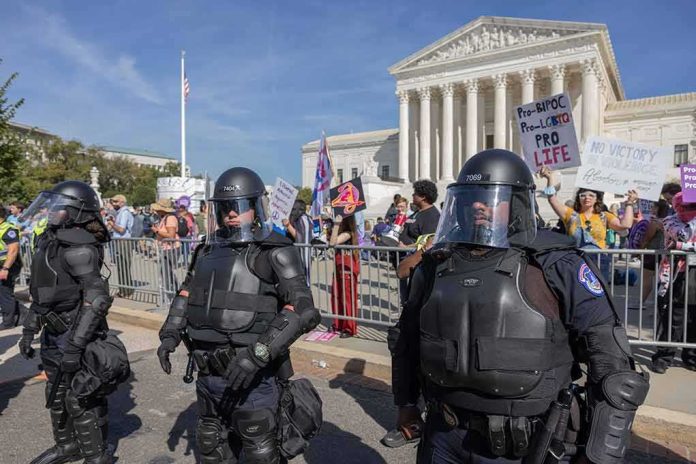
The drama did not stop with the charges. Outside the federal courthouse in St. Paul, protesters and supporters of the defendants gathered as the first court appearances took place.[9] Local coverage says tensions escalated quickly, with U.S. Marshals deploying chemical spray after protesters pressed toward courthouse steps and police lines.[9] Video from the scene shows shouting, banners, and people coughing and retreating, adding fuel to activist claims of heavy-handed response while reinforcing public concern about left-wing street militancy.[9]
Inside the courtroom, prosecutors asked that at least some defendants be held in custody, citing the seriousness of the charges and alleged organized conduct.[9] The judge declined to detain them at this early stage, finding no clear flight risk or danger of interference, but did set conditions, including limits on direct contact among defendants and restrictions on protests at federal property.[9] Defense lawyers and activists outside described the case as political repression tied to immigration policy, pointing to earlier protest-related cases that were dropped for lack of evidence or alleged misconduct by federal agents.[8]
What This Means for Law, Order, and Conservative Concerns
This case lands in a broader national fight over how far protest can go before it becomes domestic political violence.[16][18] For years, state and federal officials have strengthened laws against blocking roads, rioting, and obstructing officers, especially after waves of unrest tied to immigration and policing.[15][18] Conservatives see these moves as overdue steps to restore order and protect officers, while many on the left call them “anti-protest” crackdowns. Now, with federal officers allegedly stalked, blocked, and assaulted, that debate is no longer abstract but focused on a specific network operating in Minneapolis.[1][3]
For readers who support the Constitution, secure borders, and equal justice, several points stand out. First, prosecutors say these defendants are being charged for conduct, not for opinions, which matters for the First Amendment.[2] Second, the use of encrypted apps, organized blockades, and targeted surveillance of officers looks less like spontaneous protest and more like a campaign to intimidate law enforcement and nullify federal immigration law on the ground.[1][2][3] Third, past dropped cases and activist messaging mean the government must present solid, transparent evidence so that any convictions rest on facts, not politics.[8][13]
Sources:
[1] Web – All Hell Breaks Loose Outside Federal Courthouse in St. Paul After …
[2] Web – 15 Members of Direct Action Minnesota, a Minneapolis …
[3] Web – 15 in Minneapolis facing charges for anti-ICE actions, feds …
[5] YouTube – Killings of Good and Pretti: Will Agents be Charged?
[8] YouTube – Federal charges against anti-ICE demonstrators spark …
[9] Web – 15 members and associates of Direct Action Minnesota …
[13] YouTube – When ICE Agents Lie: DOJ Drops Charges Against 2 Minneapolis …
[15] Web – DOJ charges 30 more people in Minnesota anti-ICE church protest
[16] Web – As anti-ICE protest cases falter, prosecutors notch first conviction …
[18] Web – US Protest Law Tracker – ICNL