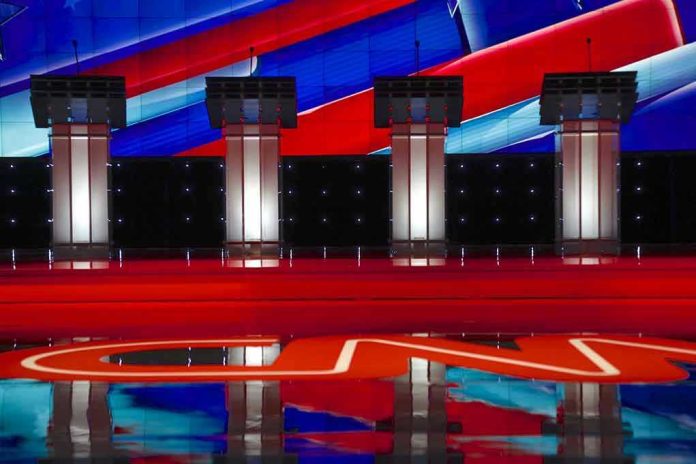
Jill Biden’s stunning admission that she feared her husband was “having a stroke” on live television has reopened the debate over what Americans were really seeing that night in 2024 — and what the political establishment chose to tell them.
Story Snapshot
- Jill Biden now says she thought Joe Biden might be suffering a stroke during the 2024 debate with Donald Trump.
- She also insists the episode was a “one-off” anomaly, while stating doctors later told her he was fine.[1][2]
- No detailed medical records or named physician statements have been released to verify what happened that night.[2]
- The incident fits a larger pattern of opaque presidential health disclosures that leave voters guessing.[2]
Jill Biden’s Frightening Debate-Night Realization
During a recent media tour for her memoir, Jill Biden described watching the June 2024 debate and suddenly fearing that her husband was suffering a stroke on stage.[1][2] She told CBS that as Joe Biden appeared to freeze and struggle to answer questions, she thought, “Oh my God, he’s having a stroke,” emphasizing that she was “frightened out of my mind.”[2] That first-hand account confirms what millions of Americans sensed: this was not a normal debate stumble but something far more alarming.[2][3]
In the same round of interviews, Jill Biden repeatedly stressed that she had never seen Joe Biden like that before or since, framing the debate as an isolated episode rather than evidence of ongoing decline.[1][2] She recounted that after the debate they proceeded to three additional events where he spoke on stage, which she offers as proof that he quickly returned to form.[1] Yet she also admitted that even now she “still cannot say what happened in that moment,” underscoring how little hard information the public actually received.[1][2]
Conflicting Narratives: One-Off Slip or Warning Sign?
Jill Biden has tried to reconcile her private terror with a public message that downplays long-term implications.[1] She told interviewers that campaign aides never came to her before the debate with concerns about her husband’s health, pushing back on reports that staff had seen growing signs of trouble.[1] At the same time, she acknowledged that, right after the debate, she and Joe Biden agreed he had “messed up,” even though she went before cameras that night and praised his performance as if nothing were wrong.[1][2]
Media coverage and political analysis treated the debate as a turning point, especially on the question of Joe Biden’s fitness to serve.[2][3] A Brookings Institution review concluded the performance “threatens his ability to win,” highlighting how it amplified preexisting doubts about his age and mental sharpness.[2][3] Research from Harvard’s Kennedy School later found debate performances can significantly reshape media narratives and elite perceptions, even when raw voter preferences move only modestly. For many viewers, that shaky showing confirmed fears that had been building for years.[2]
Missing Medical Records and the Pattern of Presidential Opacity
Despite Jill Biden’s revelations, no detailed medical documentation from debate night has been made public in the materials reviewed.[1][2] There are no hospital notes, emergency medical service logs, or neurological evaluations confirming or ruling out a stroke or similar episode.[2] Jill Biden says doctors reassured her that Joe Biden was fine, yet no named physician has appeared on the record in these sources to explain what was examined, what tests were run, or what diagnosis was reached.[1][2]
Give me a break. You never questioned Biden's health or mental acuity, even after the debate where Jill Biden stated she wondered if he was having a stroke. (And then went to Waffle House rather than Walter Reed).
— SacraBos (@SacraBos) June 3, 2026
This lack of transparency fits a long-running pattern in Washington, where presidential health is often wrapped in vague statements and selective disclosures.[2] Joe Biden entered office as the oldest president in American history, making every visible lapse more politically charged. When a visibly struggling commander in chief is explained away with phrases like “a cold” or “fatigue,” voters are left to choose between official talking points and their own eyes.[2][3] That ambiguity undermines trust and fuels speculation on both sides of the aisle.
Why This Still Matters Under a New Administration
Under President Trump’s second term, conservatives are right to remember how the previous establishment handled questions about Joe Biden’s health and capacity.[2] The 2024 debate was not just about one man’s bad night; it was a case study in how political elites, consultants, and friendly media outlets can manage perception while withholding hard facts.[2][3] Jill Biden’s late-stage admission that she feared a stroke validates the instincts of millions who were mocked as conspiratorial for asking if something more serious was happening.[1][2]
For Americans who value limited government and accountability, the lesson is clear: constitutional self-government depends on honest disclosure when a president shows possible signs of serious medical impairment.[2] Whether the issue is age, cognitive decline, or an acute event like a stroke, citizens deserve timely, documented information rather than carefully scripted assurances.[2] Demanding that level of transparency from all future presidents is not partisan; it is a basic safeguard for a country that entrusts one person with nuclear codes and the command of its Armed Forces.
Sources:
[1] YouTube – “Is he having a stroke?”
[2] Web – Biden’s debate performance threatens his ability to win | Brookings
[3] Web – Jill Biden says she was “frightened” by Joe Biden’s 2024 debate …