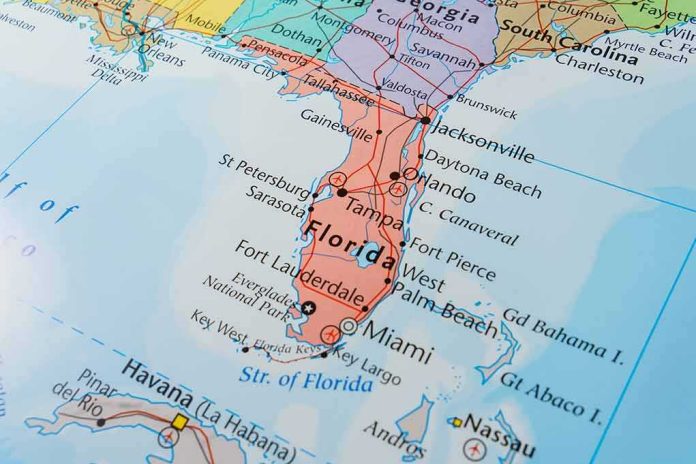
Just 240 miles from Florida, a powerful new Cuban listening post—likely tied to Beijing—is now poised to vacuum up American military and civilian signals across the Southeast.
Story Snapshot
- A massive new antenna array at Cuba’s Bejucal base is finished and likely operational.
- Analysts say the site can track U.S. radio and military activity across the Caribbean and Southeast.
- Evidence strongly suggests a China link, but Washington still lacks a public “smoking gun.”
- Trump’s team now must counter a hostile listening post sitting just off America’s shore.
What Satellite Images Now Reveal At Bejucal
New satellite analysis shows that Cuba’s largest signals intelligence base at Bejucal has completed a huge circularly disposed antenna array made up of 32 antennas in two rings, replacing an older, smaller grid of masts that once sat on the same ground.[3] Analysts at the Center for Strategic and International Studies say photos taken over the last two years show the field being dug up, cables buried, and the new antennas tied into a central control hub, and they now judge the array has “very likely” begun operations.[3][2]
The new circular array is not just bigger; it is built for a specific job: high‑frequency direction finding, which means grabbing radio signals and pinpointing where they come from across long distances.[3][2] From Bejucal’s position in northwest Cuba, experts say the array can help monitor American forces, shipping lanes, and communications across the Caribbean, the Gulf of Mexico, and deep into the southeastern United States, including Florida’s dense cluster of air and naval bases and rocket launches from Cape Canaveral.[2][17]
How Strong Is The China Connection—And What Is Still Unproven
Washington think tanks and many U.S. officials have treated Bejucal as part of China’s growing spy network in the Western Hemisphere for years, citing a history of rumors, congressional testimony, and unclassified reports that describe Chinese access to old Soviet‑era listening posts on the island.[16][10] The latest Center for Strategic and International Studies work says Bejucal is one of four Cuban sites “most likely” supporting Chinese intelligence collection, based on its sophisticated equipment, heavy security, and years of upgrades aimed at long‑range listening.[16]
At the same time, those same analysts admit there is still no clear public proof that China owns or directly runs the Bejucal base, even though U.S. agencies appear more confident behind closed doors.[3][17] Critics point out that the facility is clearly a Cuban military site and say antennas alone do not prove a foreign power is in charge, arguing that similar technology can also support space tracking, telecom links, or even anti‑drug radar.[6][14] For now, the public record shows hardened capability on Cuba’s side of the fence, a long pattern of Beijing using such sites abroad, and a persistent gap between what intelligence officials claim in private and what they are willing to put on paper.
Why A Caribbean Listening Post Matters To Everyday Americans
The new Bejucal array matters because it sits on America’s doorstep, close enough to map the “electronic fingerprints” of U.S. ships, planes, and bases, even if encrypted messages stay scrambled.[17][3] Over time, that kind of pattern tracking can help an adversary learn how our forces move, how we respond to crises, and where our weak spots might be in a future clash, which is exactly what China’s military planners want as they challenge the United States from the Western Pacific to our own backyard.[1][16] For families in Florida, Georgia, and along the Gulf Coast, this is not an abstract issue; it is a foreign listening post reaching into the same airwaves used by local airports, emergency services, and nearby military ranges.
China's spy base at Bejucal in Cuba went operational this week, confirmed by new satellite imagery, while Washington's fuel blockade pushes the island toward collapse and a fresh migration wave. A breakdown:
1) CSIS published satellite imagery on June 18 confirming Bejucal,…
— Shaiel Ben-Ephraim (@academic_la) June 19, 2026
For a conservative country already tired of globalist deals, open borders, and years of weak answers to Chinese aggression, Bejucal is a reminder of how far the last administration let things slide. Under Biden, U.S. officials acknowledged in 2019 and 2023 that China had upgraded intelligence collection in Cuba, yet the public saw little real pushback beyond stern statements.[17] Now the Trump administration’s second term inherits a finished listening post 90–240 miles from our shore, and patriots will expect more than talk: tighter sanctions on Havana, pressure on any country helping fund or equip these sites, stronger coastal defenses, and a clear message that spying on Americans from our own hemisphere carries real costs.
Sources:
[1] Web – China’s Caribbean Listening Post? Satellite Imagery Shows Cuba Spy …
[2] Web – Satellite imagery shows China expanding spy bases in Cuba – VOA
[3] Web – At the Doorstep: A Snapshot of New Activity at Cuban Spy Sites – CSIS
[6] Web – China-linked spy site in Cuba is now fully operational
[10] Web – Satellite Images Show Expansion of Suspected Chinese Spy Bases …
[14] Web – Satellites capture build-out of Cuban spy sites with suspected China …
[16] Web – Enhanced antenna array at Bejucal raises concerns over US military …
[17] Web – China’s Intelligence Footprint in Cuba: New Evidence and … – CSIS