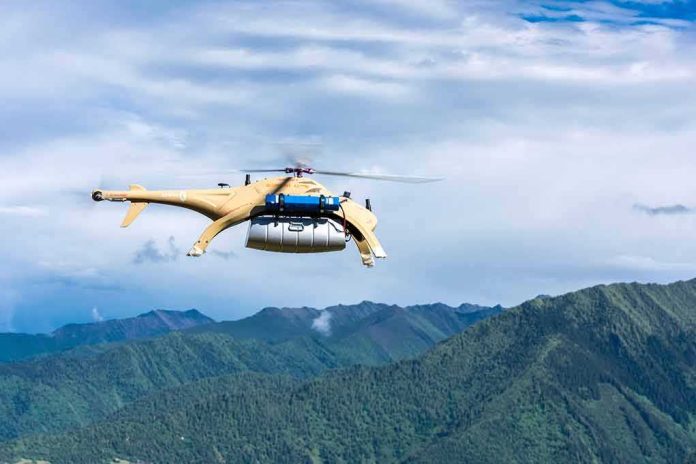
A wounded Ukrainian soldier spent two days pinned down on a battlefield too dangerous for any truck, medic, or helicopter to reach him, until a drone flew in and carried him out alive.
Story Snapshot
- Ukraine’s military says it carried out the world’s first battlefield air evacuation of a wounded soldier using a heavy-lift drone.
- Landmines and constant Russian drone activity made a ground rescue impossible, forcing the soldier to wait roughly two days before extraction.
- Footage shared by Ukraine’s 92nd Separate Assault Brigade shows the soldier strapped to a heavy hexacopter, lifted into the air, and lowered at a safer location.
- A separate case involved a soldier nicknamed Kostya, carried about 11 miles by a Gurzuf Defence heavy drone after losing both feet to a Russian strike.
- Military analysts say the rescue reflects a bigger shift: drone surveillance has made old-style evacuation routes too exposed to use safely.
A Stranded Soldier And A Battlefield No Truck Could Reach
Ukraine’s military said this week that it pulled off a “first-ever air evacuation” after a wounded infantryman became stranded in a position soaked with landmines and swarming with enemy surveillance drones. Ground crews could not reach him without risking more casualties. Instead, troops turned to a heavy-lift unmanned aircraft, strapped the soldier in, and flew him out while smaller drones screened the route overhead.
Video released by Ukraine’s 92nd Separate Assault Brigade shows the moment clearly. The soldier is secured to a large hexacopter built by the Ukrainian company Gurzuf Defence, lifted off the ground, and carried away from the contact line before being lowered where medics could finally reach him. The brigade called it the first battlefield air evacuation by drone in history.
Why Mines And Drones Turned A Rescue Into A Two-Day Wait
The delay was not caused by indecision. It was caused by geography. Ukrainian officials described the position as part of the “grey zone,” ground so contested and so heavily mined that sending a vehicle or a squad of medics in daylight would likely get more soldiers killed. Russian first-person-view drones patrol these corridors constantly, turning even a short stretcher carry into a potential ambush.
One widely reported case involved a soldier known as Kostya, who weighed about 176 pounds and was carried roughly 11 miles by the heavy drone after enduring brutal conditions in the field. Another account describes a soldier with the alias Magura, from the 30th Separate Mechanised Brigade, who spent 491 days in the grey zone and lost both feet before his own aerial evacuation. Different soldiers, same brutal math: ground rescue had become too costly to attempt.
A Battlefield Medicine Problem Bigger Than One Rescue
Military medical researchers have been warning about this exact shift for more than a year. A comparative analysis of combat operations found that more than 60 percent of wounded patients in a recent sample arrived outside the safer tourniquet treatment window, up from just 15 percent in 2016, as evacuation stages were pushed farther from the front. Persistent drone surveillance, not distance alone, is driving that change.
Ukraine has achieved many historic firsts in this war. Here is another one: the first-ever aerial medical evacuation of a wounded soldier using a heavy-lift drone.
On the Kupiansk front, Ukraine’s Defence Forces rescued Kostiantyn Vlasenko of the 30th Mechanized Brigade, who had… pic.twitter.com/lehLzHgfHM
— Andrii Sybiha 🇺🇦 (@andrii_sybiha) October 24, 2026
NATO’s long-standing medical rule of thumb called for first aid within 10 minutes, advanced care within an hour, and surgery within two hours of injury. Officers studying Ukraine’s front say that timeline has become “largely operationally unfeasible” on a battlefield saturated with drones that can spot and strike almost anything that moves. Unmanned casualty evacuation is still new and imperfect, but it is emerging because the alternative has gotten so dangerous. The Ukrainian military’s willingness to risk an untested hexacopter rather than send soldiers into a minefield says plenty about how far drone warfare has already changed the calculus of saving a life on the front line.
Sources:
military.com, independent.co.uk, pravda.com.ua, aerotime.aero, yahoo.com, apnews.com, tomshardware.com, academic.oup.com, wim.mil.pl