
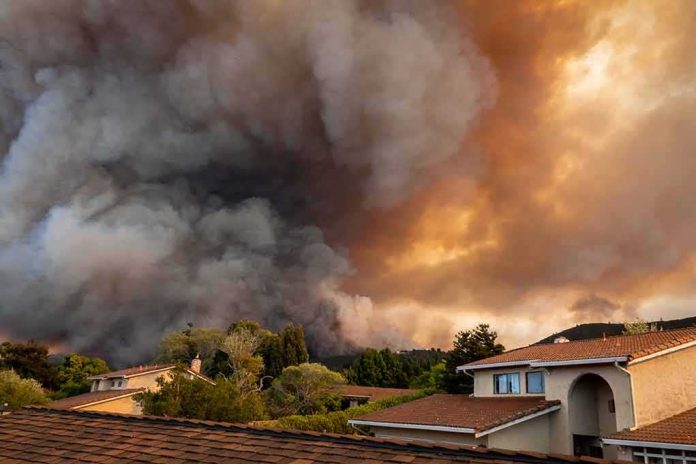
Utah’s Cottonwood Fire has turned into a fast-moving disaster that is rewriting the state’s wildfire record as residents brace for more evacuation orders.
Story Snapshot
- The Cottonwood Fire is being reported as the largest active wildfire in the United States and has burned well past 92,000 acres.
- State officials say the fire is human-caused, but investigators still have not pinned down the exact ignition source.
- The blaze has damaged the Eagle Point ski resort, forced campground closures, and triggered emergency restrictions on fireworks.
- No fatalities have been reported, but the fire is still spreading under dry, windy conditions.
Fire Pushes Past Record Territory
The Cottonwood Fire has grown into a major test for Utah’s fire crews and emergency planners. The Associated Press reported that it was the largest fire in the United States and had burned more than 144 square miles, or 373 square kilometers, in southern Utah [1]. Other reports said the blaze had passed 70,000 acres and later climbed beyond 92,000 acres, showing how quickly the fire has moved through dry land and steep terrain [3][9].
The fire has already severely damaged the Eagle Point ski resort in Beaver County and forced campground closures in Fishlake National Forest [1]. Officials also closed nearby public lands as a precaution. Gov. Spencer Cox said the state had to act fast because dangerous weather and open land were making the fire harder to stop. One report said the fire may become the most destructive in Utah history for property loss [3].
Cause Investigation Still Has Gaps
Utah fire officials have classified the fire as human-caused, but they have not yet released the exact ignition source [11]. That matters because a broad label is not the same as a full answer. The public knows the fire did not start on its own, but the current record does not settle whether it began with carelessness, equipment, a spark from another human activity, or some other cause still under review.
Social media chatter has filled part of that gap. One post mentioned that target shooting was brought up when the fire started, but that claim remains unconfirmed and is not the same as an official finding [7]. That kind of rumor travels fast during a crisis, especially when acreage counts change from report to report. The result is a familiar problem: the public hears a simple story before investigators have finished building one.
Emergency Orders Reflect Broader Fire Risk
Utah responded with a state of emergency and temporary fireworks restrictions ahead of the July Fourth holiday [4]. The governor’s order aimed to lower the chance of new starts during a period of high danger. Forecasters warned of dry, windy weather across the West, and the National Weather Service issued a rare “particularly dangerous situation” warning for parts of Utah [4]. In plain terms, the weather gave firefighters little room for error.
Even with no deaths reported, the fire has still created fear across rural communities. Evacuation orders and alerts have affected places such as Eureka, Vernon Reservoir, and other small towns in the path of fast-moving flames [1][4]. The situation also shows how quickly local life can be disrupted when a fire grows this large. Residents can lose homes, access, power, and peace of mind long before officials can fully assess the damage.
Why the Fire Has Become a Political and Public Trust Issue
The Cottonwood Fire has also become a test of public trust. Conflicting acreage reports, confusion with other fires carrying the same name, and early speculation about the cause have made it harder for residents to know what is true. That kind of mixed messaging feeds a broader frustration seen across the country: people want clear answers, but disaster updates often arrive in fragments while agencies are still gathering facts.
At the same time, the fire fits a larger Western pattern. Utah and other states face long stretches of dry fuel, strong wind, and frequent human-caused starts. In that setting, officials are under pressure to explain what happened, prove they acted quickly, and show they can protect communities without waiting for perfect conditions. For families near the fire line, the debate is less about politics than about whether the system can keep up.
Sources:
[1] Web – The largest active wildfire in the U.S. has now exploded to more than …
[3] Web – Cottonwood and Morrill Fires Update – March 22, 2026
[4] Web – CottonwoodFire MIDDAY UPDATE, June 24,2026 The fire is …
[7] Web – The Cottonwood Fire burned through structures as it exploded in …
[9] Web – Human-Caused Fire | Investigation Ongoing Utah The Cottonwood …
[11] Web – Cottonwood Fire might set cost records after destroying southern …