
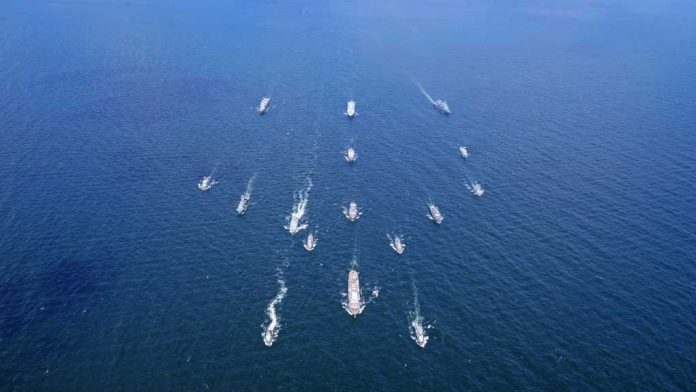
America’s maritime edge is at risk as China’s shipyards dominate global orders and supercharge a navy built to challenge U.S. power.
Story Snapshot
- China holds a commanding lead in global shipbuilding orders, powering rapid naval growth [1][5].
- Office of Naval Intelligence data shows a massive capacity gap favoring China [10].
- U.S. warship programs face delays while China expands hull numbers fast [10].
- Competing datasets dispute China’s exact share, but all show clear dominance [2][3][5].
China’s Shipbuilding Lead Is Now a Strategic Problem
Independent industry data shows China captured the largest share of global shipbuilding orders in 2025. Reports place China’s share between the low sixties and over seventy percent, depending on the dataset, with all sources agreeing China leads by a wide margin [1][2][3][5]. Analysts explain that Beijing’s state support links commercial yards to naval output, letting civilian work fund tools, dry docks, and workers that can switch to warship production when needed [5]. That dual-use engine now feeds the world’s largest navy by hull count [10].
Defense assessments describe a severe industrial gap. Estimates attribute about twenty-three million metric tons of annual capacity to Chinese yards, compared to less than one hundred thousand in the United States, a disparity well over two hundred to one [10]. That difference is not only about numbers. It is about how fast a nation can repair, refit, and replace losses if a conflict starts. In a long fight, shipyards decide who stays in the game and who runs out of hulls [10].
Fleet Numbers, Delays, and What That Means at Sea
China’s battle force fleet grew from the mid-2010s to well over 370 ships by 2026, while the United States hovered near 290 ships. That trend shows who is adding hulls faster and who is standing still [10]. U.S. programs that should add capacity are slipping. The Arleigh Burke Flight III line faces delays. The Constellation frigate program has slipped. Attack submarine output is about 1.2 to 1.4 boats per year, when the Navy says it needs two to meet strategy and keep skilled labor sharp [10].
Supporters of the status quo argue United States ships are larger, more advanced, and combat tested. They point to displacement, longer reach, and superior systems as a counter to China’s raw numbers. Analysts at major think tanks argue ship size and capability can offset some of the gap in hull count [1][19]. That claim has merit in short fights. But industrial math still matters in a long war. If you cannot replace battle damage, high-tech fleets shrink fast [10].
Competing Numbers Still Tell the Same Story
Some market trackers say China’s share eased to the low-to-mid sixties in 2025 as buyers paused due to U.S. policy signals and market swings [2][3]. Other analysts, reviewing a 2026 shipbuilding report, place China’s order book above seventy percent and highlight overwhelming control in bulkers and container ships [5]. These sets use different methods and time frames. But none show China losing its lead. All agree the United States builds only a tiny fraction of global commercial ships [5].
Policy researchers also highlight steps Washington has taken. A trade probe found China uses nonmarket practices in shipbuilding. The Office of the United States Trade Representative proposed docking fees on ships built in Chinese yards to push industry away from Beijing’s subsidized supply chain. Lawmakers floated bills to close loopholes and hit vessels tied to China State Shipbuilding Corporation even harder [24]. Those moves test leverage. They do not yet rebuild American yards or hiring pipelines at scale.
What Must Happen Next to Defend U.S. Sea Power
Strategy experts warn the United States cannot outbuild China alone under current capacity. They urge fast, focused investments at home, plus real production partnerships with allies. That includes workshare deals with trusted shipyards abroad to speed hulls, components, and repair surge capacity until U.S. yards recover [18]. Clear goals, stable multi-year buys, and on-time payments can help shipyards hire, train, and expand without fear the budget rug gets pulled next year.
Through massive subsidies, China sells ships, steel, solar panels, batteries, and countless other products for less than it costs to make them.
That means China loses money on each sale.
Or, put another way: China is paying us to buy its products.
At first, that seems insane.…
— Guy Barnett (@GuyBarnett99830) June 25, 2026
For a conservative audience, the bottom line is simple. Industrial strength wins wars and secures peace. Beijing fused commercial and military power on purpose, and it shows at sea [5][10]. America let critical industries hollow out, while chasing globalist dreams that shipped jobs and skills overseas. The Trump administration now faces the hard job of undoing that damage. That means building ships here, cutting red tape, locking in long-term orders, and working with allies who actually build. Sea power protects our trade, our families, and our freedom. It is time to act.
Sources:
[1] Web – US ‘Risks Everything’ by Not Challenging Chinese Shipbuilding: Navy …
[2] Web – China Continued Shipbuilding Dominance in 2025, Raking In Most …
[3] Web – China’s Global Shipbuilding Order Share Falls to 65% in 2025
[5] Web – China Shipbuilding Market Size USD 75,200 Mn, Forecast To 2031
[10] Web – China’s shipbuilding industry maintained the world’s largest market …
[18] Web – The United States Can’t Deter China Without Allied Shipyards
[19] Web – Unpacking China’s Naval Buildup – CSIS
[24] Web – Are U.S. Policies Eroding China’s Dominance in Shipbuilding? – CSIS