
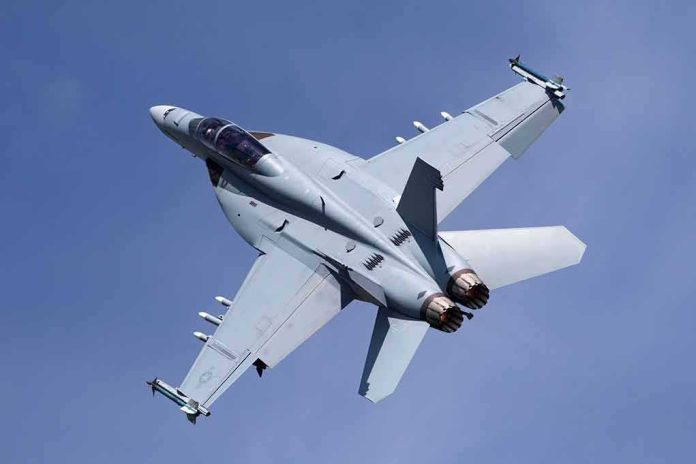
Carrier aviation is entering a new phase: the Royal Navy plans to put a jet-powered autonomy test aircraft on the deck of a Queen Elizabeth-class carrier to learn, in saltwater reality, how an uncrewed combat air wing will work beside F-35Bs—and that deliberate, at-sea experiment is the hinge between promising lab demos and a usable naval capability.
At a Glance
- The Royal Navy is working with Northrop Grumman to trial the Talon IQ test aircraft from a Queen Elizabeth-class carrier in UK waters in 2027, as stated by the First Sea Lord.
- The aim is evidence: can an uncrewed combat aircraft operate safely and effectively alongside an embarked F-35B air wing.
- Talon IQ is a flying autonomy ecosystem built around the Scaled Composites Model 437 and Northrop Grumman’s Prism software, designed for rapid partner integration.
- The trial is the opening move in the Royal Navy’s Collaborative Combat Aircraft (CCA) effort for carrier operations.
What the Royal Navy Plans to Prove at Sea
The Royal Navy intends to embark Northrop Grumman’s Talon IQ on a Queen Elizabeth-class carrier and execute a launch and related deck operations in 2027. The First Sea Lord framed the evolution plainly: the service is seeking hard data on whether an uncrewed combat aircraft can integrate with the rhythms, safety demands, and mission tempo of a carrier strike group’s F-35B-centered air wing. This is not a publicity fly-by. The working requirement, as reported, is concrete: a jet-turbine, high-subsonic platform able to embark, launch, and recover from the ski-jump carrier design without catapults or arrestor gear—conditions that drive approach speeds, structural loads, and deck-handling choreography.
The demonstration sits as the first step in the Royal Navy’s Collaborative Combat Aircraft (CCA) program, which envisions loyal-wingman style vehicles operating with F-35Bs. Success will be defined less by a single takeoff than by whether the aircraft and its autonomy stack can survive the deck cycle, deconflict airspace with manned fast jets, and execute tasking within the carrier’s command-and-control architecture—an ecosystem problem, not a stunt.
Talon IQ: A Flying Autonomy Lab, Not a Paper Study
Talon IQ is best understood as a testbed ecosystem rather than a single-purpose drone. Northrop Grumman built it around the Scaled Composites Model 437 air vehicle, coupled to an “open” autonomy architecture centered on the company’s Prism mission software. The design goal is to let developers swap, layer, and A/B-test autonomy components in flight while collecting the telemetry and edge-case data that mature algorithms need. In company-run sorties, Talon IQ has already flown missions with third-party autonomy—including Shield AI’s Hivemind—executing combat air patrols and target engagement maneuvers before handing control back to Prism, a live demonstration of on-aircraft autonomy modularity.
That modularity matters at sea. Carrier integration is a multidisciplinary challenge: deck motion, radio-frequency congestion, recovery windows, and safety cases intersect with autonomy behaviors. A platform that can ingest partner software, simulate degraded comms, and iterate fast increases the odds that what is proven on a benign range translates to a pitching deck, a crowded marshal stack, and a strike package on the clock.
Why Carrier Trials Are the Real Test
Autonomy programs routinely show impressive demos that do not, by themselves, equal fielded capability; the U.S. Department of Defense’s Technology Readiness Assessment framework is explicit on this point. Technologies must be demonstrated and applied in a relevant mission and operating environment to credibly predict integration success—aircraft carriers, with their unique launch and recovery constraints, qualify as exactly that crucible.
The Queen Elizabeth-class imposes its own physics. Without catapults or arresting gear, jet aircraft must launch via ski-jump and recover vertically or with very short landing runs; that narrows the viable envelope and drives design tradeoffs on thrust-to-weight, wing loading, and landing gear robustness. Add salt corrosion, electromagnetic interference, tight deck parking patterns, and the need to choreograph with F-35Bs, and it becomes obvious why the Royal Navy wants empirical evidence aboard its own ships rather than extrapolations from land ranges.
How This Fits the Royal Navy’s CCA Trajectory
The service has been moving methodically toward uncrewed integration on carriers. In 2026, HMS Queen Elizabeth launched British-made one-way strike drones during North Atlantic trials alongside F-35B operations—important but limited systems compared with a jet-powered CCA-class vehicle. The Talon IQ event extends that arc from disposable or light logistics systems toward a reusable, high-subsonic aircraft able to contribute to air combat tasks in the same air plan as Lightning II fighters.
The stated 2027 goal is to generate the operational evidence base for decisions that follow: how much autonomy is acceptable in the stack, what datalink and identification-friend-or-foe (IFF) solutions scale on a crowded flight deck, which deck-cycle timings are realistic, and where the safety margins must sit when manned and uncrewed aircraft share the same launch and recovery windows. Those are the questions CCA programs must answer to move from concept art to carrier duty.
What “Good” Looks Like in a 2027 Demonstration
Judging the trial starts with what the Navy has said it wants. A credible result would show repeatable embarkation and deck handling; clean launch and recovery within the Queen Elizabeth-class geometry; autonomous flight that can accept and execute mission tasking while maintaining separation from manned aircraft; resilient communications with graceful degradation behaviors; and disciplined abort modes that fit carrier safety procedures. If the autonomy stack can also demonstrate software interchangeability at sea—swapping between, say, Prism and a partner autonomy core while preserving safety envelopes—that would validate the “ecosystem” thesis under real operating stress.
Importantly, the trial’s linkage to F-35 operations is not just symbolism. Lightning II fighters set the pace for the carrier’s air wing, and any CCA worth buying must plug into F-35-driven tactics, techniques, and procedures: sensor cueing, strike package timing, emissions control, and post-mission turnaround. Demonstrating that a testbed can coexist with that battle rhythm—without adding friction—will carry more weight than any single autonomy trick.
U.K. Royal Navy Orders Jet-Powered Talon Drones to Support F-35B Fighters::https://t.co/pNsq1vYMzX#RoyalNavy #TalonDrone #NorthropGrumman #F35B #ProjectVanquish #MilitaryTechnology #AutonomousWarfare #DefenceNews #NavalAviation #UKDefence pic.twitter.com/SrItpwp8jG
— DefenseMirror (@DefenseMirror) November 13, 2026
Industrial Logic: Why Talon IQ, and Why Now
Northrop Grumman’s pitch is speed: field an optionally crewed, high-subsonic surrogate that lets navies try autonomy concepts in months, not years, and burn down risk ahead of designing a bespoke CCA airframe. Talon IQ’s “Project Talon” portfolio is structured to compress that loop—airframe, autonomy core, partner integration, and data exploitation under one roof—so customers can test, iterate, and then make informed bets on the production path. For the Royal Navy, which operates a unique STOVL carrier architecture and a compact deck, that approach offers a rational way to learn what the real constraints are before committing to a fleet program.
Why This Matters
Carrier power has always been about integration—the art of making aircraft, deck crews, command systems, and tactics work as one organism. Adding uncrewed combat aircraft raises the integration bar. If the 2027 Royal Navy–Talon IQ trials demonstrate safe, repeatable operations beside F-35Bs, they will mark a practical inflection point: autonomy not as a range demo, but as a working part of a NATO carrier group. That is the difference between a slide deck and force design.
Sources:
news.usni.org, northropgrumman.com, news.northropgrumman.com, breakingdefense.com